Premium
From exile to icon: Diaspora pour tributes for Raila Odinga
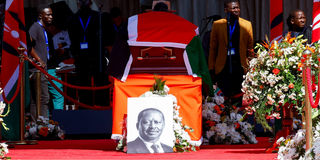
A portrait of Kenya's former Prime Minister Raila Odinga, who died while receiving medical treatment in India, is placed next to his coffin during a funeral Mass at the Jaramogi Oginga Odinga University of Science and Technology in Bondo, Siaya County, Kenya, October 19, 2025.

Few Kenyans realise that Raila Odinga, the towering figure of Kenya’s democratic struggle, once lived in exile. On June 21, 1991, following his release from detention, Raila fled to Norway amid fears that the Moi regime intended to assassinate him.
His time abroad coincided with a groundswell of pro-democracy activism back home, culminating in the birth of multiparty politics under the Forum for the Restoration of Democracy (FORD).
Now, following his passing on October 15, 2025, members of the Kenyan diaspora—many of whom were shaped by Raila’s ideals during their formative years—reflect on the man who embodied both hope and heartbreak. Their tributes reveal a complex legacy: one of sacrifice, contradiction, and enduring influence across borders.


Ms Valentine Githae, a Gen Z activist and founder of the 6.25 Movement based in Washington D.C., reflects on the immense sacrifices of her generation as she considers Raila Odinga—a man so near yet so far from the Kenyan presidency. A champion of democracy, yet one whom Gen Z feels betrayed their cause for generational turnover and state accountability.
“He didn't support us when we needed him, instead joining a government that's hurting us. I acknowledge his contributions to multipartyism and the new constitution, but lately, he's seemed self-serving," she said.
Valentine goes on to note that towards the end of his life, ODM lacked transparency in its party nominations. “Young ODM candidates in Nyanza are blocked because Raila handpicked ticket holders, favouring friends.
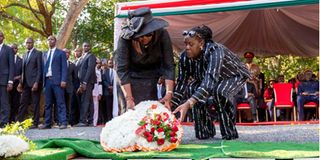
Ms Ida Odinga and her daughter Winnie Odinga lay a wreath on the grave of former Prime Minister Raila Odinga during his burial in Bondo, Siaya County on October 19, 2025. PCS
"I'm worried about the leadership gap in Nyanza and nationally. What will happen because of that power vacuum? President Ruto's visit to Gideon Moi suggests he's aware of the situation in Nyanza. Did he anticipate RAO's passing? I also think Nyanza will finally be free of the control of the Odingas. Where will this leave Babu Owino?”
Like most political parties in Kenya, the Orange Democratic Movement (ODM) bore the charismatic stamp of its founder and leader, Raila Odinga. ODM was Raila, and Raila was ODM. In its formative years following the 2005 constitution referendum, the party benefitted from Raila’s charisma and the political capital he had amassed through years of fighting for democracy and the rights of the mwananchi.
Yet his final days were marked by factional feuds, power struggles, incoherent party policy within an amorphous Broad-Based Government, and growing discontent in traditional ODM strongholds—South Nyanza counties such as Kisii and Nyamira, and Western Kenyan bastions including Trans Nzoia, Kakamega, Butere, Malava, and Bungoma.
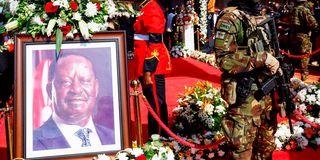
A portrait of former Prime Minister Raila Odinga is placed next to his coffin during a funeral Mass at the Jaramogi Oginga Odinga University of Science and Technology in Bondo, Siaya County, Kenya, October 19, 2025.
Diasporans foresee further turmoil and declining support for ODM abroad, as Rigathi Gachagua, Fred Matiang’i, and Kalonzo Musyoka continue to make strategic inroads into influential diaspora communities in Europe and North America.
Prof Kefa Otiso of the Geography Department at Bowling Green State University, Ohio, USA, reflects on Raila's legacy amid the hyper-political environment shaped by his competitors in the diaspora:
“Besides Jomo Kenyatta, who ushered in Kenya's independence, Raila is the most consequential post-independence Kenyan leader. He is the father of Kenya's second liberation struggle and the main force behind the passage of the 2010 constitution, which gave us a strong Bill of Rights and our current devolved system of government.
Since 2010, he has also helped to stabilise Kenya at critical junctures—even at the cost of his own ambitions. Anyone who came of age before the 2010 constitution knows Raila's immense contributions to Kenya.
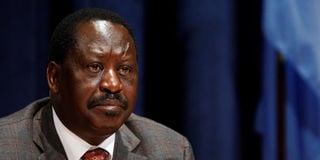
Kenya's Prime Minister Raila Odinga.
Beyond Kenya, Raila was a pan-Africanist who sought to unify the continent. He championed the development of transcontinental railways and roads—vital infrastructure given Africa’s lack of navigable rivers. Love him or hate him, Raila is truly a once-in-a-lifetime leader who has left an indelible mark on the history of Kenya, Africa, and the world.”
Otiso’s observation of Raila’s ability to steer the country through turbulent times is evident in his knack for forging coalitions of all kinds—including the Broad-Based Government, the “Handshake”, and the “Nusu Mkate” coalition brokered by Kofi Annan, the former UN Secretary General. Raila consistently found ways to influence public policymaking, even without outright electoral victories—particularly during contentious moments such as the 2007 and 2017 elections.
What will Raila’s legacy be going forward? Professor Otiso believes:
“While we all miss Raila, Kenya will be fine going forward—provided we stay true to the 2010 constitution and apply the lessons he taught us in putting country above self.”
Prof Eric Otenyo of Northern Arizona University’s Political Science Department reflects on the past to look ahead:
“Kenya's elite denied him the 2007 victory, which caused loss of life. It also marked a turning point in Kenya's history. The trauma of 2007/08 is not something we can wash away. It is generational. The fact that he did not break Kenya is the gift he gave the country.”
This ability to prioritise country over self remains an enduring legacy for many Kenyans. Raila’s capacity to foster compromise and conciliation, while ensuring that ODM-led governments had a broader national face, was a significant asset to Kenya.
In true Gen Z spirit, Valentine Githae chooses not to hold grudges as she reflects on Raila Odinga:
“Angry is not the word for me. I would be more disappointed. No matter how it is justified, I believe Raila's joining President Ruto’s government was for himself. It was self-serving.”
She adds:
“I could see ODM splitting. Already, some ODM members—led by Sifuna—were unhappy with Raila joining the Ruto government under the Broad-Based agreement. The likes of Alice Wanga and many who wholeheartedly followed every word Raila said—where do they go from here? Babu Owino stands a high chance. I think he has been following in Baba's steps.”
Time and fate will reveal whether Valentine’s predictions come to pass. But as has been true in the past and remains true today: “Great leaders don’t die—they only gracefully fade away.”