In the history of Kenya, the nation has previously witnessed the end of significant political eras.
A notable one was the death of the country’s founding president, Mzee Jomo Kenyatta, who died in 1978 aged 81.
And on February 4, 2020, just before the Covid-19 was declared a global pandemic, Kenya’s second president, Daniel Toroitich arap Moi died at 95. His death signalled the end of an era for a man nicknamed the “Professor of Kenyan politics”.
Ms Ida Odinga and her daughter Winnie Odinga lay a wreath on the grave of former Prime Minister Raila Odinga during his burial in Bondo, Siaya County on October 19, 2025. PCS
Photo credit: PCS
But it is the death of Raila Odinga, the son of Jaramogi, that shook the political landscape and the nation to the core. Raila died on October 15 while receiving treatment in India. He was 80.
A large part of the country was fond of the man who went by several names — Enigma, Agwambo, Arap Mibei, Njamba, Tinga, Nyundo, Jakom and Baba.
Raila, the undisputed king of Kenya’s second liberation struggle, was a man that Kenya never had as president. Notwithstanding his five attempts at the presidency — in 1997, 2007, 2013, 2017 and 2022. His defeat, on most occasions, was blamed on electoral manipulation, this is despite Baba enjoying huge popularity.
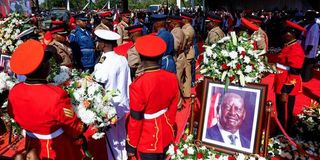
In death, the departed hero received military honours complete with a 17-gun salute. This is unlike his father Jaramogi, who never got a State funeral despite serving as VP.
Military pallbearers position the flag-draped coffin of Kenya's former Prime Minister Raila Odinga during his burial at the Kang'o Ka Jaramogi home in Bondo, Siaya County, on October 19, 2025.
Photo credit: Thomas Mukoya | Reuters
President William Ruto led Kenyans and other dignitaries during Raila’s burial, which was held at Kang’o Ka Jaramogi in Bondo, Siaya County on Sunday.
He said that there was resistance within government circles to accord Raila a State funeral with military honours since he had never been a president.
But hate him or love him, Raila was a towering figure on the Kenyan political scene. Even though he failed to clinch the top seat in the land, Raila, struck deals with successive presidents; Daniel arap Moi, Mwai Kibaki, Uhuru Kenyatta and Dr Ruto, which saw him get into the inner sanctum of power.
The former prime minister’s influence in shaping the Kenyan State prompted the government to give him top honours.
From a political detainee, Raila went on to build a fanatical following around him. He formed what is arguably one of the most popular political parties in the country — the Orange Democratic Movement (ODM), which marks its 20th anniversary next month.
Raila was once a long-serving Member of Parliament for Lang’ata Constituency. And during the Grand Coalition Government headed by Kibaki, he served as prime minister.
The son of Jaramogi rose to the public limelight as a political detainee after he was linked to the failed 1982 coup led by disgruntled Kenya Air Force officers who wanted to depose Moi from power.
Later, Raila, an indefatigable champion for democracy, became a very influential figure in Kenyan politics. He contributed immensely in the country getting a new Constitution that was promulgated on August 27, 2010.
His decades-long fight for democracy, human rights and constitutional reform is well documented. In the push for change, Raila rubbed up government operatives the wrong way.
As an opposition leader, Raila played a significant role in shaping the country’s politics. He crusaded for the rights of common people and political reforms.
As he was laid to rest yesterday, speaker after speaker gave glowing tributes. President Ruto, his predecessor Uhuru Kenyatta, former Nigerian President Olusegun Obasanjo and ex-VP Kalonzo Musyoka lauded Raila a great leader.
Describing Raila as a mentor, President Ruto said the country had lost a great hero, and “a man made through the fabric of struggle.”
Former VP Kalonzo Musyoka’s heartfelt tribute to friend Raila Odinga
“Raila is fondly referred to as the people’s president. We honour him with a lot of respect because of his contribution to the nation. I can confidently say that Raila was not just an engineer, but a political engineer,” said Dr Ruto.
Former Speaker of the National Assembly Justin Muturi said:“While we may have differed with Raila politically at various points, I have always respected his tenacity and deep love for the country.”
President William Ruto pays tribute to Raila Odinga
“For decades, Raila Odinga stood at the heart of Kenya’s struggle for freedom, reform, and inclusion. His journey marked by sacrifice, resilience, and an unrelenting belief in the promise of this nation inspired millions across generations,” said Mr Muturi.
Leaves void in nation’s conscience
Acknowledging that few men “have so profoundly shaped Kenya’s democratic space or borne its burdens with such resolve, Raila’s passing leaves a void not just in politics, but in the conscience of our nation.”
“Raila’s legacy will endure in our institutions, in our freedoms, and in the hearts of all who believe in the dream of a just and united Kenya,” said Mr Muturi.
Rtd President Obasanjo said: “One thing you could not take away from Raila was his passionate love for his country and Africa.”
Mr Obasanjo was among the people who attended a meeting in Mombasa that brought once-bitter rivals Dr Ruto and Raila together after a closely fought August 2022 presidential election. This resulted in the formation of the broad-based government in 2024.
Former Nigerian President Oluṣẹgun Ọbasanjọ pays tribute to long term friend Raila Odinga
“Tolerance is a lesson of love. Raila tolerated accommodation. It’s a lesson we must learn from him. I have lost a brother, a friend and a confidant,” Mr Obasanjo said.
Former President Kenyatta referred to Raila as a close friend. He said that his loss presents the country with a huge challenge.
“We will miss Raila as a leader of this nation. His thoughtfulness, his freedom and those good virtues will always be remembered,” he said.
“Raila was a patriot who fought for justice, equity and unity even in the face of adversity,” he said, the former president.
Mr Kenyatta said they had fierce political battles, which and later ended in friendship, and the “Handshake” on the stairs of Harambee House in 2018.
“Raila was the epitome of the struggle for justice and the fight against corruption,” said Mr Musyoka. “Despite the pain of a stolen election, he was very accommodating.”
Former Prime Minister Raila Odinga is buried at Kango Ka Jaramogi in Bondo, Siaya County on October 19, 2025.
Photo credit: PCS
Raila has left an indelible mark in Kenya’s history. As a key figure in the opposition, he relentlessly pushing for electoral reforms.
Born on January 7, 1945, Raila spent years in detention and exile for his activism against Moi’s regime.
Since the country and the continent of Africa bids him goodbye, 43 years after the failed coup, Raila never revealed his role in the failed 1982 coup.
Not even in his biography; Raila Odinga, an Enigma in Kenya Politics by Nigerian author and lawyer Dr Babafemi Badejo, which was launched in 2006.
The matter, which landed Raila in detention, has been mentioned as a passing cloud. He was never charged. Raila had promised to give more details on the coup plot in a book that he promised, but never wrote until his death.
However, in his autobiography; The Flame of Freedom, released in 2013, he revealed that his role was merely “peripheral.”
The question that remains unanswered, and which followed Raila to the grave, was whether his failure to be prosecuted was a political deal with Moi.
Unlike his fellow political detainee— former Subukia MP Koigi Wamwere — Raila also never produced his detention diary.
In the book; Raila Odinga, An enigma in Kenya Politics, he revealed that the coup plotters sought and got the blessings of Jaramogi and that he set up a communication centre at an apartment on Ngong Road from where the plotters monitored events.
When the Raila biography was released, former Internal Cabinet minister Mr Chris Murungaru called for Raila to be tried for treason, and that if convicted, he be hanged as per the law.
“Raila is a dangerous person and he has declared himself to be so,” Mr Murangaru said immediately after the book was launched.
He asked legal experts to scrutinise the book for action, as he told Raila not to disown the contents “since he must have sanctioned every word and was present at the launch”.
Apart from Mr Murungaru, Moi who had then retired as president, told his Kalenjin community to “be wary of Raila’s antics” because his biography had exposed his true character.
Speaking in the Kalenjin dialect, Moi said; “You can now read the kind of person the man of the lake is.”
But Raila hit back at those calling for his arrest, saying that what he expected was an intellectual debate by people who had read the book and not wild allegations that could not be substantiated.
“What I want is intellectual discourse from people who have read this book and not unfounded allegations. I will only respond to reasoned critique over the issues in the book,” Raila said then.
Then Nyakach MP Peter Odoyo, was among the MPs who defended Raila. He said the book was not an autobiography, and that “the views expressed in it represented the assessment of the author and did not come directly from Raila”.
On page 94 of Raila’s biography, he comes out vaguely, neither denying nor confirming having actively participated in the failed coup.
However, in his autobiography, The Flame of Freedom, he downplayed his role.
“The publication of a biography of me in 2006, where the writer intimated a peripheral role for me in the coup attempt, caused a vindictive outcry—indicating that freedom of speech is, at the time I tell this, my story, as shackled as ever in our country,” he said in 2013.
Raila’s friend in the liberation struggle, Senior Counsel Paul Muite, said the fallen hero will always be remembered for the democratic space that the country continues to enjoy.
“Raila will always be remembered for his immense contribution to justice in our motherland — detentions, torture and exile,” he said. “We have now handed the baton for the unfinished business to the current generation.”
Mr Muite and the Odinga’s share a long history of collaboration in politics and beyond. He was Jaramogi’s and Raila’s colleague in the National Assembly on the opposition benches.
Mr Muite was a close ally of Jaramogi, and he served as his vice chairman in Ford-Kenya party. And during the 2022 presidential election petition at the Supreme Court, Mr Muite represented then Raila’s Azimio coalition that was challenging the declaration of Dr Ruto as the winner of the presidential election.
Former Imenti Central MP Gitobu Imanyara, who was also a colleague of both Raila and Jaramogi in the National Assembly, said that “some lives speak for themselves.”
Kisumu Governor Prof Anyang’ Nyong’o, who was Raila’s colleague in the second liberation struggle, said that without him, the country may not have realised the 2010 Constitution.
Siaya County Governor James Orengo, who was also in the trenches with Raila, welcomed his befitting send-off.
“This is the first State funeral with military honours in the Nyanza region,” he said.
Orengo's fiery speech at Raila Odinga's State funeral
“They do not want to be celebrated. They are lived out loud, with conviction and cost, shaped by purpose and defined by endurance. The life of Raila Odinga is one of these,” Mr Imanyara, Raila’s comrade in the struggle movement, said.
“For those of us who have walked beside him, not in ceremony but in resistance, his journey is one we carry not only in memory but in bone,” added the former Imenti Central MP.
Prof Anyang’ Nyong’o, the Kisumu County governor, Raila’s colleague in the second liberation struggle, said that without Raila, the country may not have realised the 2010 constitution.
“The Nation was ready for change, and Baba was for that change. He was instrumental in pushing for devolution of power and resources,” said Governor Prof Nyong’o.
Siaya County Governor James Orengo, who was also in the trenches with Raila in the fight for the second liberation, did not fail to recognise the befitting send-off Raila was accorded.
The coffin of Kenya's former Prime Minister Raila Odinga, who died while receiving medical treatment in India, lies in a grave surrounded by floral wreaths during his burial at the Kango Ka Jaramogi home in Bondo, Siaya County, Kenya, October 19, 2025.
Photo credit: Thomas Mukoya | Reuters
“This is the first State funeral with military honours in the Nyanza region. We lost prominent leaders from this region- Jaramogi, Tom Mboya, Dr Robert Ouko but their sendoff never came close to this. But this is the first,” said Governor Orengo.
“What did Raila really stand for? Many came and fell by the wayside but Raila stood. He was a fighter for democracy. There are those who lead political parties and have abused Raila without knowing that without Raila, they would not be leading those parties,” added Governor Orengo.
According to Governor Orengo, Raila was courageous.
“In 2017 when his votes were stolen, he decided that he will be the people’s president. Before you open your mouth to speak against Raila, remember what he stood for and what he fought for. He was a peacemaker- as you can see that even in his death, he has brought President Ruto and Uhuru together,” said Governor Orengo.