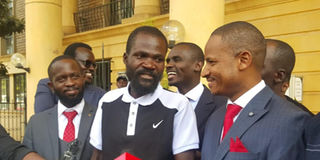
A diehard supporter of the late Opposition leader Raila Odinga who has for the last one and a half years been facing charges of incitement to violence is now a free man.
Mr Nuru Okanga was on Tuesday acquitted by a Nairobi Milimani Law Courts magistrate who faulted police investigations and ruled that the prosecution had failed to link him to charges linked to social media post about President Ruto.
Mr Okanga had been accused of posting a video clip on social media platforms, including TikTok, allegedly containing remarks construed as a threat against President William Ruto.
“I will not relent in my determination to voice and champion the rights of the lowly in society. Now that you have cleared me of any wrongdoing, I will concentrate on my education since I am a student at City Secondary School,” Mr Okanga told the court following his acquittal.
Senior Principal Magistrate Rose Ndobi freed Mr Okanga under Section 210 of the Criminal Procedure Code, blaming investigators for relying on unverified and potentially artificial intelligence–generated material to frame the political activist.
“The prosecution has failed to present evidence to prove that the accused, Nuru Okanga, posted the alleged offending material on social media,” the magistrate ruled.
The ruling was greeted with applause from defence lawyers and activists who had accompanied Okanga to court.
In her decision, the magistrate faulted the police for presenting testimony that sought to link Mr Okanga to alleged offending video clips, which formed the basis of the charges under the Computer Misuse and Cybercrimes Act.
However, the court found glaring gaps and contradictions in the prosecution’s evidence.
During the trial, the investigating officer admitted that he was not an expert capable of determining whether the video was authentic or generated using artificial intelligence.
He further told the court that he relied on a report from the Communications Authority of Kenya (CA) to prefer the charges and did not personally play or analyse the video in court.
The officer also acknowledged that while Mr Okanga was a known political activist, he could not conclusively determine whether the content amounted to political opinion protected under the law.
A digital analyst who testified conceded that the video was not extracted from the accused person’s devices and admitted that the analytical tools used had emerging errors, raising questions about their reliability.
In her ruling, the magistrate noted that the prosecution failed to prove that Okanga authored or uploaded the video adding that no evidence was presented to establish a nexus between the accused and the alleged content.
Nuru Okanga in various engagements in the past.
Photo credit: Facebook | Nuru Okanga
Additionally, the prosecution failed to demonstrate compliance with legal requirements governing the handling of electronic evidence, including failure to show that telecommunication devices were tendered in court or that proper extraction procedures were followed.
The court further found that the chain of custody and extraction process were not adequately demonstrated, contrary to Section 106 of the Evidence Act.
On whether there was a case to answer, the magistrate ruled that the prosecution had failed to meet the required threshold.
“This court finds that the prosecution has not demonstrated a prima facie case against the accused person on all three counts,” the magistrate said.
Consequently, the court acquitted Okanga of all charges, holding that he had no case to answer.
Following the acquittal, a team of defence lawyers announced plans to file a constitutional petition against the National Police Service (NPS), seeking compensation and enforcement of Okanga’s fundamental rights.
Reacting to the decision, Okanga described the ruling as “my New Year present.”