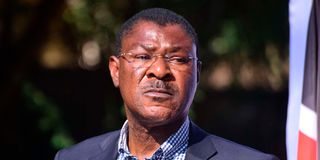
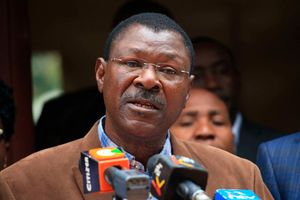
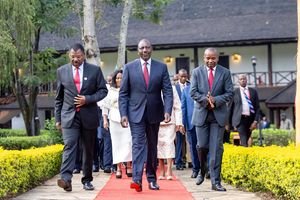
Less than 16 months to the August 10, 2027, General Election, National Assembly Speaker Moses Masika Wetang’ula finds himself at a precarious political crossroads, increasingly operating as a “cornered man” caught between the demands of the executive, the constraints of the law and his own political survival.
Mr Wetang’ula’s tenure as Speaker of the House, following his assumption of the office in 2022, has been marked by a growing, controversial disdain for the rule of law and court orders, most notably, his refusal to recognise the Azimio coalition as the majority in the National Assembly.
These, among others, top accusations against him of using the floor of the National Assembly to countermand court rulings.
The most recent example of his contempt for the orders of the court is his refusal to comply with the orders overturning his indefinite suspension of Kitutu Chache South MP Anthony Kibagendi from the House for comments he made on a live national television that unsettled him.
The two scenarios combined have fuelled questions over his suitability to serve as a speaker amid previous calls for his impeachment.
Immediate former Speaker of the National Assembly Justine Muturi says that he may have had his lows during his reign, but “I did not stoop that low to a point of desperately campaigning for the president.”
“Mr Wetang’ula is increasingly seen as a spectator in his own backyard. He is trying to balance his constitutional duties with a desperate need to retain political relevance,” said Mr Muturi.
Mr Muturi, Speaker Wetang’ula’s classmate at the University of Nairobi’s law school, is also the immediate former Attorney-General and Public Service Cabinet Secretary in President Ruto’s administration.
National Assembly Speaker Moses Wetang’ula in a communication to the House, ruled Kenya Kwanza the majority side in the National Assembly with 165 MPs and Azimio la Umoja One Kenya Coalition the minority with 154 MPs.
Mr Wetang’ula had not responded to our enquiries by press time yesterday but has previously defended his tenure as speaker and rejected claims of bias.
Speaker Wetang’ula has previously faced accusations of frustrating Azimio interventions to de-whip MPs they consider not loyal and who have openly pledged allegiance to the rival Kenya Kwanza coalition, from the House committees.
The man from Kabuchai, Bungoma County, is also navigating a tense political tightrope by maintaining his position as party leader of Ford Kenya in a House where he presides over, despite a High Court ruling indicating that his dual role is unconstitutional.
As a Speaker of the House, he is called to be a neutral arbiter, meaning that he must not be aligned with any of the parties in the House.
The man’s disdain for court rulings is further complicated by conflict of interest and is intensified by his defiance of pressure from President William Ruto to fold his Ford Kenya party and join the president’s UDA party.
The refusal places him at odds with the ruling Kenya Kwanza consolidation strategies and the president’s effort to successfully defend his seat, ahead of the 2027 general election.
A section of MPs allied to the Linda Mwananchi grouping, a loose political grouping within ODM opposed to the party’s collaborative efforts with UDA, say they will institute contempt of court proceedings against Speaker Wetang’ula for refusing to readmit Mr Kibagendi in the House.
The MPs led by Senators Edwin Sifuna (Nairobi) and Godfrey Osotsi (Vihiga) and Suba South MP Caroli Omondi note that Speaker Wetang’ula’s refusal to reinstate Mr Kibagendi is a direct assault on the rule of law and an “attempt to turn the National Assembly into a partisan shield for the executive.”
“The decision by the National Assembly Speaker is illegal, unconstitutional, and we will be pushing through the courts for contempt proceedings to be initiated against him for the disobedience of the court order,” said Senator Sifuna.
National Assembly Speaker Moses Wetang’ula during the Kenya Kwanza Kisumu County Tuk Tuk Sacco empowerment event on August 2.
Photo credit: Alex Odhiambo | Nation Media Group
Speaker Wetang’ula, on February 17, 2026, indefinitely suspended Mr Kibagendi, without affording him the cardinal right to be heard as decreed by the constitution.
The Kitutu Chache MP, who has been vocal about mismanagement at the Social Health Authority (SHA), found himself on the wrong side of Speaker Wetang’ula after he questioned parliament’s independence by saying that it has become an “auction House” during a live interview on TV in one of its morning shows.
An extraction of the National Assembly Hansard, the official document that records the proceedings of the House, captures Speaker Wetang’ula saying, “I am not going to invite the member to explain himself because I saw with my own eyes and heard it with my ears.”
“You will be excluded from the sittings of this House until you bring a properly worded apology. You will not bring it to me, because I am used to being insulted, but to the House for bringing disrepute to it,” the Speaker said.
He directed that “that apology should be delivered to the Clerk” and that “it will be looked at carefully and if the wording is acceptable, it will be brought to the House and you will be allowed to come back to the House.”
“For now, Kibagendi, you are excluded from the proceedings of this House, the precincts of parliament and committee sittings, including your office in parliament.”
Following the decision, Mr Kibagendi sought refuge from the court, and on March 19, 2026, the High Court temporarily suspended Speaker Wetang’ula’s decision to indefinitely bar the MP from parliament as it reinstated him to full duties pending the determination of his petition.
The court effectively restored the MP’s privileges to the full discharge of his duties as a representative of the people.
“The doctrine of separation of powers and constitutional independence of branches of government only operates to require that the High Court exercises greater care and apply a higher standard when it is called upon to inquire into the internal operations of the other branches of government,” ruled the court.
However, when Mr Kibagendi came to the House on March 31, 2026, armed with the conservatory order to serve the Speaker and the House, he was prevented by Homabay Town MP Peter Kaluma, the temporary Speaker at the time.
“The decision whether or not a member is named is not for the House but for me as the Speaker. Now, pursuant to Standing Order 108 (1), I name Kibagendi for gross disorderly conduct,” said Mr Kaluma as he suspended the Kitutu Chache South MP for 14 days.
Suba South MP Caroli Omondi addresses delegates during the People’s Delegate Convention organised by the Linda Mwananchi faction of the ODM at Ufungamano House in Nairobi on March 27, 2026.
Photo credit: Wilfred Nyangaresi | Nation Media Group
Interventions by Suba South MP Caroli Omondi to stop Mr Kibagendi’s suspension on account of the court order were also dismissed by Mr Kaluma.
This is despite Standing Order 110 of the House rules limiting the period of suspending a member from the House to four days.
“If any member is suspended under Standing Order 108, the suspension on the first occasion shall be for four days, including the day of suspension,” the House rules state.
“On the second occasion during the same session, the suspension shall be for eight days, including the day of suspension, and on the third or any subsequent occasion during the same session for 28 days, including the day of suspension.”
The continued frustration of Mr Kibagendi locks him out of privileges, House sittings and those of its committees and travels- local and foreign- raising the risk of losing his parliamentary seat under Article 103 of the constitution, if a prolonged absence of at least six months is realized.
In granting the court orders, the High Court held that the doctrine of separation of powers does not shield parliament from judicial scrutiny; instead, the court said, it is required of the court to act and intervene with restraint while still exercising its mandate.
On February 7, 2025, the High Court delivered a ruling declaring Azimio as the rightful majority party in the National Assembly, overturning the October 6, 2022, decision by Speaker Wetang’ula that conferred President Ruto’s Kenya Kwanza coalition the status.
The three-judge bench of justices John Chigiti, Lawrence Mugambi and Jairus Ngaah noted that the Speaker violated the constitution.
The justices noted that there was no evidence that political parties- MDG, UDM, PAA, CCM and MCCP, that Mr Wetang’ula alleged to have left Azimio and joined Kenya Kwanza Alliance, had made steps to comply with the Political Parties Act, requiring them to sign a post-election agreement with the Kenya Kwanza coalition.
"By assigning the 14 MPs from MDG, UDM, PAA, CCM and MCCP to Kenya Kwanza Alliance without evidence of a post-election agreement or justification and declaring Kenya Kwanza Alliance as the majority, the Speaker acted arbitrarily and violated the constitution," the judges said.
They added, "Speaker Wetangula's ruling declaring Kenya Kwanza Majority did not have a legal or factual basis".
On February 11, 2025, as the House met for the first day of the fourth session of the 13th parliament after the long 2024 Christmas recess, Suba North MP Millie Odhiambo wrote to the Speaker requesting that the Azimio coalition be recognized as the majority side.
This was followed by Suna East MP Junet Mohamed, Kathiani MP Robert Mbui and Ms Odhiambo, declaring themselves majority leader, deputy majority leader, and majority whip, respectively, in the letter to the Speaker as they occupied the designated slots in the debating chamber.
But on February 12, 2025, Speaker Wetang’ula “purportedly turned the House into a Court of Appeal” and overturned the High Court order as he declared President Ruto’s Kenya Kwanza coalition the majority side in the House.
Speaker of the National Assembly Moses Wetang'ula, makes his address during the Legislative Retreat for lawmakers in Naivasha on January 27, 2026.
Photo credit: Bonface Mwangi | Nation Media Group
Mr Wetang’ula ruled that Kenya Kwanza has 165 MPs and therefore the majority side in the 349-member House, with Azimio 154 MPs.
“Arising from the foregoing, the Kenya Kwanza Coalition is the majority party, and the Azimio La Umoja One Kenya Coalition party is the minority party in the House,” Speaker Wetang’ula communicated to the attentive House.
The Azimio has since appealed against the ruling, making it impossible for legislators to comment on the matter lest they be cited for sub judice. At the time, Mr Junet Mohamed said, “the contradiction in the Speaker’s communication is just glaring.”
“This is a communication that will be taken back to the court for quashing. The House is not the Court of Appeal to overturn the High Court decision as Mr Wetang’ula has just done,” said Mr Mohamed.
Speaker Wetang’ula’s vulnerability is further compounded by public criticism regarding his decision to demolish the media centre from the main parliament buildings, relocating it to a dingy room far away.
This was in reaction to the Gen Z protests, a move perceived as an attack on press freedom as it curtailed media practitioners’ access to follow House proceedings from a vantage position.
In February 2025, the High Court formally ruled that it is unlawful and unconstitutional for Mr Wetang’ula to simultaneously serve as Speaker of the National Assembly and leader of Ford Kenya party.
The court ruled that, being a public officer, Speaker Wetang’ula is expected to be a neutral or impartial arbiter and therefore he cannot be a leader of a political party.
This is unlike his peer in the Senate, Amason Kingi, who resigned as party leader of his Pamoja African Alliance (PAA).
The High Court’s order was anchored on three grounds- requirement for impartiality, automatic cessation, breach of statutes and the neutral referee principle.
Under the constitution, the court ruled, the speaker must be a neutral arbiter, holding that leading a political party that sponsors members in the same House creates a “clear conflict of interest” and undermines the impartiality required of the office.
The court also ruled that upon being elected as Speaker, an individual automatically ceases to be the head of a political party.
The court further established that section 12 of the Political Parties Act restricts State Officers from holding leadership positions in political parties to prevent undue influence on governance.
Article 75 (1) of the constitution states that a state officer shall behave, whether in public and official life, in private life or in association with other persons, in a manner that avoids any conflict between personal interests and public or official duties.
The Leadership and Integrity Act states that a state officer is required to avoid any conflict between personal interests and public or official duties, compromising any public or official interest in favour of a personal interest or demeaning the office the officer holds.
While delivering the ruling, the bench compared the Speaker of a legislative House to a referee in a football match, stating that a player-coach cannot fairly preside over the game.
Makueni Governor Mutula Kilonzo Jnr.
Photo credit: File | Nation Media Group
Makueni County Governor Mutula Kilonzo Jnr says that Speaker Wetang’ula should have stepped down from his party leadership position before contesting for the Speakership.
“His continued serving as the party leader manifestly compromises his impartiality as Speaker of the House because he has members in the House who competed against his party’s candidates,” Governor Kilonzo Jnr, an advocate of the High Court, said.
The Governor added, “It was weird and disturbing how he campaigned for his party's candidate and lost in his own Ward in the November 27, 2025, Kabuchai-Chwele Ward by-election.”
Also, throwing Mr Wetang’ula in the deep end of the sea is his refusal to fold Ford Kenya and join President Ruto’s UDA party.
Prime Cabinet Secretary Musalia Mudavadi, although having resigned from his ANC party before he was appointed to the cabinet, oversaw his party folding up to join UDA.
ANC’s dissolution was, however, successfully appealed in court.