The metallic drums stood defiantly in the sun, guarding Nairobi’s busiest intersections like silent sentinels of hope. It was 2015, and then-Governor Evans Kidero had a plan.
If roundabouts were choking the city’s arteries, why not block them with drums and force traffic into supposedly smoother patterns?
The experiment lasted barely a few months before the drums disappeared as mysteriously as they had appeared, leaving behind only memes, frustrated motorists, and a cautionary tale about quick fixes to complex urban problems.
But the drums were just the beginning of what would become a decade-long series of well-intentioned but ultimately futile attempts to tame Nairobi’s traffic beast.
By 2015, Nairobi’s roundabouts had become victims of their own success. What worked well for a smaller city couldn’t handle the tsunami of vehicles pouring into the capital each day.
Uhuru Highway’s five multi-lane roundabouts had turned into nightmares where right turns, requiring three-quarters of a roundabout journey in a left-hand drive system, created gridlock that rippled through the entire city network.
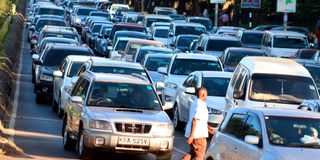
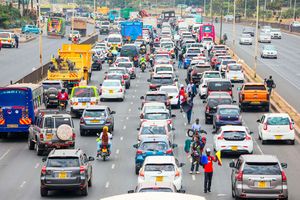
Hawkers sell their wares to motorists stuck in a traffic jam on Thika Road in Nairobi on September 30, 2025.
Photo credit: Bonface Bogita | Nation Media Group
Kidero’s solution was radical: drums appeared overnight at the Lusaka and Bunyala Road roundabouts, barricading sections to make room for modifications intended to improve the road network. The theory sounded reasonable on paper: force traffic into predetermined patterns, eliminate conflict points, and watch congestion melt away like morning fog.
Reality had other plans. Instead of the promised traffic nirvana, serious traffic snarl-ups occurred, subjecting motorists to unprecedented delays. The drums had effectively turned working roundabouts into bottlenecks, creating the very problem they were meant to solve. Commuters who had learnt to navigate the circular flow now found themselves trapped in confusion, unsure which lanes to use or where they could legally turn.
Social media erupted with memes showing the drums as tombstones for traffic sanity, and “Kidero drums” became their new name.
Within months, the drums vanished without fanfare, without explanation, and without any official acknowledgement that the experiment had failed. Motorists thanked Kidero for their removal, but the damage to the county government’s credibility was already done.
Undeterred, Kidero’s administration tried again in March 2016 with yellow box junctions at notoriously congested intersections along Kenyatta Avenue, Mama Ngina Street, Wabera Street, and City Hall Way. For a brief moment, it seemed like Nairobi had found salvation. The freshly painted yellow lines looked crisp and authoritative, and initial compliance was encouraging.
But Nairobi’s traffic culture proved more resilient than yellow paint. The refusal of drivers to respect the yellow lines led to the swift collapse of the initiative. The idea behind it was simple: if your exit is not clear, do not enter the yellow box.
Traffic jam on Jogoo Road, Nairobi after a heavy downpour.
Photo credit: Bonface Bogita | Nation Media Group
This way, you wouldn’t obstruct the motorist whose exit was clear. Within months, most motorists began disregarding the boxes, and the measure faded into obscurity alongside the drums, pushing the city back into the familiar territory of daily gridlock. Subsequent governments have turned their focus squarely on matatus.
Since 2008, every major city leader has promised to ban matatus from the CBD, creating a pattern as predictable as Nairobi’s daily traffic jams. President Uhuru Kenyatta attempted, in vain, that year when he was Minister for Local Government, to declare that all buses and matatus would be banned from the city centre streets. The announcement made headlines, sparked debates, and then quietly faded away as the practical realities of implementation set in.
Evans Kidero announced a ban by September 2013, but it was never implemented. The Nairobi Metropolitan Services planned to relocate vehicles by April 2022, starting with matatus plying Ngong, Lang’ata and Argwings Kodhek roads, but repeatedly postponed the opening of new bus termini. Each announcement followed the same trajectory: bold declarations, detailed timelines, public anticipation, and eventual silence as the deadline passed without action.
“The challenge goes beyond logistics to economics and political will. Matatus serve over three million passengers daily in Nairobi, forming the backbone of the city’s public transport system. They represent not just transportation but livelihoods for thousands of drivers, conductors, owners, and the informal economy that surrounds them.
Simply banning them without viable alternatives doesn’t just create transportation chaos – it threatens economic survival for a significant portion of the urban population,” said Gamal Elgerishom, a resident of Nairobi.
Photo credit: Sil Kiplagat | Nation Media Group
Current Governor Johnson Sakaja has revived the plan with what he calls a more pragmatic approach. Under his proposal, matatus will be allowed to drop passengers only at specific designated locations and must leave the city centre within five minutes. Whether this iteration will succeed where all others have failed remains to be seen.
Meanwhile, boda bodas have faced even harsher treatment and shown even greater resilience. A Kenyan court banned motorbike taxis from operating in the CBD on October 31, 2016, following safety and security concerns. The Nairobi County Government announced an immediate ban on boda boda operations in January 2018, directing riders to drop passengers at peripheral areas such as City Stadium and Ngara.
The riders, however, had other ideas. They resisted the directive, arguing that the move would devastate their businesses as a majority of their passengers worked in the CBD.
Inefficient transportation systems
Cabinet Secretary for Roads and Transport Davis Chirchir offers an assessment of why Nairobi’s traffic solutions have repeatedly failed. “Inefficient transportation systems affect national and international trade and transport and have negative impacts on inclusive and sustainable economic growth,” he explains. “Inadequate transportation systems contribute to congestion, poor safety and security, and poor integration between different modes of transport, among others, which ultimately result in high transportation costs.”
Traffic jam on Jogoo Road, Nairobi after a heavy downpour.
Photo credit: Bonface Bogita | Nation Media Group
The government has now adopted what Chirchir calls “a strategic planning and development model of an integrated public transport and mobility system” consisting of commuter rail, public service vehicles, Bus Rapid Transit, Light Rail Transit, and Non-Motorised Transport. Once fully developed, the urban transport system will consist of approximately 165 kilometres of commuter rail, approximately 300 kilometres of BRT lines, and a comprehensive network of walkways and cycle tracks.
Chirchir acknowledges the behavioural dimension. “A lot of what is wrong with traffic and mobility has to do with bad manners. We are so set in our ways and resist any change,” he says. His solution includes working with NTSA “to develop programmes, policies, legislation, and training to support culture and habit change to support and institutionalise discipline and good manners on our roads and transport systems,” he said.
“The government is also deploying technology. Implementation of the Intelligent Transport System and Junction Improvement Project is at an advanced stage of financial close and will initially cover Nairobi and Mombasa,” Chirchir explains, noting it will include geometry improvement for over 200 junctions, CCTV cameras, and Vehicle Enforcement Systems. “We will subsequently deploy AI, which is now here with us, to address and institutionalise discipline on our roads.”
He also mentioned that the Cabinet has recently approved second-generation smart driving licences with merit and demerit points, as well as the integration of violation management with the Judiciary, and instant fines to support road safety initiatives.
While Nairobi continues to struggle with failed experiments and abandoned plans, Mombasa County has found a solution that actually works — proof that smart traffic management can succeed in Kenyan cities when it’s designed around reality rather than against it.
The coastal city’s “Happy Hour” traffic management programme, introduced in February 2019, uses a traffic engineering principle called tidal flow to temporarily reverse lanes during peak hours. It’s simple: instead of fighting rush hour traffic, Mombasa channels it.
Every evening at 5:30 pm, a siren from a county inspectorate vehicle signals the start of something unusual in Kenyan traffic management. Motorists are directed to use all four lanes in a single direction to exit the island via Buxton, cross Nyali Bridge, and continue toward the Kengeleni junction. With all lanes flowing in one direction, drivers can leave Mombasa island within minutes rather than the hours it might otherwise take.
“Once the Happy Hour is in effect, all four lanes move in one direction. It only lasts 15 minutes, but it clears the traffic buildup,” explained Twafiq Balala, the County Transport Executive.
The Mombasa Transport Department, working alongside traffic police and county marshals, coordinates the operation with military precision. The system was formalised when the county gazetted it as a by-law in January 2021 under Gazette Notice No. 1665.
Under the by-law, traffic flows in one direction from the CBD toward the main northern corridor on both carriageways for no more than 15 minutes per session, with a maximum of three sessions on weekdays, typically at 5pm and 6:30pm.
The success of Mombasa’s Happy Hour stands in stark contrast to Nairobi’s failed experiments with drums and yellow boxes. It works because it accepts rather than fights human behaviour. It’s a lesson Nairobi has yet to fully absorb: sometimes the best solution isn’t changing driver behaviour, but working with it.
Chirchir outlines massive infrastructure projects, including the dualling of Rironi-Nakuru-Mau Summit, JKIA-James Gichuru restoration, and construction of interchanges at Valley Road, Upper Hill, and Green Park.