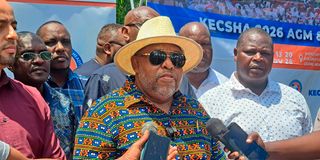
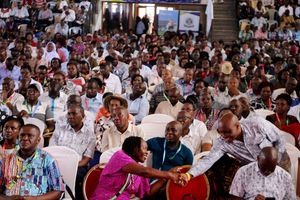
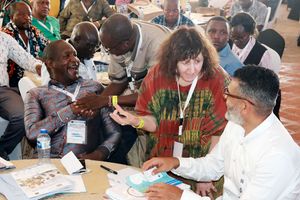
More than 15,000 heads of comprehensive schools from across the country have converged in Mombasa for a four-day conference focusing on the future of the education system, foundational learning and school leadership.
The gathering has boosted business for hotels, restaurants and other enterprises in the port city, while security has been heightened ahead of the 2026 Kenya Comprehensive School Heads Association (KECSHA) Annual General Meeting and Conference, running from November 9 to 12 at the Sheikh Zayed Children Welfare Centre.
The meeting comes at a critical moment for Kenya’s education sector as schools navigate curriculum reforms and confront persistent gaps in foundational learning.
KECSHA national chairman Fuad Ali said the conference would provide an opportunity for school leaders to examine how institutions should adapt to changing learner needs, technological advances, rising accountability demands and the need for inclusive learning environments.
Kenya Primary School Heads Association chairperson Fuad Ali.
Photo credit: File | Nation Media Group
“As our education system evolves, school leaders must respond to curriculum reforms, changing learner needs, technological advancement, increasing accountability requirements, and the need for more inclusive, supportive, and relevant learning environments,” Mr Ali said during a pre-conference briefing in Mombasa.
He said the discussions would address a fundamental question: What should the comprehensive school of the future look like, and what will it take to build it?
School heads are also expected to raise professional and institutional concerns with their employ-er, the Teachers Service Commission (TSC), particularly on school leadership, the teaching service and the quality of education.
The four-day meeting will examine leadership models, partnerships, institutional systems and the skills needed to turn policy ideas into practical improvements in schools.
Key themes include strengthening teaching and learning, improving foundational literacy and numeracy, enhancing school management, developing future-ready skills and promoting learner inclusion and wellbeing.
Foundational learning is expected to feature prominently following recent findings by the Centre for Mathematics, Science and Technology Education in Africa (CEMASTEA) and Echidna, which exposed significant gaps in numeracy as learners progress from Grade One to Grade Three.
The assessment was conducted under the Numeracy for Life (NFL) in Early Years Education (EYE) project in 15 counties selected for their high gender parity indices. It covered pre-primary learners in PP1 and PP2, pupils in Grades One to Three and their teachers.
Using Learner Assessment Tests, Teacher Proficiency Tests and classroom observations, the study found that few teachers responsible for early-years numeracy met the required 75 per cent benchmark in pedagogical content knowledge.
CEMASTEA national trainer Rahab Chiira said only 10.1 per cent of pre-primary teachers attained the benchmark. Performance among lower-primary teachers was higher, at about 40 per cent, but still pointed to significant weaknesses.
“We found gaps in both areas because, for the teachers, we administered a test, observed lessons, and also assessed their knowledge of pedagogy,” Ms Chiira said.
She added: “For PP1 and PP2 teachers, those who met the benchmark of 75 per cent were only 10.1 per cent. For Grade 1 to Grade 3, it was a bit higher, at around 40 per cent. You can see that these are the teachers who are taking care of our learners.”
In response, KECSHA has placed literacy and numeracy at the centre of its agenda, describing them as the foundation for future learning.
Mr Ali said the association wanted comprehensive schools to build strong basic skills, nurture competencies and positive values, promote learner wellbeing and inclusion, and equip children to participate meaningfully in society.
The conference has also introduced six specialised masterclasses offering practical training for school heads. They will cover instructional leadership, education technology, parental engagement, foundational learning, financial literacy and school health.
Mr Ali said the sessions would help school leaders improve classroom instruction, integrate digital tools into teaching and school management, strengthen partnerships with parents and communities, and improve literacy and numeracy.
Other areas will include learner health, safety and psychosocial wellbeing, as well as financial accountability and responsible management of school resources.
“These masterclasses will complement the wider conference deliberations by equipping school heads with practical insights and approaches that can be applied directly in their institutions,” he said.
Delegates will also engage with education agencies and strategic partners, including the Kenya Education Management Institute (Kemi), School Equipment Production Unit, CEMASTEA and the Kenya Institute of Special Needs Education.
Others are the Kenya National Examinations Council (KNEC) and the National Council for Nomadic Education in Kenya (NACONEK), whose contributions will focus on education management, curriculum implementation, assessment, inclusive education and support for learners in vulnerable settings.
President William Ruto is expected to attend the closing ceremony, giving school managers an opportunity to raise operational challenges and policy concerns directly with him.