The Auditor-General has flagged the use of millions of shillings in taxpayers’ money to pay subscription fees to the Kenya Secondary School Heads’ Association (Kessha), in a far-reaching finding that could cripple the operations of the welfare lobby representing over 7,000 principals.
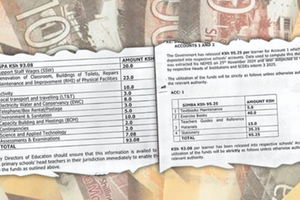
An analysis of audit reports for public secondary schools shows that in nearly every financial statement reviewed by the Auditor-General, schools made annual payments to Kessha.
Auditor-General Nancy Gathungu has classified the expenditure as irregular, arguing that because Kessha is a welfare association for principals, subscription fees should be borne by head teachers from their payslips, and not public schools.
Auditor-General Nancy Gathungu.
Photo credit: Wilfred Nyangaresi | Nation Media Group
The payments ranged from Sh2.77 million by Mang’u High School to a low of Sh66,500 for Starehe Boys’ Centre and School.
Kessha’s total collections would cross the Sh1 billion mark if schools, represented by 7,300 heads, paid Sh137, 000 each, signalling that the lobby is collecting hundreds of millions annually. The finding places Kessha, which has existed since the late 1960s, in a precarious position.
If enforced, principals would have to dip into their own pockets to finance the association’s activities instead of relying on school funds.
The Auditor-General flagged the spending line in virtually all the audited schools, noting that Kessha is a “welfare organisation that draws its membership from school principals only”, hence should not benefit from public funds sent to their schools.
“The organisation is not defined in the government funding system, and there is no assurance that it has implemented effective, efficient, and transparent financial management and internal control systems to manage the funds transferred by schools,” said the Auditor-General in her report for the financial year ended June 2025 on Mang’u High.
In another audit, Ms Gathungu said the payments violated Regulation 23(2)(c) of the Public Finance Management (National Government) Regulations, 2015, which requires an accounting officer transferring public funds to another entity to obtain written assurance that the recipient has effective, efficient and transparent financial management and internal control systems.
The annual subscription fees paid by more than 7,000 public secondary schools, which vary from one school to another, could cumulatively run into over Sh1 billion, given that many schools transferred hundreds of thousands of shillings to Kessha.
Alliance High School transferred Sh2,125,550 during the review period, while Moi Forces Academy paid Sh2,052,800.
Moi Girls Secondary School, Kamanungu, transferred Sh1.82 million to the lobby, while St Mary’s School, Yala, paid Sh1,523,640. Alliance Girls High School contributed Sh1.42 million, Chania High School Sh1,070,955, Utumishi Academy Sh1,023,820, and Nairobi School Sh996,800.
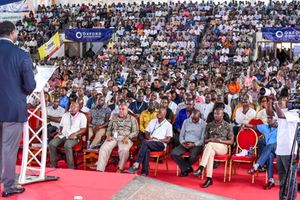
The national chairman of Kenya Secondary Schools Heads Association Willie Kuria speaks during the Muranga County Conference in Mombasa on April 15, 2026.
Photo credit: Kevin Odit | Nation Media Group
Willie Kuria, chairperson of the Kessha and Principal of Murang’a High School, did not respond to questions from the Nation on how the association intends to regularise the audit queries.
However, in past interviews, Mr Kuria defended the transfers, saying the money consists of members’ contributions used to run the association’s activities.
“Kessha is a registered association, and members contribute Sh500 every month to run the association. What comes there is money for activities, and there’s no other way other than to put money in that clearance account,” Mr Kuria said in a past interview.
It was not immediately clear why the transfers ran into millions if members only contributed Sh500 per month, which would translate into an annual subscription of Sh6,000.
With about 7,000 members, the association would collect roughly Sh42 million a year, or about Sh3.5 million a month, a figure that appears significantly lower than the cumulative amounts reflected in the audited school accounts.
Kessha describes itself as a professional organisation comprising about 7,000 members drawn from public and private secondary schools across Kenya. Kenya has 9,713 public secondary schools and 1,338 private ones.
Established in the late 1960s, its primary objective is to provide professional advice and support to school heads in all the country’s 47 counties.
The audit findings come against the backdrop of expanded oversight brought about by the 2010 Constitution, which created an independent and more powerful Office of the Auditor-General under Article 229.
The Constitution requires the Auditor-General to audit all public entities receiving taxpayers’ money and submit the findings to Parliament.
Public secondary schools fall squarely within that mandate because they receive billions of shillings annually from the Exchequer through the Free Day Secondary Education capitation programme.
Besides government capitation, schools also collect approved boarding fees and other authorised levies, making them custodians of significant amounts of public resources.
Consequently, every public secondary school is required to prepare annual financial statements, which are audited to establish whether public funds have been applied lawfully and effectively.
Beyond Kessha subscriptions, the latest audits highlight other financial breaches by schools, including unsupported expenditure, irregular procurement, unapproved fees charged to parents, and delayed submission of financial statements.
The country’s top accountant has also flagged non-functional procurement units, inaccurate student enrolment data affecting capitation, weak asset management, failure to prepare school improvement plans, non-compliance with the Data Protection Act, and the Public Procurement and Asset Disposal Act as other challenges facing public secondary schools.