Hello

Your subscription is almost coming to an end. Don’t miss out on the great content on Nation.Africa

Ready to continue your informative journey with us?

Hello

Your premium access has ended, but the best of Nation.Africa is still within reach. Renew now to unlock exclusive stories and in-depth features.

Reclaim your full access. Click below to renew.

ChatGPT
Caption for the landscape image:

As technology evolves, Universities embrace Artificial Intelligence

Scroll down to read the article

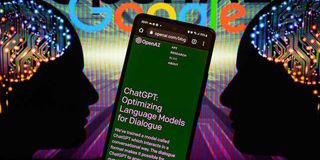
Google-OpenAI displayed on screen with ChatGPT on a mobile phone seen in this photo illustration.

Photo credit: AFP

When ChatGPT burst onto the global scene in late 2022, it sent ripples in classrooms and lecture theatres worldwide.

It brought hype and fright that played out with curiosity and anxiety at the same time in Kenyan universities.

The discovery of a tool capable of delivering quick, well-structured answers and even writing essays was astonishing.

While academia was coming to terms with ChatGPT’s instant feedback, Google launched “Gemini Live”, a beefed-up Artificial Intelligence (AI) search and real-time chatbot.

The tool can brainstorm ideas out loud, simplify complex topics and assist in rehearsing for presentations with real-time responses.

The generative AI tools have opened up new possibilities for learning, teaching and research, but at the same time raised questions on academic integrity, ethics and digital readiness.

artificial intelligence

For Kenya's young teachers, artificial intelligence isn't just another educational buzzword.

Photo credit: Shutterstock

At the University of Nairobi (UoN), for instance, AI has been introduced as a mandatory co-course, much like communication, which is required for all students regardless of their programme of study.

UoN Director of Corporate Affairs, John Orindi, says the institution has embraced AI, but insists on its use in ethical and professional ways.

“As technology rapidly evolves, we have to keep pace. As such, there are guidelines on how one can use AI at the university. It is not illegal per se,” Mr Orindi says.

The UoN appears to be taking a cue from the University of Cambridge in the UK and Harvard in the United States, which have developed comprehensive AI use guidelines, balancing the potential of the technology with academic integrity safeguards.

To keep pace with the fast-changing digital era, the UoN has launched a Master’s of Science in Artificial Intelligence programme, which is expected to spearhead the much-needed academia-industry linkages.

Work efficiently 

At the Open University of Kenya (OUK), the Bachelor of Data Science and Master’s of Science in Cyber Security and Digital Forensics have become among the most popular programmes, prompting the institution to launch a Master’s of Science in Artificial Intelligence this year.

Open University of Kenya VC Elijah Omwega says chatbots like ChatGPT and DeepSeek are the clearest indication that AI is helping humans work efficiently.

DeepSeek is known for strength in technical areas, particularly coding and mathematical computations.

“We cannot stop AI, we can only embrace it while putting in place strong policies and guidelines that allow us to use the technology progressively and responsibly without compromising on integrity or our humanity,” he told Higher Education.

The Open University has introduced AI tutors (robotic systems designed to complement human lecturers) with a vision of developing highly accurate virtual professors capable of engaging students with up to 99.9 per cent precision.

AI is also transforming the delivery of content by lecturers and the handling of assignments by students.

Pioneer International University Dean of Students, Patrick Ntonja, says it is now easier to explain abstract concepts using AI.

“Using AI-generated videos to explain certain concepts, for instance, enhances learners’ understanding as the visuals make it easy for them to relate to the discussion, ultimately easing our work,” Prof Ntonja says.

On how assignments are handled, the challenge that always emerges is plagiarism and how to handle it.

The use of AI in post-graduate assignments is becoming a big talking point in universities worldwide, especially because graduate work demands originality, critical thinking and advanced research.

A Master of Business Administration student at Jomo Kenyatta University of agriculture and Technology (JKUAT) admits to using AI to handle assignments.

“Since the allowed threshold on the university’s plagiarism software is 20 per cent, one navigates that by paraphrasing AI-generated answers,” he says.

ChatGPT logo and AI Artificial Intelligence

ChatGPT logo and Artificial Intelligence words are seen in this illustration taken, May 4, 2023. 

Photo credit: Courtesy | Reuters

Universities are also turning to software such as Turnitin AI Writing Detection, Copy Killer and Copyleaks AI Detector to flag AI-generated assignments.

Prof Ntonja says some students still find ways to circumvent this so a lecturer can arrest cheating by checking the references quoted and listed.

“AI cannot critique knowledge. Even with that, I know the scholars in my area and the latest contexts. For citation, we can figure out if the scholar quoted is off-track,” says Prof Ntonja, who is also the Director of the Fisheries and Marine Institute at Pioneer International University.

His sentiments are shared by Dr John Ndavula, a senior journalism don at Murang’a University of Technology, who says navigating AI has meant adjusting the giving and assessing of assignments.

Dr Ndavula, who heads the Humanities Department, says lecturers can no longer assign generic topics to learners. They must think harder about things that will intellectually involve the students.

“There are now more presentations made in class in order to gauge the students’ mastery of the topics and understanding of the various connected aspects,” he says.

Dr Ndavula adds that while technology is good, it comes with challenges and what the academia and education need is a guide on the ethical use of AI, which should also include disclosure on where information has been sourced.

Beyond the plagiarism debate, AI has made higher education more accessible, especially with more institutions embracing remote learning.

In mid-2019, Usiu-Africa sought accreditation from the Commission for University Education (CUE) to offer an online MBA, a request that was granted in November 2020.

That made Usiu-A the first university in Kenya to earn the regulator’s recognition for online delivery of MBA.

Teaching and learning 

With the Covid-19 pandemic disrupting teaching and learning, Usiu-Africa quickly turned to “Blackboard” – a management system designed to deliver, manage and track learning.

While it is not primarily an AI tool, its newer versions are integrating AI features, including chatbots and automated grading for quizzes.

Other universities have followed suit, embracing the blended approach – a mix of sessions that are face-to-face and others that are online.

During the Dialogue on Innovative Higher Education Strategies workshop in Naivasha recently, Higher Education Principal Secretary Beatrice Inyangala acknowledged that AI – once a distant concept – is now daily reality.

“It’s shaping how we live, work, and learn. The ministry is not just watching, it is preparing to lead,” she told participants at the workshop organised by DAAD.