David Kanyoro, 26, stared at the timetable taped to the staff-room wall. Creative Arts & Pre-Tech. He had studied History and Kiswahili. Now, twenty-five eleven-year-olds were waiting, and the only thing between him and total panic was the shaky school Wi-Fi and a tab he'd just opened called ChatGPT.
David Kanyoro , 26 years, a Junior School teacher at Imenti Junior School in Laikipia County.
Photo credit: Pool
"I literally typed 'how do I teach Creative Arts to Grade 6' and held my breath," Kanyoro recalls from his desk at Imenti Junior School in Laikipia. That desperate Google search two years ago has since evolved into something that's transforming classrooms across Kenya – and turning fresh graduates like him into confident teachers of subjects they never studied.
For Kenya's young teachers, artificial intelligence isn't just another educational buzzword. It's survival.
When Kanyoro first asked ChatGPT to help him plan a lesson on colour theory, he half-expected gibberish. Instead, he got a structured breakdown, complete with activities for mixing primary colours and suggestions for everyday objects students could use as examples.
"The AI explained things in a way I could understand, then helped me simplify it for eleven-year-olds," he says. "Suddenly I wasn't just winging it – I actually knew what I was talking about."
His students noticed the change immediately. "Mwalimu, how do you know all this cool stuff?" became a regular question. What they didn't know was that their teacher was learning alongside them, using AI to stay just one step ahead.
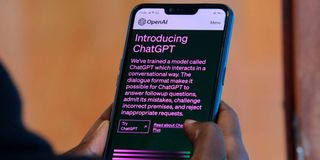
Most college students entirely depend on the app known as Chat Generative Pre-trained Transformer (ChatGPT), for studying and even during examinations.
Photo credit: AFP
Across the country, teachers are discovering that AI could bridge the gap between what they had studied and what they were expected to teach – a particularly acute problem as Kenya's Competency-Based Curriculum demands expertise across multiple subjects.
At GK Prison Primary School in Kitengela, Julie Nandi, 43, had a different introduction to AI. When students started talking about "artificial intelligence," her mind went straight to livestock breeding.
Julie Nandi durng an interview in Isinya, Kajiado County, on August 20, 2025
Photo credit: Bonface Bogita | Nation Media Group
"I thought they meant artificial insemination," she laughs. "My Grade 8 pupils had to sit me down and show me how to create a ChatGPT account."
That role reversal – pupils teaching teachers – has become a defining feature of AI adoption in Kenyan schools. During the school's weekly Digital Hour, Nandi watches as learners crowd around the eight donated desktops and a handful of tablets, taking turns to explore everything from math problems to art project ideas.
"Five pupils around one computer sounds chaotic, but they're actually teaching each other," she observes. "One types, another suggests questions, someone else fact-checks the answers. They've created their own system."
The collaboration extends beyond the ICT lab. Pupils who've mastered AI prompting during Digital Hour often become informal teaching assistants, helping classmates phrase questions or interpret responses.
Both teachers have watched AI unlock potential in unexpected ways. Nandi recalls one habitually disengaged pupil who used Digital Hour to research a science topic that had confused him in class. The next day, he presented findings that impressed both his teacher and classmates.
"He'd never shown that kind of initiative before," she says. "The recognition he got completely changed his approach to learning. Now he's the one helping others with their research."
ChatGPT logo and Artificial Intelligence words are seen in this illustration taken, May 4, 2023.
Photo credit: Courtesy | Reuters
For Kanyoro, the change is visible in everyday interactions. Pupils ask deeper questions, challenge his explanations, and bring ideas from their AI explorations into class discussions. Lessons that once felt like one-way lectures have become collaborative investigations.
"My pupils see AI as part of their world," he says. "It motivates them to dig deeper, to not just accept the first answer they find."
But this AI revolution comes with limitations. Both teachers acknowledge the technology's imperfections – and their own vulnerabilities when using it.
"Sometimes ChatGPT gives me Grade 9 content when I ask for Grade 7 material," Kanyoro admits. "In History and Kiswahili, I can spot the mistakes. But in subjects I never studied? I have to trust what it tells me."
This dependence concerns him, particularly when teaching Pre-Technical Studies concepts he's encountering for the first time himself. "I'm learning and teaching simultaneously. It works, but it's not ideal."
Nandi emphasises that AI, however helpful, can't replace teacher judgment. "The children need us to interpret information, to help them understand what fits their level and what doesn't. Without that guidance, they're just copying answers they don't understand."
The resource constraints are also a challenge. Nandi's school serves 2,500 pupils with just 26 digital devices. Yet the weekly Digital Hour sessions are oversubscribed, with older pupils particularly eager to explore AI's capabilities.
"Parents tell me their homework stress has decreased," Nandi notes. "Before, they'd panic when children brought CBC assignments they couldn't help with. Now families learn together, using AI as a starting point for discussions."
For many veteran teachers, AI has become an unexpected bridge between the 8-4-4 system they trained under and the CBC reality they must now deliver. Terms like "rubrics" and "learning outcomes" that once seemed foreign now have AI-generated explanations available at the click of a button.
Kanyoro believes Kenya's young teachers are ready for broader AI integration, but worries about the digital divide. "If we don't expand this beyond a few subjects and a few schools, our students will fall behind globally," he argues.
The government has responded with initiatives like CEMASTEA's programme to train 5,400 secondary teachers in AI integration. But for teachers like Kanyoro and Nandi, the learning is happening in real-time, one lesson at a time.
Two years after that first panicked ChatGPT search, Kanyoro now helps train fellow teachers in AI use. His advice is simple: "Start small, stay curious, and remember – your students are probably better at this than you think."