Cash-strapped public universities seek waiver on statutory debt penalties

University of Nairobi Vice-Chancellor Professor Eng. Ayub Njoroge Gitau during an interview at his office at the University of Nairobi on July 16, 2026.

Public university vice-chancellors are seeking a government waiver of penalties and interest accrued over years of unpaid statutory deductions as the cash-strapped institutions struggle to meet their obligations.
The universities have asked the Ministry of Education (MoE) to negotiate a waiver with the Kenya Revenue Authority (KRA), blaming chronic underfunding for their failure to remit statutory deductions even as they continue to pay employees their net salaries.
The outstanding bill for unremitted statutory deductions across public universities stood at Sh33.3 billion as of January 31, 2026, adding to the institutions' mounting financial liabilities.


Appearing separately before the National Assembly Public Investments Committee on Governance and Education (PIC-G&E), University of Nairobi (UoN) Vice-Chancellor Ayub Gitau and his Kenyatta University counterpart, John Okumu, said universities had collectively petitioned the Ministry for intervention.
Prof Okumu said KU had entered into payment arrangements with KRA but continued to default because of inadequate funding.
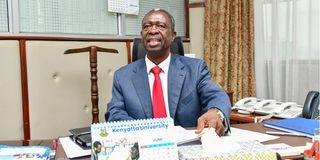
Kenyatta University Vice-Chancellor Prof John Okumu.
“We have payment plans but sometimes we default because it's the same issue of funding. Even as we indicate that we are paying salaries, we are paying the net because we don't have enough funds,” he told the committee chaired by Luanda MP Dick Maungu.
He noted that engagements with KRA were aimed at having the university settle its current obligations even as discussions on possible solutions to historical arrears and a possible waiver continued.
Prof Okumu said the universities had approached the Ministry collectively because the problem affected institutions across the sector, but nothing had come out of the request.
Delayed government funding has compounded the crisis for Kenyatta University, which is owed Sh3.6 billion by the Universities Fund (UF) and the Higher Education Loans Board (HELB).
“It is a cyclic problem. The people who are supposed to fund us, like HELB and the Universities Fund, also come back to the same government for funding, and they also don't get enough,” he said.
On its part, the University of Nairobi said it was working with the Ministry of Education to explore whether the government could take over its outstanding Pay As You Earn (PAYE) obligations to KRA.
“We are doing some simulation and analysis with the Ministry of Education towards whether the PAYE that we have not remitted to the KRA can at least be taken over by the government,” he said.
Prof Gitau also disclosed that the university had previously failed to remit pension deductions but had since prioritised payments to retiring employees.
University of Nairobi Vice-Chancellor Professor Eng. Ayub Njoroge Gitau during an interview at his office at the University of Nairobi on July 16, 2026.
The UoN is currently owed about Sh3 billion by the Universities Fund and HELB for the 2025/2026 financial year, further constraining its ability to meet its obligations.
UoN's financial difficulties intensified in the 2017/2018 financial year when the government switched to the Differentiated Unit Cost (DUC) funding model, which significantly reduced government funding.
Education reforms introduced in 2015/2016 under former Cabinet Secretary Fred Matiang’i to curb examination cheating in national examinations reduced the number of self-sponsored students joining universities, undermining KU's revenue projections.
The decline in the number of students qualifying for university significantly reduced UoN's Module II revenue, creating a funding gap of about Sh1.6 billion.
“The situation was compounded by the Covid-19 pandemic, which disrupted revenue streams and worsened the institution's inability to meet its obligations, including pension remittances,” said UoN acting director of finance Stephen Kimeli.
The university also faced additional pressure from collective bargaining agreements (CBAs), whose costs were not fully financed.
Committee chairman Dick Maungu noted that much of the universities' statutory debt was historical, with some obligations dating back nearly 20 years.
He questioned the rationale of government agencies demanding remittances from institutions that depend on the same government for funding.
“The same government that funds you is the same government that desires this money to come back to it in terms of PAYE,” Mr Maungu said.
He urged the universities and the Ministry to explore a broader solution, including writing off historical debts, to give institutions an opportunity to start afresh.
The proposed waiver comes against the backdrop of mounting financial pressure in public universities, whose combined pending bills rose by 17.6 per cent to Sh100.3 billion in the eight months to January 2026, from Sh85 billion in July 2025.
The liabilities include unpaid suppliers, capital projects, part-time lecturers, as well as unremitted statutory and Sacco deductions.
Data previously tabled in Parliament showed that UoN had the highest statutory deductions arrears at Sh8.8 billion, followed by Kenyatta University at Sh5.2 billion, Moi University at Sh4.7 billion, Technical University of Kenya at Sh4.4 billion, Jomo Kenyatta University of Agriculture and Technology at Sh4.3 billion and Egerton University at Sh3.3 billion.
Follow our WhatsApp channel for breaking news updates and more stories like this.