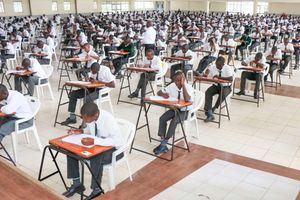
The candidates were in third term of Standard 8 in January 2022, sat their Kenya Certificate of Primary Education (KCPE) examinations in March and joined Form One in May for a crash programme to recover lost time. The entire Form One curriculum was covered in just six months.
However, that did not stop the class from posting one of the most impressive results in recent history. It produced the highest number of students qualifying for university admission in eight years.
While some 232,281 candidates who sat the 2021 KCPE did not complete Form Four by sitting the KCSE, 993,226 of them were tested and scored various grades that will open doors for tertiary education training.
The CEO of the Kenya National Examinations Council (Knec), David Njeng’ere, observed that the pass rate has placed the country close to global best practice and is good for the development of human capital. He said the good performance takes the country closer to the “global minimum” of students who qualify for university education in a normal population (where there are no disasters like war, famine or a pandemic).
At least 270,715 out of the 993,226 candidates who sat the examination attained a C+ and above, qualifying them for university degree programmes. This translates to 27.18 percent of the total candidature.
At 27.18 percent, the qualification rate exceeds the 25.53 per cent in 2024, 22.3 per cent in 2023, 19.03 percent in 2022 and 11.3 per cent in the 2017 KCSE.
“For the longest time, we have been below 20 per cent. With such an education system, it means that you will not be able to get adequate human resource that is trained at the tertiary level to come and help grow the economy,” Dr Njeng’ere said.
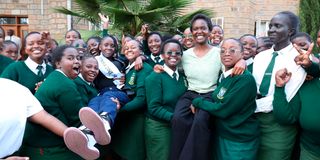
Moi Girls' High School Eldoret students celebrate the institution's good performance in the 2025 Kenya Certificate of Secondary Education examinations on January 9, 2026. The school registered a mean score of 9.73.
Photo credit: Jared Nyataya | Nation Media Group
While internationally there is no single fixed percentage, education policy guidelines and the United Nations Educational, Scientific and Cultural Organization (Unesco) reports give some broad benchmarks of between 30 and 40 percent.
The African Union continental Education Strategy 2016–2025 encourages 30 percent of upper secondary students to access tertiary education.
“In a normal country that doesn’t have war, a minimum of 30 per cent should be able to qualify for tertiary higher education,” said Dr Njeng’ere.
As has been tradition, national schools produced the bulk of the top grades, indicating the wide gap between better-resourced schools and sub-county schools, which lack basic infrastructure and also face serious funding and staffing challenges.
Out of the 1,932 candidates who scored a mean grade of A, 1,526 of them were in national schools. Extra-county schools had 197 As, county schools 6, sub-county schools 18 while private schools had 185.
The results, however, show a worrying trend where a considerable number of candidates score a mean grade of E. The grade is only good for artisan courses. Last year, 47,798 candidates scored the undesired grade.
At least 39,325 of these were from sub-county schools, 6,081 from private schools, 2,104 from county schools and 173 from national schools. Extra-county schools had the least number of Es at 115.
Asumbi Girls High School students and teachers celebrate after the announcement of the 2025 KCSE results. The school got a mean of 9.7844.
Photo credit: George Odiwuor | Nation Media Group
There are now only two classes left in the 8-4-4 in basic education, with the last KCSE examination scheduled for next year. The country will then have fully transitioned to competency-based education (CBE) at the basic education level.
“Examination results are not an end in themselves but a means to an end. As Kenya retires the nostalgic KCSE by 2027, the transition to the Competence Based Education and Training (CBET) system will provide a more adaptive human resource for our country, the software and key enabler of Kenya’s ambition to join the nations of the economic first world within a generation. While the 8-4-4 programme has been a good education system, CBET is a better and superior alternative,” said Deputy President Prof Kithure Kindiki.
In the 2025 results, female candidates posted better grades in languages and arts subjects as compared to their male counterparts, who did better in mathematics and science subjects.
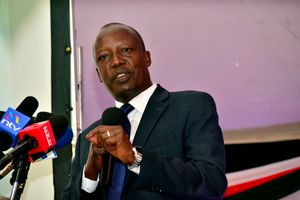
Education Cabinet Secretary Julius Migos Ogamba during the release of the 2025 Kenya Certificate of Secondary Education results, at AIC Chebisaa Boys School in Eldoret City, Uasin Gishu County on January 09, 2026.
Photo credit: Jared Nyataya | Nation
Education Cabinet Secretary Julius Migos Ogamba released the results for the 993,226 candidates at AIC Chebisas Boys High School in Eldoret, Uasin Gishu County, after earlier briefing President William Ruto of the outcomes of the examination at the State Lodge, Eldoret.
Some 492,013 male and 501,214 female candidates sat for the national examination in 2025, representing 49.54 percent and 50.46 percent of the total candidates, respectively.
The number of candidates who sat for the examination last year increased from 962,512 in 2024, representing a rise of 30,714 candidates (3.19 percent).
“This is the second year in a row since the inception of the KCSE examination that female candidates are more than male candidates,” disclosed the CS, who was accompanied by Education Principal Secretary Prof Julius Bitok and senior officials from the Kenya National Examination Council (KNEC) and Teachers Service Commission (TSC).
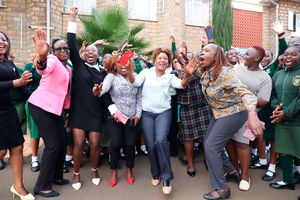
Nyabururu Girls Principal Joyce Orioki (in black) celebrates with teachers, students and support staff yesterday after the school registered stellar performance in the 2025 KCSE examination.
Photo credit: Wycliffe Nyaberi | Nation Media Group
While female candidates recorded better mean score performance in English, Kiswahili, Kenyan Sign Language, Home Science, CRE and Art & Design, their male counterparts did well in 11 subjects - Mathematics Alternatives A and B, Biology and Biology for the Blind, Chemistry, General Science, History & Government, Geography, IRE, Building & Construction and Business Studies.
Mr Ogamba disclosed that 1,180 candidates had their results cancelled after they were involved in examination irregularities.
“In November last year, we indicated that there were reported cases under investigation and that action would be taken upon conclusion of the investigation. At the conclusion of the KCSE examination, 1,180 candidates were found to have been involved in examination irregularities. Consequently, and in line with the applicable law and regulations, their examination results have been cancelled,” explained Mr Ogamba.
He said 10 counties - Garissa, Mandera, Wajir, Turkana, Narok, Samburu, Mombasa, Homabay, Nyamira and West Pokot reported entry of more male than female candidates.
Likewise, 14 other counties -Vihiga, Elgeyo Marakwet, Kisumu, Kiambu, Kwale, Nairobi, Kakamega, Meru, Isiolo, Uasin Gishu, Machakos, Kitui, Busia, and Tharaka Nithi — had more female than male candidates.
The CS said the government has employed 100,000 teachers since 2023, with 24,000 being recruited this year, while 25,000 teachers have been promoted.
He said teachers have been retooled and re-oriented in readiness for the rollout of Competency-Based Education (CBE).
“Our primary objective is to strengthen teaching and learning in our schools, and consequently, improve our educational outcomes,” said the CS.
The government, he said, has built 23,000 classrooms in the 2024/2025 Financial year to support the transition of the first Grade 9 cohort.
“This year, we will construct 1,600 laboratories in various Senior Schools to support practical learning,” said Mr Ogamba.
Nakuru High School students, teachers and Chief Principal John Ole Kuyo celebrate with Keith Kahihia who scored an A (plain) of 84 points in the 2025 KCSE examinations on January 9, 2025.
Photo credit: Boniface Mwangi | Nation Media Group
He disclosed that the government has released Sh44.2 billion as capitation and asked heads of institutions to ensure prudent use of the money.
“This is the first time in over ten years that capitation has been disbursed before schools' opening. Heads of Institutions are expected to ensure prudent use of these public resources for the benefit of learners, and to desist from imposing any extra levies or fees,” added the CS.
He said the government was implementing the Student Centred Funding Model, which supports students and trainees through scholarships and loans to further their education.
The CS fees for academic programmes at public universities have been rationalised by 15 percent to 40 percent, and it will now range from Sh5,800 to Sh75,000 per semester.