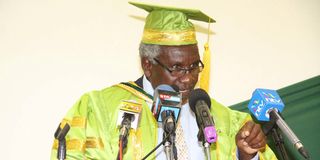
The appointment of a new council to steer the University of Nairobi marks a fresh chapter for an institution plagued by leadership wrangles and administrative challenges. It presents an opportunity for renewal and strategic recalibration.
Other members are Dr John Kakonge, a diplomat and former Kenya’s Permanent Representative to the UN in Geneva; Mr Samuel Njuguna Kimani, a financial and banking professional; Dr Jonathan Ltipalei, scholar and public policy adviser; and Ms Mary Amuyunzu, public health researcher and social scientist.
The council will be inaugurated this week. The formation of the council by Education CS Julius Ogamba represents a critical effort to bring stability and harmony back to the university. Once a beacon of academic excellence, the institution has, in recent years, been rocked by governance challenges and a revolving door of top officials.
It has had two substantive vice-chancellors and several others in acting capacity in the past decade. For Deputy VCs, the list is long. Each VC left under unfortunate circumstances, serving only briefly without making a mark.
Yet, ideally, a VC should serve for 10 years – two terms of five years – which provides sufficient time to initiate and see through important projects and programmes.
For now, the university does not have a substantive VC and Deputy VCs. Those in office are in acting positions.
Similar disruptions plagued the previous councils, with the most recent one led by Prof Amukowa Anangwe, which was unceremoniously disbanded following persistent clashes with the university management and the Ministry of Education.
First, they have to oversee the appointment of a substantive VC and the deputies. The offices have been vacant for months because of persistent contestations between the council and the ministry and as well, political manouvres.
The latest attempt to appoint a VC was bungled, hurting the reputation of the institution. The team must urgently initiate a fresh and transparent process to identify eminently qualified candidates for the top leadership positions and restore credible, strategic direction at the university.
Second, the council must work with the management to restore the university’s glory and put it on a pedestal for growth.
One indicator of the university’s falling fortunes is the declining student population. For instance, the number of students enrolled has declined from an all-time high of 98,713 in the 2015/16 academic year to the current 50,643.
Notably, Kenyatta University, which had a smaller student population of 76,879 in 2015/16, now surpasses the UoN with an enrolment of 54,643.
Admittedly, all public universities have experienced a diminishing student population but the case at the UoN is particularly striking.
It is no longer the university of choice, a point that ought to worry the administration and council.
Third is the pressing issue of a rising debt burden and the institution’s capacity to execute its programmes. According to the Ministry of Education, the UoN tops the list of universities with a huge debt burden.
As of May, the university had a debt of Sh13.2 billion. Others in similar situation are Technical University of Kenya (Sh11.1 billion), Kenyatta University (Sh10.6 billion) and Egerton (Sh10.1 billion).
Universities’ debt burden is complex and systemic. Largely, it has been occasioned by the steadily declining capitation from the government but notably, it has also resulted from the institutions’ inability to generate their own revenues.
Moreover, the universities’ cost structure – characterised by a large wage bill and substantial auxiliary expenses – coupled with poor financial management and weak internal controls, has significantly contributed to the mounting debt.
Diversification and exploring other revenue streams is an imperative and this is where Prof Nyaigoti’s council has to come in and provide direction.
Fourth is resource utilisation. The UoN has a solid asset base, with properties across Nairobi and several other counties. It has, for instance, a 12,000 acre-farm in Kibwezi, Makueni County, which is a goldmine with potential for high agricultural production and which, if augmented with agro-processing capabilities, can significantly boost the university’s income. Yet, the farm lies idle because of mismanagement and neglect.
To be sure, the 2023 report of the Auditor-General shows that an irrigation project started there by the university in 1990s in collaboration with the Israeli government collapsed due to poor management. All the equipment was left to go to waste.
For example, the UoN is littered with stalled projects, such as a proposed 500-bed hostel, kitchen and common room in Lower Kabete and a pharmacy tuition building at the Faculty of Health Sciences.
These have remained incomplete for years, and their conditions have been deteriorating.
Related to this is research and innovation. There is evidence that the university has the capacity to lead major research projects but the challenge is funding.
Given the present circumstances, the university should strengthen its research and consultancy programmes to attract grants and generate additional funding. Not only will that raise new revenue but also foster innovation and elevate its profile.
Taken together, these issues present a clear challenge for the council members.
They have to ensure the university management takes strategic actions to revitalise the institution.
Prof Nyaigoti has a long tenured history in university management, having founded the Higher Education Loans Board (Helb) in the mid-1990s as the chief executive.
Later, he proceeded to the Inter-University Council for East Africa, an institution of the East Africa Community (EAC), which he restored from decline and had it elevated to international standing.
Equally, every council member brings a wealth of talent and expertise capable of steadying Kenya’s premier institution of higher learning.
With expectations running high, the new council must act swiftly to kickstart the revitalisation of the UoN and set it firmly on the path to transformation.