The Ministry of Education has introduced a digital school allocation system to ensure equity and fairness in the first transition of Grade Nine learners to senior school under the competency-based education (CBE).
The system, which is being piloted, will guide the placement of the pioneer cohort of 1.13 million Grade Nine learners expected to sit the Kenya Junior School Education Assessment (KJSEA) from Monday.
According to the ministry, slots in Cluster One schools – currently referred to as national schools – will be shared across the country to reflect equity as well as consider the students’ individual performance.
At least one child from each of the 47 counties will be placed in a Cluster One school. There are more than 100 such schools in Kenya.
Just weeks ago, the Ministry of Education said more than 1,000 senior schools were not selected by any learner.
This is expected to trigger stiff competition for Cluster One schools as they have better infrastructure than the rest.
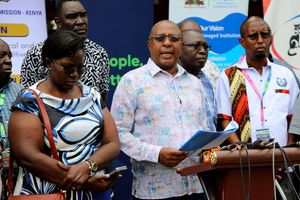
Knec Chief Executive David Njengere (left) with Basic Education PS Julius Bitok (seated), accompanied by senior education officials, during the launch of the Educational Assessment Resource Centre in Nairobi, on July 4, 2025.
Placement in senior school will also be guided by career pathways chosen by the learners. The pathways are social sciences; arts and sports; and science, technology, engineering and mathematics (STEM).
Basic Education Principal Secretary, Julius Bitok, said the slots would be shared out to reflect equity and fairness. The PS added that the government would use Artificial Intelligence (AI) to place the learners in senior school.
“This will ensure distribution of learners to these schools is fair,” Prof Bitok said.
The PS added that the digital allocation would promote inclusivity by allowing a learner from any part of the country to be admitted to a top school.
“Cluster Two comprises extra-county schools, Cluster Three has county schools, while day or sub-county institutions fall in Cluster Four,” Prof Bitok said.
The PS added that the digital model would help ensure that “a learner from Mandera County can secure a place in Kisumu, or one from Mombasa can join a school in Nairobi, in the spirit of national cohesion”.
“The system allocates slots digitally, based on a student’s KJSEA results. It is being piloted and we are testing it to ensure equity and fairness,” he said.
The Kenya National Examinations Council (Knec) will use a combination of assessments to determine a learner’s performance, which will then be used for placement in senior school.
This will comprise 20 per cent from KPSEA (Grade Six), 20 per cent from Grades Seven and Eight school-based assessments and 60 per cent from the summative KJSEA.
KPSEA is administered at Grade Six before transition to junior school. However, the results are not used to place candidates in junior school but to monitor learning progress.
Prof Bitok said the government expects 60 per cent of public secondary schools to offer STEM. This is supported by the building of laboratories.
“We will ensure every student accesses quality education as we work to integrate private schools, many of which have invested heavily in infrastructure,” the PS said.
He added that overall capacity is not a concern, with 2.4 million available Grade 10 spaces compared to 1.13 million Grade Nine candidates, effectively doubling the available slots for transition.
The 9,350 public secondary schools will offer at least two pathways.
“We are constructing and launching laboratories and will ensure students get quality education. The transition will be smooth. There are very good private schools in Kenya,” Prof Bitok said.
The PS said the ministry is working to mainstream private schools into the selection, acknowledging their heavy investment and opening up more opportunities for learners to select them based on capacity and choice.
“Learners interested in joining private schools should be given a chance and select the institutions. There are 2.4 million places in Grade 10 and 1.13 million children graduating from junior school,” Prof Bitok said.
Parents and students have always preferred national schools due to the availability of resources, infrastructure and teachers.
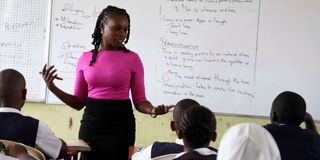
Grade 9 learners at Fairfield Primary School in Mombasa during a lesson.
Photo credit: File | Nation Media Group
Meanwhile, Prof Bitok said the ministry would open a week-long window for learners to revise their choices as happens with the Kenya Universities and Colleges Central Placement Service before they transit to senior school in January.
“When the assessment results are out, we will give a chance to Grade Nine learners to revise their choices. The children have selected schools, but some institutions have not been chosen. With AI, the ministry should be able to do permutations and ensure every learner is placed in senior school,” Prof Bitok said.
The PS added that the government would give an opportunity to every learner who excels in junior school to proceed with education.