The Ministry of Education (MoE) is determined to ease the financial anxiety that has gripped parents ahead of the inaugural 2026 senior school transition, with a commitment to unveil a revised and affordable fees structure based on the chosen learning pathway.
Kenya has adopted three pathways in senior schools: Social Sciences, Arts and Sports and Science, Technology, Engineering and Mathematics (STEM)
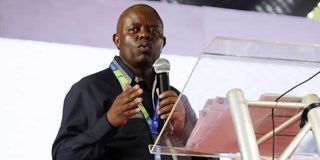
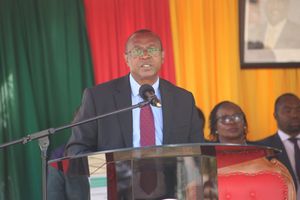
The Director of Secondary Education William Sugut, said a new school fees structure is being developed by a team comprising school principals and MoE officials.
Dr Sugut said the State is determined to ensure the new fee structure for Senior School (Grade 10, 11, and 12) is affordable.
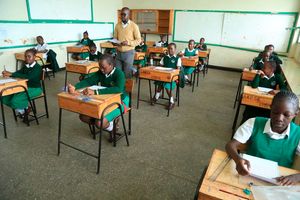
Students in class in this picture taken on August 28, 2024. Poor performance in mathematics is one of the reasons for making it optional at senior school level.
Photo credit: File | Nation Media Group
"There is a team that is working on the fee structure with the principals. ..we will be communicating on the new figures. But definitely, it is something that will be affordable for the purpose of ensuring that children can access education. It is going to touch on the pathway and the schools,” said Dr Sugut.
The final figures which will vary by school cluster and match the cost of implementing senior school pathways, will be unveiled once the working team completes its review.
Dr Sugut was responding to questions from parents about the financial implications of the transition.
Some 1 million Grade 9 learners will transit to senior school in January. There are around 9,000 public secondary schools across the country which have been clustered into four categories dubbed C1, C2, C3 and C4 replacing the old National, extra county, county and sub-county schools.
C1 schools offer all three pathways (STEM, Social Sciences, Arts & Sports), while C2-C4 schools offer limited options based on their facilities and capacity.
"My fear is, will it be more expensive to join Grade 10, or will it lead to more dropouts? Or will I make my child repeat Grade 9?" asked Kamau Samuel, a parent from Embakasi North.
The categorisation of schools was another concern. Edwin Ndege, the chairman of the Kisumu Parents Association, questioned the fees in the absence of the traditional national, extra-county and sub-county labels.
"Now that schools have not been categorised as national, extra-county, county and sub-county, has the fee structure been reorganised? Or is it going to remain the same? This is because, currently, the fee structure is different as per each level of school," said Mr Ndege.
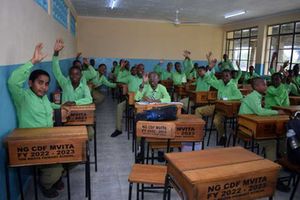
Kakamega Primary School and Junior Secondary School Grade 9 learners during a lesson on January 6, 2025. Learners are expected to pick their senior schools before undertaking the Kenya Junior School Education Assessment in November.
Photo credit: Isaac Wale, Nation Media Group
Mr Ndege also raised the issue of "hidden costs" in primary schools, where some teachers reportedly ask learners to bring items like eggs and chickens for practical lessons.
However, Dr Sugut warned heads of institutions against demanding such materials from learners.
He explained that government capitation for the Competency-Based Education (CBE) materials should be used by teachers to acquire practical resources for demonstrations in class.
"Ideally, that is wrong. Unless the parent wants to appreciate the teacher for doing so well," said Dr Sugut.
However, some parents countered, informing Dr Sugut that their children face victimisation if they fail to supply the materials. They also highlighted compulsory payments for assessment books.
“When we rolled out Junior School (JS), we subsequently issued guidelines in terms of capitation on the vote heads that the government funds. There is a vote head in terms of CBE materials to help the teachers acquire some of these materials to be able to do demonstrations in class,” said Dr Sugut.
However, some of the parents told Dr Sugut that if they fail to give their children eggs for practical reasons, their learners will be victimised. They said they also pay for assessment books.
The Kenya Primary Schools Headteachers Association (Kepsha) National Treasurer Kennedy Kyeva, pointed out the disparity between the funding for primary school and junior school.
"For JS, the capitation is fair; the Presidential Working Party on Education Reforms passed the capitation at Sh15,000. But for primary school, there is a big gap because the capitation remains Sh1,400 annually," said Mr Kyeva.
He confirmed that while teachers in lower grades (6 and below) sometimes request items like eggs for demonstration, such demands do not occur in JS (Grades 7 to 9).
Meanwhile, the MoE is navigating a placement puzzle. Out of the 9,603 public secondary schools, about 1,000 schools were not selected by any of the Grade 9 learners.
"There are a few schools with fewer than 1,000 that were not selected by learners. We will try as much as possible to place children in one of the 12 schools chosen by every learner. But if there is a difficulty, we shall navigate through that," said Dr Sugut.
"We will try as much as possible to place children in one of the 12 schools chosen by every learner. But if there is a difficulty, we shall navigate through that," he said.