A total of 1.13 million Grade 10 learners have embarked on a three-year Senior School journey under Kenya’s Competency-Based Curriculum (CBC), as preparations get underway for a pilot of summative assessments next year following the completion of this year’s School-Based Assessment (SBA).
According to the Kenya Institute of Curriculum Development (KICD), the Senior School phase lasts three years for learners aged 16 to 18 and lays a firm foundation for further education, training and transition into the world of work. Under the CBC vision, learners exiting Senior School are expected to be engaged, empowered and ethical citizens equipped to contribute meaningfully to socio-economic development.
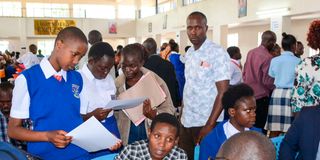
Parents and children on arrival at Shimo la Tewa High School, Mombasa, for Grade 10 admission.
Photo credit: Kevin Odit | Nation Media Group
Speaking to the Daily Nation , Kenya National Examinations Council (Knec) Chief Executive Officer David Njengere said learners will first spend at least one year covering core content before participating in the pilot.
Assessment at Senior School differs from primary and junior levels, which mainly focused on identifying learners’ strengths. At this stage, strengths are combined with learners’ interests to guide placement into specific pathways. Knec will administer both formative and summative assessments.
“Once we complete the SBA this year, next year we plan to pilot summative assessments. Learners need at least one year to acquire sufficient content. As with previous levels, piloting will precede full implementation of the Kenya Basic Education Assessment,” said Dr Njengere.
He added that learners will be registered early after settling into their chosen pathways, before the first SBA is administered.
“Competency-based education does not rely on one examination. We assess progression and competence, allowing learners to reflect on their progress, identify gaps and work with teachers to improve,” he said.
Assessment will use achievement levels described as Below, Approaching, Meeting and Exceeding expectations, alongside numerical scores, continuing the CBC approach of combining descriptive feedback with quantitative evaluation.
“Even at the end of Senior School, the learner’s exit profile will combine performance achievement levels, community service learning and values. Education is not just about academic performance but also about who you are and whether you uphold the values we aim to achieve as a country,” said Dr Njengere.
Senior School assessments will also integrate core competencies such as communication, cooperation, critical thinking, problem-solving, creativity and imagination. Learners will engage in practical, community-based projects, including market observations and problem-solving exercises.
A group of parents outside Starehe Boys Centre and School on January 2, 2025 where they had gone to seek clarity on the admission of their children for Grade 10.
Photo credit: Bonface Bogita | Nation Media Group
“All these skills and experiences will be embedded in the assessments to ensure learners acquire the competences necessary to succeed in the 21st century,” he said.
Reports generated from the assessments will combine qualitative and quantitative data, using an eight-point scale for each learning area to provide a detailed picture of a learner’s performance, growth and potential over time.
The assessment system is also designed to support learner mobility and transitions, including opportunities for further studies both locally and internationally, by offering detailed learner profiles rather than a single terminal score.
The Ministry of Education is yet to release the curriculum designs for Grade 12. Pilots for Senior School summative assessments will begin next year after learners have had at least one year to cover core content.
“This system moves beyond traditional grading. It explains where a learner is performing well, where they are struggling and what they need to do to improve,” said Dr Njengere.
Knec CEO David Njeng'ere at a past event.
Photo credit: Bonface Bogita | Nation Media Group
The CBC marks a departure from the former 8-4-4 education system, which was largely exam-oriented and rigid, with limited flexibility to nurture individual talents or align learning with learners’ career interests.
Under the previous system, emphasis was placed heavily on academic performance, often at the expense of practical skills, critical thinking and real-life competencies that are increasingly demanded in the modern workplace.
Quantitative evaluation areas
KICD Chief Executive Officer Prof Charles Ong’ondo said Senior School is the fourth and final level of basic education under CBC, offering learners a pre-university or pre-career experience organised around pathways rather than a one-size-fits-all curriculum.
Kenya Institute of Curriculum Development CEO Charles Ong’ondo.
Photo credit: File | Nation
Learners will take seven subjects, comprising four compulsory learning areas and three electives selected based on aptitude, interest and career goals, with guidance from career teachers.
The compulsory subjects are English, Kiswahili or Kenyan Sign Language, Mathematics and Community Service Learning. Learners pursuing STEM careers will take Core Mathematics, while others will study Essential Mathematics.
A parent accompanies his son on arrival at Shimo la Tewa High School, Mombasa, for Grade 10 admission.
Photo credit: Kevin Odit | Nation Media Group
Beyond the compulsory subjects, learners will choose three electives from a wide range of options under arts and sports, social sciences, sciences, and technical and vocational fields, including agriculture, business studies, computer studies, engineering-related courses and creative arts.
All learners will also participate in Physical Education, ICT skills development and Pastoral Programme Instruction to support physical fitness, digital literacy and character formation.
Kenya Publishers Association chairman Kiarie Kamau said CBC represents a fundamental shift from teacher-centred learning to a learner-centred approach that encourages inquiry, research and practical engagement.
According to Mr Kamau, textbooks under CBC are designed to stimulate critical thinking through activities, discussion and problem-solving rather than rote note-taking, while retaining internationally accepted foundational principles.
“The approach to teaching and book design has changed. Learning is now active and participatory, unlike the passive classroom model under the 8-4-4 system,” he said.