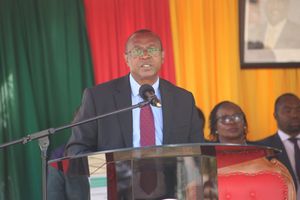
Head of the Directorate of Secondary Education in the Ministry of Education Dr William Sugut during a past event.
The science, technology, engineering and mathematics (STEM) pathway is the most popular among Grade 9 learners, the Ministry of Education has said.
Although 569,000 learners have selected the pathway, the figure — 50.5 per cent — is still below the targeted enrolment 65 per cent.
Social sciences has 437,000 learners, while arts and sports follow with 121,000.
According to the Competency-Based Curriculum Framework, the social sciences pathway is projected to admit 20 per cent of the learners, but 38.8 per cent applied. And instead of 15 per cent of the learners enroling for the arts and sports pathway, only 10.7 per cent applied.
The latest statistics from the Ministry of Education indicate that 1,127,000 learners are set to join senior school in January 2026 under the Competency-Based Education (CBE) system.
“Some 569,000 learners have selected STEM, 437,000 (social sciences), while arts and sports has 121,000 of learners transiting to senior school in January 2026,” said Head of the Directorate of Secondary Education Dr William Sugut.
He tried to allay fears over the transition to Grade 10, saying it will be smooth. He said the government is well prepared.
2.3 million capacity
“We are more prepared than we were when we were transiting from 7-4-2-3 to 8-4-4 and the reason is because we have put a lot of emphasis on what is required to transition successfully,” said Dr Sugut.
The director said senior schools have enough capacity since they have been accommodating students from Form 1 to Form 4, while under CBE, the schools will handle three classes only. Dr Sugut said the current capacity of secondary schools stands at 2.3 million.
“Simple mathematics definitely shows us there is more infrastructure. We have a lot of capacity. There is even a possibility that some schools may not receive learners, or get very few. We will place learners in terms of pathways that is STEM, social sciences and arts and sports,” Dr Sugut said during an interview with a local TV station.
There are about 9,000 public secondary schools which have been regrouped into four categories dubbed; C1, C2, C3 and C4. They replaced the old national, extra-county, county and sub-county nomenclature, which was based on enrolment and facilities.
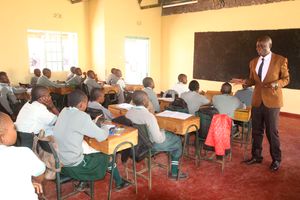
Kakamega Primary School and Junior Secondary School Grade 9 learners during a lesson on January 6, 2025.
C1 schools offer all three pathways, while C2-C4 schools will offer limited options based on their facilities and capacity.
Dr Sugut said the ministry asked schools to pick the subjects that they are comfortable to offer, which were approved by field officers operating within those institutions. The schools were approved to offer pathways based on infrastructure, staffing and facilities available.
The director said that placement will be done concurrently across all pathways to ensure learners join schools aligned with their interests and available infrastructure.
“We were deliberate when it came to selection; we ensured there was parental involvement. We deliberately began by asking schools to declare what they have. Quality assurance officers then assessed before approval,” said Dr Sugut.
Dr Sugut said parental involvement was mandatory during selection to ensure they understand and support their children in the exercise.
“At this point, it’s no longer about which school a child joins, but about what the child can do. The focus is on pathway first, then subject combination, and finally the school,” he said, and assured that the ministry is ready to receive learners in January.
The chairperson of the National Parents Association (NPA) Silas Obuhatsa backed the ministry’s approach, saying nationwide education dialogues helped prepare parents for the transition.
“Parents are well informed. We’ve sensitised over 24 counties, including Mandera, Garissa, Vihiga, Kakamega, Kisii, Samburu, Kitui, Makueni, and Mombasa,” he said, though noting that a few regions like Turkana still need more awareness campaigns.
However, the Kenya Union of Post-Primary Education Teachers (KUPPET) issued a stern warning that the upcoming transition of Grade 9 learners to senior school is likely to be shaky and chaotic.
Kuppet secretary-general Akello Misori detailed the historical missteps and current structural flaws.
Kenya Union of Post Primary Education Teachers (Kuppet) Secretary-General Akello Misori.
He warned that the transition might be shaky and chaotic due to the historical challenges during the transition to JS.
"This is because the schools where the learners are expected to sit for the Grade 9 assessment in two weeks, thereafter the Ministry of Education will use the same to make a selection on who joins which pathway. So that is where the problem is," he added.
Meanwhile, Dr Sugut said Grade 9 learners will only be allowed to change their academic pathways during the first term of senior school. This decision is a setback for learners who may wish to reconsider their career choices later in their academic journey.
“Junior school is an exploration stage. Children are expected to explore the curriculum, understand what they are good at, and identify challenges. This process is meant to guide their choice of pathway,” said Dr Sugut.
He noted that learners receive guidance from both teachers and parents before settling on a pathway based on their interests. He cited a recent case where a learner wanted to pursue social sciences, but the parent and teacher preferred STEM.
“When learners report in Grade 10, they will already have chosen a pathway. If they’re strong in all areas, they are encouraged to show interest in one,” he said.
He went on: “But it is possible when they are in Grade 10 and there are subjects that they feel they want to change, they may drop one and add another one.”
Grade 9 learners at Fairfield Primary School in Mombasa during a lesson.
However, the MoE official explained that changing from one pathway to another would be difficult for planning purposes. Change can only be within the pathways.
“But changing from STEM to social sciences or to arts and sports will not be difficult because it will delay the process, and therefore that is what will be very critical,” he said. He added that the learners will be allowed to change pathways only in the first term of Grade 10.
While subject adjustments within a chosen pathway will be allowed during the first term, switching from one pathway (for instance, STEM to Social Sciences or Arts) will not be permitted after that window.
“For planning purposes, we need accurate data to allocate resources to schools effectively,” Dr Sugut explained, adding that flexibility within subject combinations but not across pathways is essential for the smooth implementation of the Competency-Based Education.