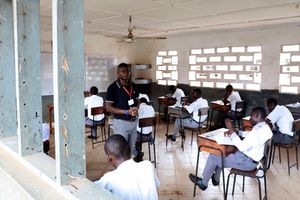
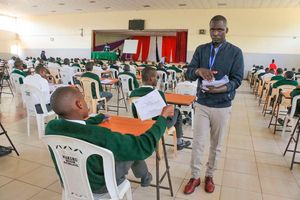
The Kenya Junior School Education Assessment (KJSEA), which Grade Nine students will take at the end of junior school, consists of projects, multiple-choice questions, short-structured questions and essays.
Students will be evaluated in nine areas, which will be divided into papers or sections, depending on complexity.
Candidates have completed some parts of the assessment that require projects. The creative arts and sports project was administered in the second term, from May to July.
In July, candidates worked on pre-technical studies and agriculture projects.
In the sample assessment materials uploaded to schools’ portals by the Kenya National Examinations Council (Knec), the time allotted for every test and the maximum score possible are indicated.
The Kenya Primary School Education Assessment (KPSEA) will contribute 60 per cent to the final grade in every learning area, while the remaining 40 will come from previous assessments.
This includes 20 per cent from KPSEA, which the candidates took at the end of Grade Six and 20 per cent from school-based assessments in Grades Seven and Eight.
The final grade will be used for placement in senior school in January and will take into consideration candidates’ career pathway choices.
“The aim of availing the samples is to facilitate junior schools with access to the papers for their use in familiarising KJSEA candidates with the format of the question papers and the instructions for every subject,” Knec Chief Executive Officer David Njeng’ere said in the circular.
For multiple choice questions, candidates will be expected to shade the correct answers on the sheet. They will use an optical mark reader.
Candidates will write answers for the integrated science paper in an hour and a half. The paper has three questions, which are further broken down into smaller bits. Each of the three questions is worth 10 marks.
The agriculture project was administered in July and assessed in parts, where every task was scored, and records were maintained for learners.
The project comprised activities from all components of the agriculture curriculum designs – agriculture and home science. Learners were to work in groups of four or five on some tasks.
The same applied to the pre-technical studies project. The three tasks candidates were given had cumulatively 40 marks.
The theory paper will be done in two hours and 10 minutes. It comprises two sections. Section A has multiple choice questions (30 marks) while Section B comprises short, structured questions (50 marks).
The creative arts and sports theory paper will be one hour and 40 minutes. Section A of the paper will be multiple choice (40 marks), while Section B will account for 65 marks. It is divided into three parts: Part I: performing arts, Part II: sports and Part III: visual arts.
Teachers were provided with scoring guides and assessed the project in phases, where every milestone was scored and records were maintained.
“This is an integrated project assessment comprising activities from component disciplines in the creative arts and sports subject (visual arts, performing arts and sports),” read the instructions.
KJSEA candidates will write the mathematics paper in two hours. It will comprise 40 questions arranged in five parts. Section A will contribute 20 marks from multiple choice questions, while Section B (80 marks) will be short structured questions.
English will be tested in two papers. The first will comprise composition (15 marks), literary analysis (35 marks), oral literature (10 marks), poetry (five marks), play (10 marks) and the novella (10 marks).
The second paper will test candidates on reading comprehension, oral skills and grammar in one hour and 50 minutes.
A similar arrangement goes for Kiswahili and Kenya Sign Language (for hearing-impaired learners). Kiswahili insha (15 marks), comprehension (10 marks), novella (10 marks), tamthilia (play) – 10 marks and ushairi (poetry) five marks.
Religious education, which can either be Christian, Islamic or Hindu, will be assessed in one hour and 30 minutes. The paper consists of two sections.
Section A will be multiple choice questions, while Section B comprises short structured and essay questions and will be marked out of 80.
Candidates will undertake the social studies paper in one hour and 30 minutes. The paper consists of two sections.
Section A comprises multiple choice questions while Section B has structured and essay questions, all to be marked out of 80, the notice added.
The agriculture and nutrition theory paper will take candidates one hour and 40 minutes and is a mix of multiple and short structured questions.
Agriculture will account for 24 marks, while nutrition will contribute 16 marks.
Creative arts and sports, agriculture and nutrition, Pre-technical studies English: - language, composition and literary analysis, mathematics, Kiswahili: - lugha, Insha na utangulizi wa fasihi, Kenyan Sign Language (for the hearing impaired), Integrated Science, Social Studies and Religious Education.