University lecturers and non-teaching staff have called off their 49-day industrial action after striking a deal with the government, paving the way for the resumption of learning in public universities across the country.
Their unions—the Universities Academic Staff Union (Uasu), the Kenya Universities Staff Union (Kusu), and Kenya Union Of Domestic Hotels Educational Institutions Hospitals and Allied Workers (Kudheiha)—on Wednesday ended the job boycott after accepting the government offer of Sh7.9 billion.
The unions signed a return-to-work formula with their employer, the Inter-Public Universities Councils' Consultative Forum (IPUCCF), outlining the payment of the owed funds under the 2017-2021 Collective Bargaining Agreement (CBA) after lengthy talks that saw the intervention of Parliament.
The signed agreement commits both parties to conclude negotiations within 30 days for the 2025-2029 CBA that the university workers had demanded.
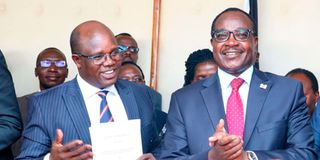
Education CS Julius Ogamba (centre) with union officials from Uasu, Kusu and Kudheiha on September 5, 2025, when the university workers called off their 49-day strike.
Photo credit: Mercy Simiyu | Nation
It also outlines a two-phased payment plan for the Sh7.9 billion: Sh3.88 billion by December 31, 2025, and the remaining Sh3.88 billion by July 2026.
Consequently, universities are now expected to reorganise their academic calendars to recover lost time and ensure smooth progression for students.
“We are not leaving this industrial action with all that we wanted, which was immediate full implementation payment of Sh7.9 billion. Yet, we consider the firm commitment by the National Treasury and Parliament and balanced against the interests of students, and the survival of the higher education sector in this country. Uasu has made concessions and hereby calls off the strike,” said Secretary-General Constantine Wasonga.
Treasury Cabinet Secretary John Mbadi on Tuesday said the government is cash-strapped and could not pay the owed Ksh.7.9 billion at once, as he urged the striking staff to take the instalment payments.
The agreement also address previous underutilisation of funds. Universities that did not fully use their Sh2.2 billion allocation to pay arrears under the 2017–2021 CBA will be required to top up Sh182 million once the government releases the funds.
As part of the return-to-work formula, all disciplinary actions against lecturers linked to the strike will be withdrawn, and participation in the industrial action will not prejudice contract renewals.
“All disciplinary action commenced during the strike shall be deemed withdrawn. We thank all Uasu members, officials, and students for their patience and solidarity,” Dr Wasonga added.
Education Cabinet Secretary Julius Ogamba said the Sh2.73 billion owed to lecturers under the 2021–2025 CBA was paid after the strike had already been declared.
However, tensions persisted over pending arrears and the timelines for negotiating the new CBA.
Universities Academic Staff Union Secretary-General Constantine Wasonga and Education Cabinet Secretary Julius Ogamba address journalists during a press conference at Jogoo House, Nairobi, on November 5, 2025, where the lecturers' unions signed a return-to-work formula with the government to end the 49-day strike.
Photo credit: Bonface Bogita | Nation
A proposal by the Salaries and Remuneration Commission (SRC) to stagger the arrears into three instalments was rejected by the unions, prompting renewed talks and parliamentary intervention.
“We went back to the table because the three-instalment plan was not acceptable,” said a senior official at the Ministry of Education. “After constructive discussions, we agreed on a two-phase payment that would ease the burden while ensuring the lecturers are paid.”
The breakthrough was reached after meetings at Parliament, where both the Ministry and union officials agreed to compromise in order to restore normalcy.
“It was time to put down the gun so that we can resolve this matter. The strike had disrupted learning and affected students for too long,” said Mr Ogamba.
Kusu Chairman Charles Mukwaya noted that the return-to-work agreement marked a major milestone in resolving the seven-week-long industrial action.
Both parties, he said, recognised the importance of resolving the dispute amicably to restore normal operations in public universities and constituent colleges, safeguard the academic calendar, and protect the welfare of academic staff.
“Now, therefore, through mutual understanding and goodwill, the parties agree to enter into this return-to-work formula to restore normalcy in all public universities and constituent university colleges while addressing the issues raised by Kusu in good faith,” Mr Mukwaya said.
“This agreement is a step in the right direction. Our members’ concerns over salary arrears, contract security, and the pending 2025–2029 CBA have been addressed. We hope this restores confidence and stability in our universities so that learning can continue without disruption.”
Under the agreement, Kusu members are guaranteed protection from victimisation, with no job losses or loss of benefits.
Staff whose contracts were terminated during the strike will be reinstated unconditionally, and contract renewals will not be affected by participation in the industrial action.
The strike, which began on September 17 and affected more than 600,000 students, was triggered by three main issues: non-payment of 2021–2025 phase two CBA arrears totalling Sh2.73 billion; incomplete implementation of the 2017–2021 CBA despite a court ruling; and delays in negotiating the 2025–2029 CBA.