The Ministry of Education has cautioned heads of institutions against entering junior schools into financial contracts—including hire purchase arrangements or bank loans—without the express written approval of the Cabinet Secretary.
In a circular outlining guidelines for the use of Free Day Junior School Education (FDJSE) funds sent to county directors of education, the ministry directed that heads of institutions are the accounting officers responsible for the application and utilisation of funds.
It further stated that junior schools are not allowed to charge any additional fees or levies, including for lunch programmes.
“Junior schools shall not enter into financial contracts, for example hire purchase arrangements or bank loans, without the express written approval of the Cabinet Secretary, in line with Section 18 of the Fourth Schedule of the Basic Education Act, 2013,” said Basic Education Principal Secretary Prof Julius Bitok.
“Every head of institution shall be responsible for the application and utilisation of funds as the accounting officer of the school. Junior schools are not allowed to charge any other fees or levies and are not allowed to charge for lunch programmes,” he added.
The ministry further directed that all communication to the ministry must indicate the school’s Unique Institution Code (UIC), also known as the National Education Management Information System (Nemis) code.
County Directors of Education have been instructed to circulate the circular to all heads of public junior schools within their jurisdictions.
Citam Schools Woodley Deputy Principal Bridgid Mukabi (right) joins her students in celebrating their top student Chris Nyabwari at the school following the release of KJSEA results.
Photo credit: Evans Habil | Nation Media Group
In the circular, the ministry said all public junior schools have been allocated Sh92,490.33, translating to Sh4,193.07 per learner.
The ministry stated that the disbursement was based on learner enrolment data extracted from the Nemis on April 24, 2025.
Under the allocation, each school will receive Sh90,562.23 for operational expenses. This includes Sh22,937.23 for rent, postage, telephone charges, Board of Management meetings and capacity building; Sh3,000 for electricity, water and conservancy services; Sh9,375 for internet connectivity; and Sh55,250 for personal emoluments.
An additional Sh1,928.10 has been earmarked for tuition expenses, bringing the total per-school allocation to Sh92,490.33.
The ministry further broke down the per-learner funding, allocating Sh2,297.71 for operations.
This includes Sh1,600 for repairs and maintenance of facilities; Sh130 for administration; Sh100 for co-curricular activities disbursed to schools, plus Sh250 centrally procured; Sh140 for local transport; and Sh77.71 for medical and insurance cover.
Tuition support stands at Sh1,895.36 per learner, covering Sh50 for teacher capacity building, Sh795.67 for textbooks and supplementary readers procured by KICD; Sh119.25 for laboratory materials; Sh300 for CBC practicals; Sh130.05 for assessment; and Sh500.39 for stationery and writing materials.
The ministry warned that schools that failed to submit data or submitted incorrect information were excluded from the current disbursement.
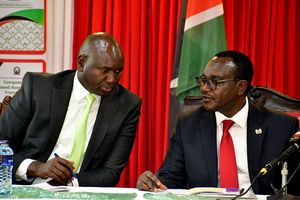
Principal Secretary for Basic Education Prof Julius Bitok.
Photo credit: Dennis Onsongo | Nation Media Group
Funds will be released once the correct details are verified and Sub-County Directors of Education have been directed to submit lists of affected schools within two weeks.
“Schools that did not submit data or submitted it in the wrong format during the verification exercise were left out of the disbursement. Such schools will receive their funds once the correct details are provided and confirmed,” said Prof Bitok.
“The head teacher of the concerned school shall submit the correct data and write to the office of the Principal Secretary detailing the correct account details and enrolment. In addition, the respective Sub-County Directors of Education will submit a list of the affected schools to the office of the Principal Secretary within two weeks of the disbursement,” he added.
Prof Bitok further directed schools to maintain separate accounts for tuition, operations and infrastructure, each with its own cashbook. Tuition funds must be used strictly for teaching and learning materials, while operations funds should cover repairs, utilities and staff costs.