Ogamba orders audit of past school unrest findings
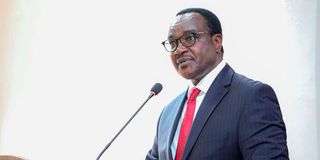
Education Cabinet Secretary Julius Ogamba.

Education Cabinet Secretary Julius Ogamba has directed the taskforce investigating school unrest to conduct a comprehensive audit of recommendations from previous inquiries and establish why they have not been fully implemented.
The Multi-Stakeholder Task Team on Unrest in Schools has been tasked with identifying outstanding recommendations, implementation gaps, barriers to execution and the institutions responsible for enforcing them.
Speaking during the inauguration of the team in Nairobi, the CS said the persistence of school unrest despite several investigations pointed to a failure to enforce existing measures and hold those responsible accountable.


“Our challenge extends beyond identifying causes. It is fundamentally an implementation, enforcement and accountability challenge,” he said.
Kenya has undertaken several inquiries into school unrest, including the Sagini, Macharia, Wangai and Koech inquiries, which generated recommendations on preventing the recurrence of school fires and other forms of unrest.
The directive comes amid a resurgence of unrest in learning institutions, with more than 687 incidents reported nationally during the second term of 2026.
Mr Ogamba said the incidents, including the 2024 Hillside Endarasha Academy tragedy and the May 2026 fire at Utumishi Girls Academy, underscored the urgency of addressing safety concerns in schools.
In August, the Ministry of Education tabled a report in Parliament showing that 462 learners had been arrested, investigated or subjected to disciplinary action over school unrest in the four months to July 31, 2026.
Former University of Nairobi Vice-Chancellor Peter Mulwa Mbithi will lead the team as it investigates the immediate and underlying causes of the 2026 unrest.
The team, comprising education officials, union representatives, academics, legal experts, security personnel and other professionals, has been given 90 days to complete its work.
“We will draw on data, prepare reports and experience from Kenya and abroad. Our findings must be verifiable, presented with integrity, fairness and impartiality,” Prof Mbithi said in his inaugural speech.
The August report by the State Department for Basic Education to the National Assembly Education Committee documented a spike in school unrest during the second quarter of the year.
It showed that between April 27 and June 6, schools recorded 71 fires, 24 planned arson attacks, 95 incidents of unrest, 14 precautionary closures and 18 deaths.
Between June 7 and June 14, another 24 fire incidents, 10 planned arson attacks and 29 cases of student unrest were reported, prompting 63 precautionary school closures.
After the mid-term break, between June 29 and July 31, the situation eased considerably, with 27 fire incidents and only two planned arson attacks reported.
The taskforce has also been directed to review school safety standards, emergency preparedness, fire prevention and response systems, infrastructure, security arrangements and disaster risk management.
Particular attention will be paid to boarding schools, including dormitory conditions, emergency exits, fire safety equipment, supervision and evacuation procedures.
The team is also expected to examine the relationship between school infrastructure, household contributions, Government capitation, school fees and the overall cost of education. It will also review school uniform policies and their affordability.
On learner welfare, the CS wants a review of existing approaches to discipline, guidance and counselling, mentorship, psychosocial support and grievance-redress mechanisms.
The team will also investigate factors that contribute to unrest, including bullying, peer pressure, substance abuse, gender-based violence and learner distress.
Emerging threats such as the influence of social media, smartphones, misinformation, online mobilisation, criminal gangs and religious extremism will also form part of the inquiry.
Mr Ogamba said the taskforce should establish clear accountability among school heads, Boards of Management, teachers, parents, sponsors, learners and education officers, while identifying gaps in policies, regulations and legislation that impede effective prevention and management of unrest.
“Let your recommendations be practical, costed and prioritised, with each intervention assigned a responsible institution, implementation timeline, resource requirements and measurable indicators,” he said.
The team is expected to conduct consultations across all 47 counties, drawing views from learners, parents, teachers, school leaders and affected communities.
Follow our WhatsApp channel for breaking news updates and more stories like this.