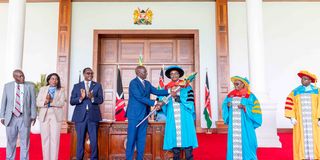
President William Ruto has awarded university charters to the Kenya Advanced Institute of Science and Technology (KAIST) and the Kenya Medical Research Institute (KEMRI), elevating the two institutions into specialised degree-awarding centres.
The granting of the charters formally transitions the two institutions into postgraduate degree-awarding universities under Section 24(1)(a) of the Universities Act.
The move marks a major milestone in the country’s higher education and research sector, with the government saying the elevation of the institutions will strengthen Kenya’s scientific, technological and medical research capacity.
Speaking during the ceremony at State House, Nairobi, on Wednesday, President Ruto said the two institutions would serve as strategic pillars in Kenya’s transformation agenda.
“One institution will help protect the health and survival of our people. The other will help drive the technological and industrial transformation of our economy. One will help Kenya fight disease. The other will help Kenya compete in the industries of the future,” said President Ruto.
The elevation of KAIST and KEMRI brings the number of chartered universities in Kenya to 68, comprising 36 public and 32 private universities.
President William Ruto hands over mess instrument to KEMRI Council Chair KAIST Dr. Abdulahi Ali after he presided over the awarding of charters to the Kenya Advanced Institute of Science and Technology (KAIST) and the Kenya Medical Research Institute (KEMRI) at State House, Nairobi.
Photo credit: PCS
The award of the charters also signals a new phase for the two institutions as centres of advanced research and innovation.
KAIST will operate as a specialised postgraduate university focused on training highly skilled scientists, engineers and researchers in areas including mechanical engineering, electrical and electronics engineering, ICT, chemical engineering, civil engineering and agricultural biotechnology, among other disciplines.
The institution is situated at Konza Technopolis and is modelled after the Korea Advanced Institute of Science and Technology.
KEMRI, on the other hand, will focus on training scientists and researchers in biochemical sciences, biodefence, biosurveillance, epidemic intelligence and national health security.
The President said strengthening KEMRI’s academic role would enhance Kenya’s ability to anticipate and prevent future disease outbreaks.
“Investing in medical research, disease surveillance, vaccine development and strong health systems is more than a public health imperative. It is a national development strategy. And this is where institutions like KEMRI become essential.
“The COVID-19 pandemic taught the world a painful but important lesson: health security is national security. Countries with strong scientific institutions responded faster, adapted faster and recovered faster,” said the President.
President Ruto also reaffirmed the government’s commitment to allocate at least two per cent of the country’s Gross Domestic Product to research and development, saying the investment would unlock billions of shillings annually for innovation and scientific advancement.
He said the administration had established a State Department for Science, Research and Innovation to coordinate institutions and strengthen science, technology, engineering and mathematics (STEM) education across the country.
“If we are to become producers of our own technologies, generators of our own knowledge and a nation that adds value to what we produce, then we must deliberately, intentionally and strategically strengthen our capacity for research, science and innovation,” he said.
The two institutions earned the distinction following an assessment and accreditation process conducted by the Commission for University Education, the national regulator of university education in the country.
“We must build a strong research ecosystem with synergies, creating centres of excellence in various clusters. We must build capacity and capabilities across the board to produce a high calibre of human resources to help us on the trajectory to a first-world economy,” he said.