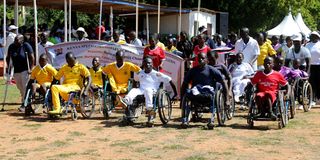
Kenya is grappling with a severe shortage of Special Needs Education (SNE) teachers, the Teachers Service Commission (TSC) has revealed.
As of February 2026, the commission had employed a total of 439,009 teachers, but only 9,340 of these are persons living with disabilities and teaching in SNE schools. This represents just 2.1 per cent of the total teaching workforce.
TSC acting Chief Executive Officer Evaleen Mitei said the commission continues to face limited supply of teachers trained in highly specialized SNE areas, including deaf-blindness and multiple disabilities.
Teachers Service Commission CEO Evaleen Mitei speaks to the media at the Ministry of Health offices in Nairobi on March 10, 2026.
Photo credit: Bonface Bogita | Nation Media Group
“We are grappling with a limited supply of SNE teachers, especially in science-based learning areas as well as vocational skill areas under the stage-based curriculum,” Ms Mitei revealed.
She noted that budget constraints have hampered recruitment and promotion of teachers, further worsening the shortage.
Despite the challenges, Ms Mitei emphasised that the commission remains committed to providing equal opportunities to all qualified and registered teachers during recruitment. She added that affirmative action measures are applied to ensure persons with disabilities who meet the requirements are considered.
However, education stakeholders have warned that the shortage of specialised teachers could undermine the delivery of quality education to learners with special needs, particularly under the competency-based curriculum.
“In adherence to Article 54(2) of the Constitution, the Commission has progressively considered persons with disabilities during recruitment to support realization of the constitutional requirement that at least five percent of employees in public service be persons with disabilities,” said Ms Mitei.
Ms Mitei said TSC continues to provide equal opportunities to all qualified registered teachers during recruitment while applying affirmative action measures for persons with disabilities who meet the prescribed requirements.
Speaking during the Kenya Disability Parliamentary Association (KEDIPA) forum in Mombasa, Ms Mitei highlighted the recruitment trend over the last four Financial Years. In 2022/2023 TSC recruited 26,346 teachers and 268 SNE. In 2023/2024 some 3, 755 were hired and 29 others in SNE.
However, in 2024/2025, when the government recruited the highest number teachers 76, 689 and 12 45 in SNE in 2025/2026 TSC hired 33, 147 teachers and 821 SNE.
Ms Mitei said that during the four-year period, the commission recruited 2,723 teachers with disabilities across all levels.
In line with the ‘Policy on Teacher Recruitment and Selection (2022)’, Section 9.3, Ms Mitei said TSC ensures that at least five per cent of advertised vacancies per Sub-County are reserved for teachers with disabilities.
However, the applicants must be qualified teachers duly registered by the National Council for Persons with Disabilities,” said Ms Mitei.
Vacancies for persons with disabilities
“This is operationalised through reserving at least five per cent vacancies for PWD applicants at Sub-County level; Separate scoring consideration among PWD applicants as they compete among themselves; Mandatory reporting of reserved and filled PWD vacancies and ensuring accessibility of recruitment venues,” she added.
Ms Mitei said the commission reserves at least five percent of advertised vacancies for persons with disabilities in accordance with the recruitment policy, actual recruitment outcomes are influenced by the specific staffing needs declared by schools and the qualifications required for each advertised vacancy.
“Recruitment is demand-driven and based on identified subject and level requirements in schools. For example, where a vacancy is declared for a specialized subject such as Physics, recruitment depends on the number of qualified teachers (applicants) with disabilities available in that specific teaching subject and who meet all prescribed requirements relevant to the job advertised,” she said.
KEDIPA chairperson Timothy Wanyonyi, who is also the Westlands MP said persons with disabilities in Kenya continue to face systemic barriers that undermine the full realisation of their rights.
“As leaders and institutions responsible for advancing disability inclusion in Kenya, we note with concern key challenges including widespread stigma and discrimination, which continue to limit social inclusion and participation. Low levels of public awareness on disability rights and inclusion,” said the MP.
Mr Wanyonyi said persons with disabilities still have limited access to essential services, including education, healthcare, employment, and infrastructure as most services are not inclusive, inadequate and fragmented data, affecting planning, targeting, and service delivery.
The MP emphasised that despite existing legal frameworks, gaps remain in execution, often leaving persons with disabilities excluded from opportunities in employment, education and public life.
He called for sustained engagement with institutions to ensure commitments translate into measurable outcomes, noting that inclusion must be reflected in everyday processes that determine access.
KADIPA raised concern over recruitment practices that continue to lock out qualified persons with disabilities.