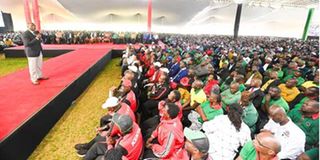
More than 400,000 teachers employed by the Teachers Service Commission (TSC) are set to benefit from an enhanced medical scheme, following a deal struck by President William Ruto with union officials.
Not only did the president accede to the demands of the Kenya National Union of Teachers (Knut) and the Kenya Union of Post-Primary Education Teachers (Kuppet) to review the scheme, but he also directed that it be improved to match that offered to public service officers.
Although the finer details of the deal are scanty, Knut Secretary-General Collins Oyuu said that, once implemented, the new scheme will be much better than the current one being offered by Minet-Kenya.
“During the meeting with teachers, the president announced that their medical scheme will be retained, but the packages would be reviewed,” said Mr Oyuu.
“The president said that he had been convinced by the memorandum presented by Knut and Kuppet to retain the scheme.”
During the meeting held at State House in Nairobi on Saturday, it was concluded that the packages offered to teachers by Minet-Kenya were less favourable than those given to public sector employees.
At the end of last year, the Minet-Kenya scheme was extended by a year. This followed teachers’ opposition to the government’s decision to discontinue the scheme to allow tutors to transition to the Social Health Insurance Fund (Shif).
The grey areas in the law, specifically relating to how the Shif would provide benefits to teachers in public schools and how hospitals would differentiate between commercial and social health benefits, prompted the resistance. Following the president’s assurance, extending the teachers’ cover, which is due to expire this year, should be straightforward.
“The president said that the scheme must be retained at all costs after engaging experts in the field who advised him that the packages offered to teachers are inadequate and do not fully cover principal members and their dependants,” said the Knut secretary-general.
The Minet cover allows teachers to enrol up to eight children, and it includes inpatient and outpatient services, overseas treatment, and dental and optical benefits for teachers in job groups B5 to D5. Teachers in these groups also receive maternity, funeral expenses and group life benefits.
According to Minet’s 2024 data, 1.3 million teachers on the TSC payroll, including at least 230,000 spouses and 677,000 children, are covered.
The current cover enables couples (both of whom are teachers employed by the TSC) to insure up to eight children, compared to the previous arrangement which was limited to a maximum of four children.
Also set for review is the inpatient cover of Sh1 million for teachers in job group B5 and Sh3 million for those in job group D5.
Previously, inpatient cover for job group B5 was limited to Sh750,000, while teachers in job group D5 were allowed a maximum of Sh2.5 million.
The outpatient cover for the teachers in job group B5 will be Sh150,000, an increase from Sh100,000 while teachers in job group D5 will rise to Sh450,000 from Sh375,000.
The enhanced benefits for dental and optical services have been increased uniformly across the job groups.
Under the current scheme, maternity cover for teachers in job groups B5, C1, C2 and C3 is Sh120,000, having risen from Sh100,000.
Teachers in job groups B5, C1, C2, C3, C4, C5 have last expense benefits pegged at Sh300,000 from the Sh200,000 in the old scheme.
During the State House meeting, the president also announced that TSC, the Ministry of Education, teachers’ unions and headteachers’ associations would form a technical team to review the scheme. The panel will be supported by experts.
“As it is in its current status, the teachers’ medical scheme hardly compares to the current market rates,” Knut said in a statement. “It was observed that the medical scheme is very important to the teaching service, and that is the reason why it should be retained.”
Presently, teachers enjoy inpatient post-hospitalisation of up to five weeks, and post-hospitalisation attendant therapy that was not covered for up to three months.
Laser surgery was previously not covered. However, now it is part of the inpatient cover.
Overseas treatment currently has a standalone cover of Sh2 million, up from Sh1 million, Sh200,000 for an air ticket and accommodation for a caregiver.
All sexually transmitted infections (STIs), illnesses resulting from alcohol intoxication including liver sclerosis will be covered in the inpatient package.