The Universities Academic Staff Union (Uasu) has petitioned the International Monetary Fund (IMF) Wage Bill Mission to Kenya over what it terms as persistent violations of collective bargaining rights and long-standing pay injustices in public universities.
In a memorandum signed by Uasu secretary General Constantine Wasonga, the union accuses the Salaries and Remuneration Commission (SRC) of consistently overstepping its constitutional advisory mandate and imposing final decisions on salary negotiations, effectively undermining free and fair collective bargaining as protected under Article 41 of the Constitution.
Uasu argues that the SRC’s advisories, commonly referred to as “beacons,” have become non-negotiable directives, reducing negotiations between the union and public university employers to what it describes as a “public relations exercise.”
The union further highlights persistent delays in salaries and allowances, blaming the situation on delayed and inadequate funding from the National Treasury. According to Uasu, the late payments have severely compromised the welfare and morale of university lecturers, forcing some to seek side jobs and triggering recurrent industrial unrest.
“This fiscal instability directly impedes the core functions of the academic environment, resulting in diminished efficiency in teaching, lower quality research output, and inadequate mentorship, as faculty are forced to divert attention to coping mechanisms like strikes and seeking secondary employment. institutionally, the practice of accumulating significant salary and CBA arrears artificially inflates annual expenditures when finally budgeted for, worsening the universities’ fiscal health and contributing to the wider challenge of unsustainability of the public sector wage bill,” read the petition.
This is after The National Treasury confirmed that the International Monetary Fund (IMF) Fiscal Affairs Department will conduct a Wage Bill Mission in Kenya from November 17 to 25, 2025, barely days after universities’ academic staff petitioned the global lender over stalled salaries and unfulfilled collective bargaining agreements.
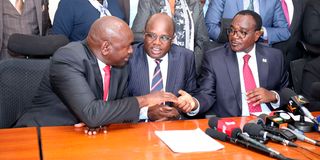
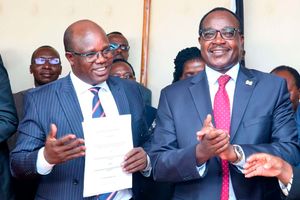
Universities Academic Staff Union Secretary-General Constantine Wasonga (left) and Education Cabinet Secretary Julius Ogamba during a press conference at Jogoo House, Nairobi, on November 5, 2025, where they signed a return-to-work formula to end the 49-day lecturers' strike.
Photo credit: Bonface Bogita | Nation Media Group
In a letter addressed to trade unions, the Treasury said the mission will review the management of the public sector wage bill, analyse expenditure trends, and assess ongoing wage reforms across government ministries, departments and agencies (MDAs).
Uasu has also raised concern over failure to budget for staff promotions, saying many lecturers perform higher duties for years without corresponding pay due to lack of pre-funded promotion provisions, resulting in massive salary arrears and low morale.
The memorandum further flags severe staff shortages in public universities, noting that Kenya requires more than 35,000 academic staff to match growing student enrolment, yet has an estimated 10,000 lecturers, leaving a deficit of over 25,000.
Harmonization of allowances
On pay disparities, the union says academic staff receive an automatic annual salary increment of only 4 per cent, compared to up to 12 per cent for other public servants, a situation it describes as discriminatory and unconstitutional.
“The SRC has also failed to conclusively and convincingly address the dire need for harmonization of allowances across the public sector, and between and within public universities. This is despite SRC’s promise to implement the Allowances Policy Guideline for the Public Service with effect from April 2022,” read the petition.
Uasu also faults the government for unequal allowances across the public sector, despite earlier SRC commitments to harmonise them by 2022. The disparities, it says, continue to fuel agitation and instability in the university sector.
“Consequently, the salary scales for civil service, county governments, Teachers Service Commission and parastatals (universities) have compression ratios of between 4.2 and 22.8. The civil service scale has the highest mean compression ratio of 15.9 followed by county governments, parastatals and Teachers Service Commission. The compression ratios in the public sector depict existence of salary differentials within grades. Specifically, workers in the civil service and county governments have wage premiums, which ranges from 13.3-293.7% in favour of employees in bands B5-E4 relative to those in band B4 while public sector workers in bands C1-D5 in the Teachers Service Commission have an average wage premium of 36.5-186.8 per cent relative to those in band B4,” read the petition.
The union is now urging the IMF to recommend sweeping reforms, including the return of the collective bargaining cycle to two years, structured clearance of salary arrears, harmonisation of salaries and allowances, direct payment of university staff by the National Treasury, and strict limitation of SRC’s role to advisory functions only.
“Addressing these systemic issues will restore industrial harmony, boost morale and productivity, and ultimately stabilise the public university system,” Dr Wasonga said in the memorandum.