When Catherine Kamanthe decided to move her child out of the competency-based education (CBE) to an international curriculum, it was not an impulsive choice.
It came after months spent trying to track her school projects, understand the assessment rubrics and watching her child struggle with what she describes as an overwhelming workload. By the time her child completed Grade Nine, Ms Kamanthe had had enough.
“At times, the curriculum was unclear for the classroom teacher and for the student as well,” she said.
Ms Kamanthe eventually enrolled her child in a school offering the British curriculum, joining a growing number of Kenyan parents stepping away from CBE in favour of international education systems such as the IGCSE.
While the CBE was introduced to nurture skills and talent beyond examination performance, its implementation has left many parents divided, uncertain whether to stay the course or seek alternatives they perceive as clearer and more predictable.
The promise of CBE was ambitious: learner-centred education, continuous assessment, flexible pathways and stronger alignment with real-world skills. But for many parents, the transition has been far from seamless.
“The workload became overwhelming; not just for the learner, but for me as a parent. You’re constantly expected to guide, assist and assess. It becomes confusing, and at times exhausting,” Ms Kamanthe said.
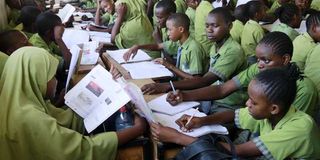
Kariobangi North Comprehensive School pupils during the official launch of CBE Connection on June 20, 2025.
Photo credit: Richard Maosi | Nation Media Group
“As my children were growing, I was looking for a curriculum that exposes them to critical thinking and creative thinking, and one that has flexible pathways,” Ms Kamanthe says. “I didn’t find that in CBE. That’s why we landed in the British curriculum, it’s global and has clear standards.”
For Kelvin Odhiambo, a parent in Nairobi, it is the inconsistency in the implementation of CBE that worries him the most.
“I want a child to be able to connect the dots, to use previous experience as they move forward, but the system keeps changing as we get new leaders or even a new government. In the long term, that’s a big problem,” he says.
For Elizabeth Andiko, her concern lies in uncertainty during transition.
“For a system to mature, it takes time. Even teacher training takes time. Any transition takes a long time for it to become solid. I did not want to experiment with my child’s education,” she says.
Education is a constitutional right of every Kenyan child and a social equaliser.
Photo credit: File | Nation Media Group
“I see a change in my child; the skills, the confidence, the knowledge from daily work. It’s not just about exams,” she says.
“I’m comfortable allowing my child to remain in CBE,” he says.
Caught between these realities, some schools are now offering both the CBE and international curricula, giving families more options. At Good Testimony International School, the principal, Berine Atieno, says the move was driven by parents’ demands.
“We have been very deliberate,” she says. “We hold meetings where parents are informed about both CBC and Cambridge. The parent decides.”
For learners interested in changing the curriculum, the school runs what it calls a “transition startup”, a two-month trial period conducted during school holidays.
“Learners are introduced to the curriculum, the culture, and the learning approach,” Ms Atieno explains. “Parents then meet facilitators to assess how the child is adapting and whether there are gaps that need to be addressed.”
“A learner transitioning from CBC to IGCSE does not mean their pathway is interrupted,” she says. “Cambridge is vast. It allows learners from different systems to fit in. What matters is proper guidance and understanding subject combinations.”
At Kitengela International School, the principal John Wanyonyi says offering choice reflects the reality of diverse ambitions.
“It gives parents a platform to choose what best suits their children's ambitions, careers and goals,” he says.
As families make different decisions, Ms Atieno believes Kenyans are still emotionally tied to the past.
“We keep comparing the current curriculum to 8-4-4. For a curriculum to stabilise, we must give it time,” he says.