Every day, more than ten 62-seater buses leave Moyale for Nairobi as hundreds of Kenyans evacuate their families from the border town amid fighting in neighbouring Ethiopia.
A spot check at several bus companies in Moyale on Friday established that many were fully booked up to five days in advance.
Abuya, one of the luxury bus companies plying the Moyale-Nairobi route, was fully booked until Tuesday next week.
But what appears to be a booming transport business tells a different story for residents, local traders and bus operators.
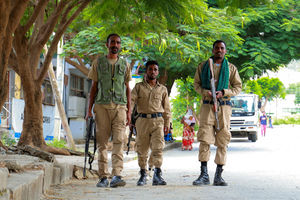
With security threats mounting due to stray bullets and rocket-propelled grenades from the ongoing clashes in Ethiopia, many families are relocating to safer areas.
A stalled bus at Moyale from Ethiopian side at Moyale Kenya one stop border post in a picture taken on November 4,2026,the border has been dormant after Ethiopia clashes.
Photo credit: Sila Kiplagat | Nation
However, we are struggling because very few passengers are travelling from Nairobi to Moyale. A bus may carry only five passengers on the return journey from Nairobi," Moyale Buses chairman Ibrahim Yakub said.
He said operators were also grappling with high fuel costs caused by power outages that have left filling stations grounded in Moyale town.
"We charge Sh2, 500 per trip from Moyale to Nairobi. Since the war started, there has been no electricity in Moyale, forcing us to spend a lot on fuel. We are barely surviving in the business, yet we cannot exploit our customers," Mr Yakub said.
He said the conflict in Ethiopia had also dealt a blow to their earnings, as buses are a popular means of transporting small consignments of goods from the neighbouring country.
"When cross-border business is booming, we have a lot of parcels and luggage to transport. There are also many Ethiopians who travel to Nairobi for business. All this business has been lost in the last two weeks of fighting," he said.
Moyale conflict explained | Guyo Turi
Since fighting broke out between Ethiopian Somali and Oromia regional forces, businesses have been disrupted, while residents' purchasing power has taken a hit.
Prices of basic commodities, including rice, cooking oil and milk, have almost doubled.
According to the 2025 Informal Cross-Border Trade Survey by the Kenya National Bureau of Statistics (KNBS), the Moyale border recorded Sh51.9 million in outbound trade and Sh19.1 million in imports over a 14-day period in June 2025.
The most commonly traded informal goods at the Moyale border include cattle, cooking oil, milk and rice.
Last year, Kenya and Ethiopia signed a Simplified Trade Border Regime (STBR) agreement aimed at boosting formal trade volumes and curbing informal cross-border trade.
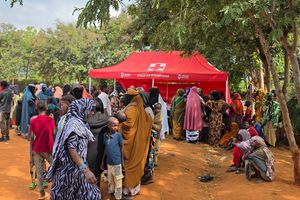
Displaced Population from Ethiopia wait for foodstuffs at OMC Camp on November 4, 2026.
Photo credit: Sila Kiplagat | Nation
The exodus from Moyale has also been driven by the rising cost of living and the growing number of displaced people seeking refuge in Kenyan households.
"We are buying a 25-kilogramme bag of rice for Sh5, 000, up from Sh2, 500 before the conflict broke out. Milk supplies have dwindled, and prices have skyrocketed. A 20-litre jerrican of diesel is retailing at Sh6, 000. Life is becoming unbearable," Mr Rashid Hassan said.
Mohamed Abdullahi, a trader on Moyale's Biashara Street, said prices of essential commodities such as rice, cooking oil, maize flour and sugar had risen sharply due to dwindling supplies and increased demand.
"Currently, we are facing challenges getting supplies such as water, soda and cooking oil.
Previously, we could sell a 25-kilogramme bag of rice for Sh2, 200, but it now goes for up to Sh3, 850. A 20-litre jerrican of cooking oil that previously retailed at Sh4, 400 now costs Sh5,100.
"A 25-kilogramme bag of sugar is now going for Sh6, 000," he said.
Mr Abdullahi said ongoing power rationing in Moyale had further affected businesses that rely on electricity.
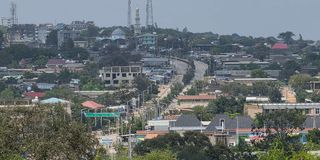
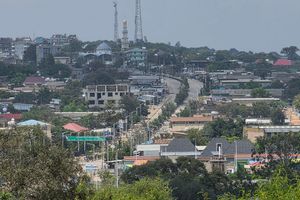
A view of deserted streets in Moyale, Ethiopia, as seen on November 2, 2026 from Moyale, Kenya.
Photo credit: David Muchui | Nation
The threat of stray bullets has also emptied once-bustling trading centres such as Biashara Street, renowned for electronics, and Soko Balle, popular for clothing, leaving them a pale shadow of their former selves.
A barrage of stray bullets that has been raining down on Biashara Street over the past two weeks has forced many businesses to close.
"Biashara Street is the go-to place for high-end goods, currency exchange, electronics, new clothes and wholesale shops, among other businesses. On a normal day, the streets would be crowded," Mr Abdullahi said.
"On a good day, I could make sales of up to Sh10,000, but I am now struggling to make even Sh1,000," she said.
Beyond the strain on businesses, families hosting displaced people are appealing for government assistance to ease the growing economic burden.
Mr Abdi Maalim, a member of the Cross-Border Peace Committee, said residents were in dire need of humanitarian assistance as the conflict dragged on.
According to government estimates, more than 25,000 Ethiopians are living with host communities in Moyale.