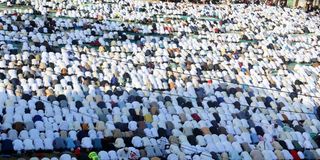
Muslims across the world will on Wednesday celebrate Eid al-Adha, one of the holiest festivals in Islam, which commemorates Prophet Ibrahim’s (Abraham’s) willingness to sacrifice his son Ismail (Ishmael) in obedience to Allah’s command.
In Kenya, Interior Cabinet Secretary Kipchumba Murkomen has declared the day a public holiday to allow Muslims to mark the occasion.
Muslims observe two major Eid celebrations each year, Eid al-Fitr and Eid al-Adha, which are often confused by non-Muslims.
Eid al-Fitr marks the end of the holy month of Ramadhan, during which Muslims fast for 29 or 30 days depending on the sighting of the moon before breaking into celebrations.
Eid al-Adha, also known as the Festival of Sacrifice, falls on the 10th day of Dhul Hijjah, the 12th and final month of the Islamic lunar calendar.
It is during this sacred month that Muslims perform the Hajj pilgrimage to the holy city of Makkah (Mecca) in Saudi Arabia, one of the five pillars of Islam. Kenya’s Hajj quota has remained at 4,500 pilgrims over the past six years.
The significance of Eid al-Adha originates from the story of Prophet Ibrahim, who saw in a dream that Allah had commanded him to sacrifice his son, Ismail. When Ibrahim informed his son, Ismail responded with unwavering faith, telling his father to do as Allah had commanded.
As Ibrahim prepared to carry out the sacrifice, Allah intervened and replaced Ismail with a ram, which Ibrahim was instructed to slaughter instead. The story is a profound symbol of faith, obedience and submission to God’s will.
To honour this act of devotion, Muslims who are financially able perform Qurbani (ritual animal sacrifice) after Eid prayers.
The slaughtering can continue for three days, known as the Days of Tashreeq, during which Muslims repeatedly recite the Takbir, proclamations of “Allahu Akbar” (Allah is the Greatest).
According to Islamic teachings, only certain sheep, goats, cows and camels can be offered for sacrifice, and they must be healthy and free from defects.
A goat or sheep is considered sufficient on behalf of one individual or household, while a cow or camel may be shared among seven people, each contributing towards the sacrifice.
The meat is traditionally divided into three portions: one for the family, one for relatives and neighbours, and one for the poor and needy, reinforcing the Islamic values of charity and community solidarity.
On Eid morning, Muslims are encouraged to wear their best clothes, often new or freshly cleaned garments and attend prayers at mosques or open fields. It is also Sunnah (tradition of Prophet Muhammad) to use a different route when returning home after prayers than the one used when going.
“It is a day of happiness, but as a Muslim you should not overindulge. You make children happy and do things that bring joy while remaining thankful to Allah,” says Eldoret-based cleric Sheikh Abubakar Bini.
For pilgrims performing Hajj, Eid al-Adha coincides with the ritual of Ramy al-Jamarat, where they throw seven pebbles at three pillars in Mina over three days, symbolising the rejection of Satan.
After completing the major Hajj rites, many pilgrims also travel to Madinah to visit Al-Masjid an-Nabawi (the Prophet’s Mosque), where Prophet Muhammad is buried. Although not part of Hajj itself, the visit holds deep spiritual significance for many Muslims.
Eid al-Adha is preceded by the Day of Arafah, observed on Tuesday, when millions of pilgrims gather at Mount Arafat, near Makkah, in one of the most important rituals of Hajj.
For Muslims around the world who are not on pilgrimage, Arafah is a day of fasting, mercy, forgiveness and spiritual renewal. It is considered one of the holiest days in the Islamic calendar, and fasting on this day is believed to expiate sins from both the previous and coming year.
The Day of Arafah also holds profound historical importance, as it was on this day that Prophet Muhammad delivered his Farewell Sermon during his final pilgrimage.
In the sermon, he emphasised the principles of equality, justice, the sanctity of human life, and the rights of women and fellow believers, teachings that continue to guide and shape Muslim life today.