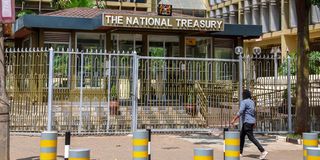
Every financial year, the National Treasury prepares a draft Finance Bill and submits it to the National Assembly for processing.
The Bill is introduced in the National Assembly alongside the draft budget estimates of the national government for the next financial year by April 30 – two months before the end of a financial year.
The presentation of the draft Finance Bill to the National Assembly by April 30 every financial year is informed by a court judgment, which necessitated amendments to the Public Finance Management Act that require the Bill to be law by July 1 every financial year.
Previously, the Finance Bill would become law 90 days after the passage of the Appropriations Bill that is required to have been assented into law by June 30 every financial year.
For instance, in the next financial year that starts on July 1, 2025, the government is projected to spend Sh4.2 trillion against a projected revenue of Sh2.8 trillion.
The Finance Bill provides the legal authority for the national government to collect additional revenue to implement fiscal policies as proposed by the government.
While the revenue projections in the draft Finance Bill have not been costed, they are certainly not in the region of the Sh344.3 billion projected in the rejected Finance Bill 2024.
The additional revenue could come in the form of taxes, borrowing and other revenue sources.
The Finance Bill also provides for tax incentives and administrative changes in the country's financial sector.
Without the legal framework, any attempt to levy taxes to fund government operations would be unconstitutional and unenforceable.
The projected Sh4.2 trillion in the 2025/26 financial year could be revised downwards after a cabinet meeting at State House on April 29, 2025, directed all government ministries to slash their budgets by Sh100 billion to prevent the risk of overburdening already overtaxed Kenyans.
It is likely that the tax proposals in the Bill will be friendlier from the rejected Finance Bill of 2024 as the government seeks to cushion Kenyans from punitive taxes that saw parliament buildings stormed by Gen Zs on June 25, 2024.
To ensure government operations run smoothly without increasing taxes, the Finance Bill 2025 will be seeking to propose measures that will scale down on VAT exemptions or even remove them.
The Finance Bill will also seek to remove the powers of the Cabinet Secretary in charge of the National Treasury to grant VAT exemptions and give them to the National Assembly, which has the power of the purse.
This is based on the findings by the Parliamentary Budget Office (PBO) that shows that the government is losing Sh400 billion in VAT exemptions every year.
The formulation of the Finance Bill is guided by the Budget Review and Outlook Paper (BROP), which is prepared by the National Treasury and submitted to the Cabinet for approval by September 30 every financial year before it is presented to the National Assembly.
This is in line with the Public Finance Management Act. BROP provides a review of the fiscal performance for the financial year including adherence to the objectives and principles outlined in the Budget Policy Statement and the Public Finance Management Act.
It also presents macroeconomic projections and sector ceilings for the financial year and the medium-term budget as well as information on variations from the projections outlined in the Budget Policy Statement.
BROP includes actual fiscal performance in the previous financial year compared to the budget appropriation for that year, updated macro-economic and financial forecasts while indicating changes from the forecasts in the most recent Budget Policy Statement.
It also contains details on how actual financial performance for the previous financial year may have affected compliance with the fiscal responsibility principles or the financial objectives in the latest Budget Policy Statement.
The BROP also includes reasons for any deviation from the financial objectives together with proposals to address the deviation and the time estimated to do so.
It is after the BROP has been approved that the experts at the National Treasury and Kenya Revenue Authority (KRA) meet to come up with the tax measures based on the BROP reviews.
The tax proposals are then formulated into a draft Finance Bill that is presented to the cabinet for consideration and approval and then presented to the National Assembly.
For instance, the 2024 BROP that guides the current process stated that the draft budget estimates and draft Finance Bill 2025 be submitted to Cabinet by April 18, 2025 and to Parliament by April 29, 2025.
It also says that the presentation of the budget statement or Speech to Parliament is scheduled for June 12, 2025 and the approval and assent of the Appropriation Bill 2025 and Finance Bill 2025 is by June 30, 2025.
Once the draft Finance Bill has been submitted to the National Assembly, it undergoes the relevant internal processes that involve officers from the Parliamentary Budget Office (PBO) to ensure it aligns with the recommendations of the cabinet.
Once this is achieved, the draft Bill is published and formally introduced in the House by the Finance and National Planning Committee.
The committee then undertakes stakeholder input on the Bill before tabling a report to the House proposing areas of amendments.
The House adopts the report of the House to formally conclude debate paving the way for the committee stage where the Bill is considered clause by clause.
Any of the recommendations made by the committee or adopted by the House on revenue matters shall ensure that the total amount of revenue raised is consistent with the approved fiscal framework and the Division of Revenue Act.
Once the Bill has been adopted by the House, it is transmitted to the president to sign it into law. If the president has any reservations on the Bill, a memorandum is transmitted to the House pointing out the areas for change.
According to the Public Finance Management Act, the Bill shall become law by July 1, the start of every financial year.