The cost of buying a job in the public service has soared eightfold in just four years, starkly exposing how entrenched corruption is exploiting the desperation of millions of unemployed citizens.
Public service recruitment, long criticised for nepotism and tribal bias, is now openly fuelled by bribes so large they could fund a small business — and yet remain the only path to employment for many.
An analysis of data from the Ethics and Anti-Corruption Commission (EACC) shows the average bribe to secure a job has skyrocketed from Sh30,110 in 2021 to Sh243,651 in 2024.
Employment bribery has now overtaken all other corrupt transactions as the largest single category of reported graft, accounting for 31 per cent of all bribes last year — up from 22.1 per cent in 2023 and 14 per cent in 2022.
Ethics and Anti-Corruption Commission Chairman Bishop David Oginde at Integrity Centre in Nairobi on March 27, 2024.
Photo credit: Bonface Bogita | Nation Media Group
The figures are based on the EACC’s “share of national bribe” metric, which measures the proportion of bribes paid for a specific service relative to all recorded bribes nationally.
In 2024, seeking employment ranked above every other bribery category, a reflection of both rampant unemployment and the desperation driving Kenyans to part with staggering sums in exchange for work.
Among youths aged 18 to 35 — the demographic most affected — the figure surges to 67 per cent, ranking Kenya among African countries that are facing the most severe youth joblessness crises.
KNBS data from December 2022 showed 3.5 million young people were neither in employment, education, nor training — barely down from 3.7 million in the third quarter of 2022 and 3.8 million in the last quarter of 2021.
Photo credit: Nation Media Group
Job creation is falling far short of demand. In 2024, the economy generated just 782,300 new jobs across both formal and informal sectors — a drop from 848,100 the year before.
This is against a backdrop of 500,000 to 800,000 youth entering the job market each year, according to the Kenya Institute for Public Policy Research and Analysis (Kippra).
The think tank also pegged youth employment at 13.35 per cent in 2022, underscoring the economy’s chronic inability to absorb its growing workforce.
EACC’s 2024 report is blunt: unemployment is being compounded by bribery, nepotism and tribalism, effectively turning public service jobs into commodities for sale to the highest bidder.
The surveys reveal the price of a public sector job has climbed steeply. After a slight dip from Sh30,110 in 2021 to Sh29,407 in 2022, bribes spiked to Sh163,260 in 2023 before leaping to Sh243,651 in 2024.
County executive recruitment emerged as the costliest, with average bribes matching the national 2024 high of Sh243,651.
Securing a tender from the national government came next, at Sh100,000.
Some of the most notorious offenders include the Teachers Service Commission (TSC), Kenya Defence Forces (KDF), National Police Service (NPS), Kenya Prisons Service (KPS) and National Youth Service (NYS).
In a recent scandal, TSC appointment letters were allegedly distributed to government-allied MPs, who then sold them to the highest bidders.
Respondents in the 2024 EACC survey reported paying an average of Sh72,665 to obtain a TSC posting.
“Kenyans interviewed in the survey conducted between November and December 2024 revealed that they parted with the largest bribe while seeking employment in counties and national government offices,” the EACC noted.
The TSC has a chequered history with graft allegations. In 2007, the Kenya Anti-Corruption Commission — EACC’s predecessor — exposed how TSC officials solicited bribes for both secretariat appointments and teaching jobs. An audit of its systems found candidates often paid to be shortlisted for interviews.
Even after securing a position, many newly recruited teachers were forced to pay further bribes to be placed on the payroll — a process that officially takes about three months but, without inducements, can drag on for six.
Photo credit: Nation Media Group
“All these complaints and the ranking of TSC as the fourth most corrupt organisation in the 2005 Kenya Bribery Index suggested weaknesses and loopholes in its policies, procedures and methods of work,” an earlier report observed.
Corruption in police recruitment is equally entrenched. A task force on reforming the NPS, KPS and NYS, led by retired Chief Justice David Maraga, found that recruitment slots were being sold for up to Sh600,000 — sometimes more.
“Those who enter the NPS through political influence sustain their place in the service by remaining loyal to those ‘they know’, while those picked on merit ‘grease’ their positions by granting favours to police bosses,” the report stated.
The NPS has appeared in every EACC corruption report in the last three years. The problem is now under active investigation: in February 2025, EACC launched an audit into police recruitment, financial management, and policy enforcement, aiming to determine whether corruption begins at the point of hiring.
Bribery incidents involving police officers surged sharply in 2024, suggesting systemic rot. Once complete, the audit’s findings and reform proposals will be handed over to the Inspector-General of Police.
In March 2024, High Court judge William Musyoka nullified the Kenya Revenue Authority’s recruitment of 1,406 revenue service assistants, ruling the process unconstitutional after more than half the posts went to just two ethnic groups.
The jobs had attracted an extraordinary 127,117 applications — a vivid illustration of the demand-supply imbalance.
EACC has also reported a sharp rise in the use of forged academic and professional credentials to secure employment or promotion. Since 2022, it has investigated 549 such cases, completed 134, and referred 74 to the Director of Public Prosecutions.
Fifty are before the courts, with 13 concluded.
Photo credit: Nation Media Group
The commission has recovered Sh16.9 million in illicit earnings. In October 2022, the Public Service Commission ordered all government agencies to verify staff certificates.
Reports from the Head of Public Service and the Kenya National Examinations Council have since flagged widespread fraud.
For years, EACC surveys have ranked unemployment and corruption as Kenya’s most critical challenges, ahead of poverty, high living costs, poor healthcare, inadequate infrastructure and weak leadership. Most respondents in the 2024 survey said they paid a bribe because it was demanded and was the only way to secure employment.
“The alarming increase in bribery not only undermines public trust in government institutions, but also perpetuates inequality, hinders socio-economic development, and poses a significant challenge to Kenya’s aspirations for transparency, accountability and good governance,” the EACC warns.
Governance expert David Ngugi cautions that the combination of unemployment, corruption and a rising cost of living risks triggering mass unrest.
“Currently, the unemployment crisis has reached boiling point. Bribery in exchange for jobs must be tamed before it leads to a youth revolution. The unemployed — mostly young — will rise, and that threatens the country’s stability,” he said. “It already began with the Gen Z-led protests in June 2024.”
Economist and lecturer Prof Tom Nyamache of Turkana University is equally blunt: “Investigative agencies must intervene. Those involved in bribery for employment should be jailed or heavily fined. The perception that opportunities are reserved for the well-connected fuels cynicism, erodes faith in institutions, and can lead to a revolution.”
Lawyer Steve Kabita says only a robust, independent anti-corruption drive can stem the tide: “Failure to tackle bribery in recruitment may, in the long run, lead to social unrest and political instability.”
Leadership scholar Dr Peter Mbae says the responsibility lies with President Ruto: “He must act to save this country from sliding into lawlessness due to acute unemployment. Lip service is not enough.”
President Ruto has repeatedly pledged to tackle youth unemployment by creating jobs in affordable housing (600,000 positions), information and communication technology (expanding from the current 180,000 digital jobs) and overseas placements (raising the number of Kenyans working abroad from 400,000 to one million).
Yet governance analysts warn that, without dismantling the bribery networks embedded in recruitment, such efforts risk being undermined.
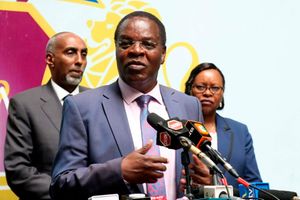
Public Service Cabinet Secretary Geoffrey Ruku.
Photo credit: Joseph Kanyi | Nation Media Group
“The era of looting public resources with impunity is over. No government official, regardless of rank, will be spared,” Mr Ruku declared.
He also urged citizens to report bribe demands directly to him or to relevant authorities: “Do not fear speaking up.”
The EACC’s latest findings leave no doubt: bribery has become a formalised toll gate on the road to public sector employment.
With youth unemployment stubbornly high and public confidence in State institutions eroding, the question is no longer whether the problem exists — but whether there is political will to end it.