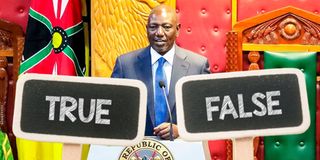
President William Ruto addressed Parliament in his State of the Nation address on November 20, 2025. The Daily Nation , in conjunction with the Institute of Economic Affairs and the Kenya Legal and Ethical Issues Network on HIV and AIDS (Kelin), undertook a fact-checking of some of the key statements made by the President.
President Ruto's third state of the nation address
1. Kenya versus the Asian tigers
In his speech, President Ruto asserted that at independence, Kenya’s development indicators were at par with those of the so-called Asian Tigers, Singapore, Taiwan and Malaysia — economies that have since become global manufacturing and innovation powerhouses.
“At independence, there was no material difference in the development indicators between Kenya and Asian Tigers,” President Ruto claimed.
However, a review of World Bank data by the Institute of Economic Affairs shows the claim is false. In 1965, literacy rates in Singapore, Taiwan, and Malaysia were 75 percent, 78 percent, and 76 percent respectively, while Kenya’s literacy rate was below 40 percent.
“Life expectancy in the Asian economies ranged between 61 and 67 years, compared to less than 50 years in Kenya. Per capita income measured in purchasing power parity (PPP) further underscores the gap, with Singapore at $3,500, Taiwan at $2,200, Malaysia at $1,800, and Kenya at just $1,100,” states the Institute of Economic Affairs.
However, the President did not clarify that the majority are on contract under the controversial internship programme, a status that has sparked protests , court cases , and growing demands for their immediate confirmation. The additional 24,000 teachers he promised to recruit by January 2026 will also be interns, meaning the long-standing crisis of permanent staffing remains unresolved.
The Head of State did not address ongoing challenges, including persistent gaps in staffing at junior schools and the looming pressure on teacher deployment with the planned rollout of Grade 10 in January 2026.
While campaigning, Dr Ruto pledged in his manifesto to hire 116,000 teachers within his first two years in office to close long-standing staffing gaps in Kenyan schools.
Nearly three years into his term, this promise remains largely unfulfilled, leaving many classrooms still understaffed and schools struggling to cope with rising enrolment.
3. Helb has supported 500,000 students
In Thursday’s address, the President also stated that the Higher Education Loans Board (Helb) had supported 500,000 students. Nation’s analysis shows this number was accurate for 2024 and increased to 723,000 students in 2025.
While the claim is technically correct, the average subsidy per student has fallen, meaning individual support for students is lower than in previous years.
Agriculture also featured prominently in the speech, particularly maize production.
“National maize harvests have risen from 44 million bags in 2022 to 67 million in 2024, setting the stage for a historic harvest of 70 million bags this year,” the Head of State said.
A review of KNBS data by the Institute of Economic Affairs shows the 2022 harvest at 44.7 million bags, making this statement true. There is, however, no officially published data yet supporting the 67 million bags harvest figure for 2024.
5. 107,000 Community Health Promoters hired
Dr Ruto further highlighted the hiring of 107,000 Community Health Promoters (CHPs) as a major achievement. A review by Kelin found that the government initially planned to recruit 103,000 CHPs, partly funded by USAID, funding that has since been withdrawn.
Currently, counties and the national government are locked in a dispute over who should finance the payroll, since primary healthcare is a devolved function. Experts have also raised questions about whether CHPs are adequately trained to handle specialised health interventions, such as HIV and STI prevention. Nation concludes that while CHPs exist, the claim of 107,000 hires is partially true, given financing and operational challenges.
6. Payment of SHA premiums and healthcare access for the vulnerable
On healthcare coverage for indigents (those who cannot afford to pay), the President said that 2.3 million Kenyans were accessing paid-for premiums under the new Social Health Authority (SHA).
An investigation by Kelin found no formal national or county-level process to identify indigents, as required by the law.
Independent estimates suggest about 5.5 million Kenyans qualify as indigents. Access to health coverage is currently facilitated through loans via the Hustler Fund or contributions from Members of Parliament using NG-CDF allocations, creating a patchwork system.
Nation therefore considers the claim misleading, as it is unverifiable and does not comply with legal standards.