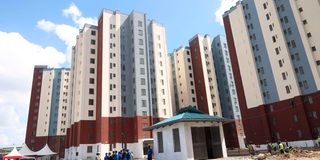
The battle over the legality of the Affordable Housing Act has shifted to the Court of Appeal, where a five-judge bench will now hear the challenge filed by 42 petitioners last year.
The development marks a significant escalation in a dispute that cuts to the heart of Kenya’s housing policy and the legality of the mandatory levy imposed on salaried workers.
Court of Appeal President Daniel Musinga delivers judgment on the Building Bridges Initiative Bill on August 20, 2021.
Photo credit: Dennis Onsongo | Nation Media Group
Court of Appeal president Justice Daniel Musinga announced the move on Wednesday during case management. He said the appeals raise weighty questions of law requiring consideration by an expanded bench of at least five judges.
“Given that the matter was determined by a three-judge bench at the High Court, the tradition and practice is that a five-judge bench should hear the appeal,” said Mr Musinga. He directed that the appeals be consolidated and heard on January 19, 2026.
The direction came as the petitioners—led by Busia Senator Okiya Omtatah and Nakuru-based surgeon Dr Magare Gikenyi—continued their fight to overturn the High Court decision that upheld the Act.
The petitioners suffered a setback in October 2024 when the High Court declined to quash the implementation of key sections of the Affordable Housing Act.
The High Court had found that the law was constitutional and that the 1.5 per cent mandatory levy on monthly gross earnings was valid.
The bench held that the levy was a taxation measure anchored in the State’s duty to provide adequate housing.
“The purpose and effect of the impugned legislation was to fulfil the constitutional duty of the State to provide housing,” the High Court said in its October 22, 2024, ruling.
The judges found that public participation was adequate, the levy was not discriminatory, and the petitioners had not shown any violation of rights.
Busia Senator Okiya Omtatah.
Photo credit: Dennis Onsongo | Nation Media Group
Dr Gikenyi immediately appealed, maintaining that the law is unconstitutional and should be struck down. He argues that forcing employed Kenyans to surrender part of their salaries without a guarantee of receiving a house is illegal and discriminatory.
In his appeal, he states that compelling salaried workers to shoulder the cost of the scheme “against their will so that others can get houses is repugnant to morality and the Constitution.”
He adds that the legal framework ignores Kenyans already servicing mortgages and homeowners, disregarding personal preference, timing, and style.
“The affordable housing legal framework is faulty due to, among other reasons, burdening citizens who are not benefiting from the housing programme in a discriminatory manner,” he submits.
Another key argument from Dr Gikenyi is that the Act unfairly targets formal workers while leaving out the informal sector.
He says the law imposes a mandatory levy on employees but does not specify how non-employed persons should contribute, creating irrational and discriminatory treatment.
He also objects to Section 54 of the Act, which limits what a purchaser can do with a housing unit. The section requires written consent from the Affordable Housing Board before a buyer can sell or transfer a unit.
Dr Gikenyi argues that such restrictions violate property rights by limiting homeowners’ control over their houses.
“These restrictions are not justified under Article 24 of the Constitution,” he contends.
However, the government maintains that the provision is necessary to protect the programme’s integrity and ensure subsidised units remain with genuine beneficiaries.
The appeal draws heavily from the failed bid for conservatory orders, which challenged the levy’s fairness, legality, and administrative structure.
The High Court rejected all concerns, ruling that taxation falls under the National Assembly’s mandate and that Parliament may impose taxes as long as the process complies with the Constitution.
The bench held that the levy was properly enacted under Section 4 of the Act and found no discrimination.
“Section 4 of the Affordable Housing Act was not discriminatory and did not infringe Articles 27(1) and (4) of the Constitution,” the court ruled.
The judges noted that while collection from the informal sector may be difficult, the law provides for self-assessment under the Income Tax Act, ensuring equitable application.
The court also found no breach of property rights, reasoning that Parliament may impose non-arbitrary limitations.
Additionally, it ruled that the Act did not violate devolution principles, as the Affordable Housing Board includes both national and county representatives, and levy funds are not allocated directly to counties.
Complaints about public land use were equally dismissed, with the court finding that Section 41 aligns with the National Land Commission’s mandate by requiring compliance with the Land Act.
Furthermore, the court ruled that the Commission on Revenue Allocation did not need to give recommendations before the Bill’s passage since the Act does not allocate funds to counties. It upheld Section 60, which preserves transactions and funds collected under the previous framework, as constitutional.
With the appeals consolidated, the Court of Appeal will determine whether the High Court correctly interpreted the Constitution and the contested Act.
The decision, expected after the January 2026 hearing, will shape the future of Kenya’s ambitious housing programme.