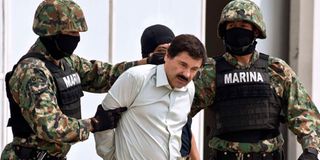
Kenya’s notorious Akasha drug trafficking network and the United States’ pursuit of Mexican cartel kingpin Joaquin “El Chapo” Guzman illustrate how criminal syndicates have long exploited maritime routes to move drugs, weapons and people across borders, prompting authorities to strengthen surveillance and enforcement at sea.
The Akasha family’s drug empire, founded by Ibrahim Akasha in the 1990s along Kenya’s coast, became one of the country’s most notorious criminal enterprises. After his death in 2000, his sons, Baktash Akasha Abdalla and Ibrahim Akasha Abdallah, inherited both his vast narcotics network and his notoriety.
The brothers are now serving lengthy prison sentences in the United States after being convicted of international drug trafficking.
Their operations mirrored those of other international criminal groups that have exploited maritime routes. Among them were Artur Margaryan and Artur Sargsyan, popularly known as the Artur brothers, who were deported to Dubai in 2006 and declared persona non grata in Kenya after they were accused of assaulting customs officials at Jomo Kenyatta International Airport and firearms were recovered from their Runda residence. Investigators linked some of their operations to suspicious cargo transported through maritime channels.
The Akasha brothers’ criminal enterprise came under global scrutiny in 2014 after their arrest in Kenya. Their father had earned the moniker “The Kenyan Pablo Escobar” for running a powerful drug cartel, a title that later became associated with his sons after they assumed control of the syndicate.
Like their father, the brothers allegedly relied on Kenya’s coastline to move large consignments of narcotics to international markets.
According to US authorities, the syndicate’s downfall began with undercover operations involving the Drug Enforcement Administration (DEA).
Investigators say that between March and April 2014, the brothers agreed through a series of meetings and telephone conversations to supply heroin and methamphetamine to individuals they believed represented a South American drug trafficking organisation. Unknown to them, the buyers were undercover DEA agents.
During one of the meetings, one of the brothers introduced the undercover agents to a heroin supplier in Pakistan through a Skype call.
Brothers (from left) Baktash Akasha, Ibrahim Akasha, Abdulsalam Akasha during a past appearance in court.
Photo credit: File/ Nation Media Group
In November 2014, Ibrahim Akasha personally delivered 98 kilogrammes of heroin to undercover agents before adding one kilogramme of methamphetamine, bringing the total shipment to 99 kilogrammes.
Following their arrest, prosecutors said the brothers attempted to frustrate extradition proceedings by bribing judges, prosecutors and police officers. Those efforts failed, and Kenya extradited them to the United States on January 29, 2017, where they were tried and convicted.
The Akasha case shares similarities with that of Joaquin Guzman, better known as “El Chapo”, whose capture also relied heavily on intelligence and surveillance.
At Homeland Security Investigations offices in Arizona, investigators demonstrated how authorities used sophisticated surveillance techniques to track Guzman’s communications and movements, ultimately leading to his arrest in 2016.
Officials said investigators exploited Guzman’s reliance on technology and his tendency to closely monitor his wife, associates and mistress through surveillance systems. By intercepting communications through his own information technology network, authorities were able to determine his location.
His arrest ended years of violent drug trafficking operations, multiple prison sentences and dramatic escapes, including one in which he reportedly hid inside a laundry cart to evade prison security.
Like the Akasha brothers, Guzman was also accused of bribing public officials to facilitate his criminal activities and evade prosecution.
Authorities say his cartel frequently used maritime routes, including submarines, to transport multi-tonne shipments of narcotics.
The cases underscore why the United States has invested heavily in maritime security. The US Coast Guard, established in 1790 as the Revenue Marine, remains one of the country’s oldest federal institutions and plays a central role in combating transnational crime at sea.
US officials say drug traffickers, human smugglers and other criminal organisations constantly adapt their methods whenever enforcement agencies disrupt established routes.
“Maybe seven to 10 years ago, jet skis weren’t even a thing here, and now they are employed routinely as a new technique where they can carry out their operations in the South,” said Captain Chris Cumberland, deputy for Coast Guard Forces at the Southwest Border.
Along the San Diego coastline, where the border between the United States and Mexico extends into the Pacific Ocean, authorities monitor both land and sea around the clock using surveillance cameras, patrol agents and maritime assets.
Officials say smugglers often attempt to exploit low tides and gaps along approximately 100 yards of border fencing extending into the water, but constant surveillance has helped disrupt many attempts.
Despite the heavy security presence, the border often appears peaceful, with tourists enjoying beaches while musicians perform nearby. Authorities, however, say criminal groups continue exploiting maritime routes whenever opportunities arise.
Adam Gordon, the US Attorney for the Southern District of California, said drug abuse remains a significant contributor to crime.
“In the Southern District of California, we have people who analyse those in jail and ask them to self-report. About 80 per cent of those who have been drug tested have reported on methamphetamine. To me, that number reports on how drugs are a huge driver of crime… at least within the district,” he said.
The Coast Guard also demonstrated pursuit operations involving high-speed vessels travelling at about 45 knots, or approximately 84 kilometres per hour, reflecting the speed often required to intercept suspected smugglers.
Supervisor Border Patrol Agent Jeff Stephenson said authorities had recorded declining illegal crossings in recent years.
“In the past two years, there have been reductions along the border. In land and maritime instances, we have seen decreases. The maritime border is, however, more consistent compared to what we’ve seen in past years,” he said.
Gordon said criminal activity has increasingly shifted from land crossings to maritime routes, a trend reflected in publicly available videos showing speedboats and jet skis dropping migrants onto beaches before fleeing.
Drugs suspect Vijayghiri Goswami (left) and his co-accused Baktash Akasha Abdalla during a bail hearing at the Mombasa Law Courts in January 2015.
Photo credit: File | Nation Media Group
The US Coast Guard patrols about 8,000 square miles of maritime territory, where officers contend not only with transnational crime but also severe weather, rough seas and changing water levels that complicate enforcement operations.
Officials say increased interceptions have pushed smugglers to use more dangerous offshore routes, making enforcement increasingly complex.
Kenya has also intensified efforts to secure its waters against drug trafficking, piracy and territorial threats.
In October 2025, authorities seized narcotics valued at Sh8.2 billion during a multi-agency operation along the Kenyan coastline, underscoring the country’s continuing efforts to disrupt maritime trafficking networks.