Swaleh, better known on the coast as Candy Rain, or Kandereni, had been picked up from his Kilifi home by individuals claiming to be Directorate of Criminal Investigations (DCI) officers nine days before his body was found.
Security authorities were convinced that Swaleh had absorbed most of the coastal supply lines previously controlled by the Akasha brothers – Baktash and Ibrahim – who are serving decades-long sentences in the US for narcotics trafficking.
Yet, none of the charges ever stuck, something his lawyer Jared Magolo attributed to lack of evidence and alleged attempts to frame Swaleh.
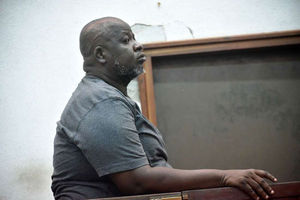
Swaleh Yusuf Ahmed in Mombasa Magistrate's Court on January 24, 2019.
Photo credit: File | Nation Media Group
In death, Swaleh’s lawyer still maintains that the Kilifi resident was not on a mission to capture the narcotics market previously controlled by the Akasha brothers, and that he was murdered by frustrated police officers who failed, on many attempts, to secure convictions in court.
“There was nothing at all to compare him with the Akasha brothers. We have also not filed any case linked to his death, but he was executed. DCI officers failed to have him jailed and they chose the other route,” Mr Magolo said in an interview, insisting that his client was unfairly targeted by rogue DCI officers.
Swaleh’s dalliance with the criminal justice system started in the 1990s, when he was charged with trafficking heroin, which formed the backbone of his trafficking network, if court and police records are anything to go by.
In 1996, he was convicted and sentenced to serve 15 years in Shimo la Tewa Prison. He, however, successfully appealed the conviction and sentence.
In 2010, Swaleh was convicted again, this time for trafficking five kilos of heroin. Once again, he successfully appealed.
Swaleh was again charged in 2011 and 2013, but was acquitted.
In 2018, Swaleh was charged alongside his wife, Fatuma Ahmed, at the Jomo Kenyatta International Airport Law Courts for trafficking 91.738 kilos of heroin with a street value of Sh275.2 million.
Fatuma Ahmed who was charged with trafficking heroin worth Sh275 million.
Photo credit: File | Nation Media Group
Police had found the drugs in Swaleh’s home in Kikambala, Kilifi County.
Eight months after his death, Swaleh’s wife Fatuma, was sentenced to 40 years in prison and fined Sh825 million. The conviction is an indication that only death may have saved Swaleh from seeing the inside of a prison cell.
But in life, his operation puzzled security authorities.
In 2018, the DCI had to send officers from Nairobi to arrest Swaleh after their Mombasa counterparts failed to follow orders from their superiors, pointing to the power and influence Swaleh wielded.
While his lawyer argues that Swaleh was repeatedly acquitted due to poor investigations and lack of evidence, the police always attributed it to the drug lord’s deep connections.
Under the Judiciary’s active case management guidelines, criminal cases should be resolved within one year; beyond which they join the backlog cabinet.
That means many of the criminal cases, including those that tried Swaleh, the Akasha brothers before their extradition, and several other drug lords, were technically in the backlog category even at the time some of them were being concluded.
In the Judiciary’s medium-term expenditure framework (MTEF) budget report for the 2025/26 financial year, the institution said that it has been reducing backlog, and that old pending cases stood at 270,015 at the end of the 2022/23 financial year.
That figure, the document tabled in Parliament last April, states, was a 19 per cent reduction from the 2021/22 financial year.
Chief Justice Martha Koome has in the past urged judicial officers to clear delayed rulings and streamline the judicial process.
A study by the Institute for Security Studies (ISS) emphasises the risks of releasing suspected drug traffickers on bail. It found that many continue with the drug trade while manipulating evidence or bribing judicial officers.
Known as Mathe wa Ngara, Nancy Kigunzu remains in remand at Lang’ata Women’s Prison after multiple arrests and ongoing investigations.
She first came under scrutiny in August 2023 when she was found with cannabis worth Sh18.1 million and Sh13.1 million in cash. Though she surrendered voluntarily and was released on bail, the case has not moved forward.
After the DCI busted her marijuana base in Ngara, Nairobi County, Kigunzu moved her operations to Juja, even as investigations into the initial case proceeded.
The ARA says she registered some properties under relatives’ names to avoid detection and lower the risk of having them surrendered to the State.
Drug suspect Nancy Indoveria Kigunzu, popularly known as Mathe wa Ngara
Photo credit: Pool
In November 2024, a court order barred Kigunzu from selling or transferring any of her assets, which include luxury vehicles, an apartment in Juja, and at least nine land parcels in Kiambu and Vihiga Counties.
Scola Namunyu was previously acquitted in cases involving the trafficking of 21 kilogrammes of heroin in 2010, and credit card fraud in 2011.
In 2019, she was arrested on the Nairobi-Mombasa highway with 20 grams of cocaine and sentenced to 15 years in prison in January 2024.
Despite denying charges, the prosecution produced eight witnesses who testified that she dispatched an envelope containing cocaine to Malindi, Kilifi County.
The ARA is also pursuing her assets. Between 2003 and 2023, Namunyu received over Sh18 million in various bank accounts.
According to the agency, that income was inconsistent with her declared income and likely proceeds of crime or money laundering.
Beth Wangechi Nduati is serving a 12-year sentence for trafficking marijuana, resisting arrest, and assaulting police officers. Arrested in February 2016 in Kirinyaga County, she was initially sentenced to 20 years in 2018.
Her sentence was later reduced by the High Court, which cited her reformed behaviour, positive reports from prison authorities, and her efforts to acquire new skills like knitting and biblical studies.
Lawyer Ken Nyaundi said that when cases are dismissed for lack of sufficient evidence, there are two areas of focus — the investigation stage and the prosecution stage.
He argued that while the DCI takes the flak in most drug-related acquittals over shoddy investigations, the spotlight should also extend to the Director of Public Prosecutions.
This, he said, is because during the secondary investigations stage, the ODPP usually issues advice on what should be done.
“We have the primary investigations stage that is conducted by DCI sleuths before the secondary stage, which is conducted after the DPP has issued an advice on what should be added and what should be eliminated to make the case strong,” he said.
Nyaundi added that when it comes to presenting witnesses in court, at times they fail to appear following threats, and at times prosecutors set aside strong witnesses following influence from suspects.
He said for a drug trafficking case to sail through and lead to a conviction, the prosecution has to prove possession, control, and also issue results that prove indeed one was found with a hard drug.
According to Kenya’s economic survey, drug-related cases have been on the rise since 2020. In 2019, 8,011 cases were reported. While this dropped to 4,477 in 2020 due to COVID-19 restrictions, the numbers rose again: 5,473 in 2021, 6,526 in 2022, and 9,338 in 2023. Men consistently represent a higher proportion of those arrested in connection with drug offenses.
A report by the Eastern and Southern Africa Commission on Drugs (ESACD) indicates that cannabis remains the most widely used illicit substance in the region. It is commonly consumed in dried or resin form (hashish), either smoked or ingested.
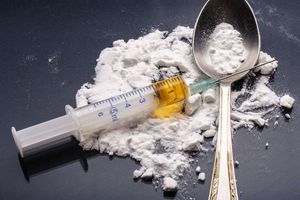
Heroin, which was initially inhaled, is now commonly injected—especially in Kenya’s coastal areas. Cocaine is also prevalent, available in both powder and crack forms, with powder cocaine costing significantly more. Methamphetamine is rapidly growing in popularity, replacing crack in many areas. It is usually smoked, but some users also inject it.
While some suspects are convicted, many cases are delayed for years, and others collapse due to poor investigations or interference. All the while, some of those being tried return to the streets and traffic narcotics.
Thousands of drug addicts have been admitted to the 142 rehabilitation centres across the country, some of which are overwhelmed.
Anthony-Omerikwa
Photo credit: File | Nation Media Group
The National Authority for the Campaign Against Alcohol and Drug Abuse (Nacada) boss, Dr Anthony Omerikwa said that 70 percent of those arrested in possession of drugs are university students.
He said that Nacada conducted a survey that targeted 15,000 students studying in 17 different universities across the country, and it emerged that there was need for the government to intervene and deal with the menace.
Data from the government agency reveal that cannabis is the most abused illegal drug in Kenya, closely followed by heroin, cocaine, and methamphetamine.