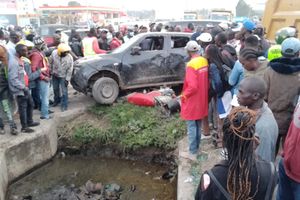
Kenya's boda boda sector, once hailed as a solution to unemployment and urban transport challenges, has increasingly become synonymous with lawlessness, mob justice, and deadly retaliatory attacks.
Despite stiff prison sentences, some as long as 30 years, handed down by courts, the wave of violent incidents involving motorcycle operators continues unabated.
From Nairobi to Mombasa, Siaya to Nakuru, motorcycle riders have been implicated in brutal lynchings, arson attacks, and even assassinations.
Courts have, over the years, responded firmly, upholding lengthy jail terms for perpetrators, yet the cycle of violence persists.
A review of various cases and incidents reveals that judicial punishments have done little to stem the tide of vigilantism, raising urgent questions about enforcement, systemic failures, and the underlying frustrations fuelling the violence.
This investigation delves into the systemic failures fuelling the crisis, examines recent court rulings, and explores whether punitive measures alone can curb the menace—or if deeper reforms are needed.
In the past three months alone (August–October 2025), more than ten cases of boda boda-related lynchings and vehicle burnings have been reported across Kenya, painting a grim picture of mob justice becoming epidemic.
The triggers vary —road accidents involving riders, motorcycle thefts, or perceived injustices—but the outcomes are consistently brutal.
Nandi Central Administration Police Commander Benson Maina inspects houses which were torched by boda-boda riders at Kamomo police post on September 15, 2015. The riders killed a suspected motorcycles thief.
Photo credit: Jared Nyataya | Nation Media Group
Recent incidents highlighting the crisis include one in Juja, Thika Superhighway (September 2025), where a public service bus was set ablaze after allegedly knocking down and killing a boda boda rider. The attack was swift, with eyewitnesses describing an angry mob descending on the vehicle within minutes.
In the same area of Juja, suspected boda boda operators set a vehicle on fire near Kenyatta University, along Thika Superhighway, after it was involved in a collision with a motorbike rider.
These incidents point to a retaliatory tit-for-tat violence, as often an attack on one motorbike -whether by a motorist or a criminal- sparks retaliatory violence from the larger boda boda community.
These were not isolated incidents. In Luanda, Vihiga County, a 14-seater matatu was torched after its driver reportedly ran over a rider along the Kisumu-Busia highway. The driver narrowly escaped lynching. In Madogo, Tana River County a suspected motorcycle thief was lynched and burned alive by riders—a chilling example of "instant justice" meted out outside the law.
Returning to Nairobi metropolitan, in Makongeni, Thika, Kiambu County, a private Audi SUV, allegedly belonging to a police officer, was burned after an accident injured a rider and passenger. The situation escalated when the officer reportedly opened fire, killing two riders.
In Lugari, Kakamega, three suspected thieves were lynched and set ablaze just two days after a rider was murdered while transporting a passenger.
The pattern repeats itself; violence begetting more violence, with little regard for due process.
Boda-boda riders and other riders whose motorbikes were allegedly stolen were recently, search for their motorbikes during a display by police at Eldoret Police Station.
Photo credit: Jared Nyataya | Nation Media Group
These cases underscore a disturbing trend: retaliatory violence has seemingly become normalised within some segments of the boda boda community.
The incidents involve another trend where motorists involved in accidents, whether at fault or not, increasingly face violent reprisals from riders, a trend that has placed the bodaboda sector at a crossroads.
While many operators are law-abiding citizens simply trying to earn a living, a growing faction has embraced mob justice as a means of settling grievances, often with deadly consequences.
Though courts have taken a hardline stance against mob violence, imposing severe sentences to deter future incidents, recent attacks show that the message is not getting through.
Among the landmark court rulings is the case of Moses Abwoto. The Court of Appeal upheld the sentence for Abwoto, a Butere sub-county boda boda association chairman, who led a mob that killed a suspected motorcycle thief.
Judges dismissed his appeal in September 2024 and condemned the attack as "a mob-inspired but misguided act of retribution." The court found the sentence imposed was not harsh, excessive or unjust.
Another case is that of Peter Abonyo from Bondo, Siaya. He received 30 years for the 2017 murder of a police officer investigating a theft case involving another boda boda operator. The court ruled he acted with "common intention"—a legal doctrine holding group participants equally liable.
The officer was ejected from a car at a roadblock near the Cereals Board stage, Siaya. Abonyo was positively identified by the other people in the car.
"The unlawful purpose was to eject and, at least, assault the deceased for perceived wrongful targeting of a boda boda rider with arrest. The doctrine of common intention was appropriately applied to link the appellant with the ultimate crime committed, which was murder," the court said.
In Nakuru, four riders are in jail for a 2013 lynching case. The four were sentenced to 15 years for burning a suspected thief alive.
"When a group of people attack a hapless individual, drag him like they did, hit him with a piece of wood, pour petrol on him and set him ablaze, they must have be presumed to have knowledge that such an attack would, at a minimum, cause grievous harm to the victim," said the High Court.
In Mombasa, Ali Abdallah, a bodaboda operator at Kwahola Estate in Changamwe, is in the tail end of completing his 20-year imprisonment term for the offence of murder arising from a mob injustice incident.
He was sentenced in July 2012 for a mob justice murder and was condemned to serve 40 years but the sentence was reduced by the Court of Appeal and in December 2023 his application to serve the remaining two years under probation was allowed.
Abdallah was convicted on the strength of an eyewitness who testified in court that the victim was beaten to death by a group of bodaboda cyclists, and Abdallah appeared as the ring leader.
Miles away in Siaya county, three riders are serving 25 years imprisonment imposed by the High Court in April 2023, also for murder through mob injustice.
Despite these rulings, copycat attacks persist, suggesting that punitive measures alone fail to address root causes.
Our investigations pointed to weak law enforcement, with motorcycle theft coming up as a major driver of the unrest.
Many riders feel abandoned by law enforcement, claiming that stolen bikes vanish without trace, leaving them with no recourse but to take matters into their own hands.
This frustration fuels a dangerous cycle: a theft occurs, suspects are hunted down, and mob justice is meted out—sometimes against innocent individuals caught in the wrong place at the wrong time.
This is aggravated by economic desperation as a stolen motorcycle means lost livelihood, driving some to extreme retaliation.
Kevin Mubadi, chairman of the Boda Boda Safety Association of Kenya, in a statement, insisted that rogue elements—not legitimate operators—are responsible for the violence.
"These acts do not represent genuine boda boda operators. We advocate for peace and lawful conduct."
A police officer stands next to the burnt shell of a motorbike at Kiganjo Police Station. The bike was set alight by a mob who accused its rider of stabbing another rider to death at the Kiganjo trading centre in Nyeri County, on August 16, 2016.
Photo credit: Joseph Kanyi | Nation Media Group
However, critics argue that self-regulation has failed.
The Mass Mobility Operators Association warned that "a comprehensive approach is needed—NTSA and associations must curb vigilantism before more lives are lost."
In response to the lawlessness, authorities have since announced crackdowns and new regulations, including mandatory registration under SACCOs to weed out criminals and wearing county-specific uniforms for easier identification.
Other proposed regulations for the sector include stiffer penalties for group violence, including life imprisonment for fatal mob attacks.
But critics argue that these measures fail to address the root causes, such as poor policing, lax enforcement of traffic laws, and deep-seated mistrust between riders and authorities.
The crisis is not limited to mob attacks and lawlessness. Motorcycles are increasingly used in drive-by shootings in the capital, Nairobi.
On the evening of September 9, 2025 lawyer Mbobu Kyalo was fatally shot in a motorcycle attack along Magadi Road in Karen, Nairobi, while, earlier in April former Kasipul MP Charles Ong'ondo Were was shot dead in a similar attack along Ngong Road.
While courts have sent a strong message with harsh sentences, legal deterrence alone is insufficient.
Observers say solutions must include faster police response towards improving stolen bikes' recovery rates, to reduce vigilante urges and economic empowerment by providing insurance schemes for the stolen bikes.
Another solution could be community engagement, with associations resolving to actively root out violent members.
Until then, Kenya’s streets risk remaining battlefields where mob justice trumps the rule of law.