What was once an ordinary farm implement is rapidly being transformed into a weapon of intimidation and violence.

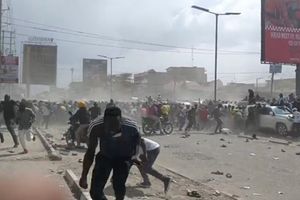
As the August 2027 General Election approaches, a familiar threat is returning to Kenya’s political arena: gangs accused of intimidating opponents, disrupting rallies and turning public spaces into zones of fear.
The warning from the Independent Electoral and Boundaries Commission (IEBC) is blunt. Political goonism and gangsterism are among the biggest threats to next year’s elections, raising questions about whether the country has learnt from its turbulent past.
In October 2026, IEBC commissioner Francis Aduol identified goonism, political gangsterism and the misuse of artificial intelligence as major risks to peaceful elections.
“As IEBC, we consider the most serious threats to the 2027 elections to be goonism, political gangsterism and the misuse of artificial intelligence,” Prof Aduol said. “And we are hoping that we can be able to bring these under control in time for election 2027 so that we can have peaceful elections.”
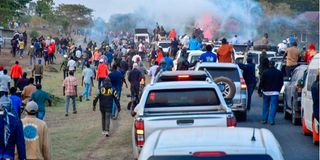
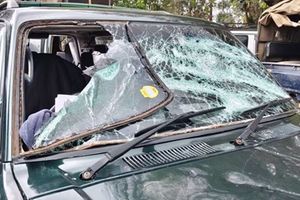
One of the vehicles torched by goons during attacks on the Linda Mwananchi convoy in Homa Bay County on August 16, 2026.
His warning revives memories of John Michuki, the late Internal Security minister whose uncompromising campaign against Mungiki in the mid-2000s disrupted a feared criminal network that had entrenched itself in public transport and parts of Central Kenya.
Michuki’s methods remain controversial, but his confrontation with the group offers important lessons for a country struggling to prevent criminal gangs from becoming instruments of political power.
According to the Kenya Yearbook Editorial Board, Mungiki had established control over matatu routes in Nairobi, costing operators billions of shillings through extortion and illegal levies.
The group’s offshoots, including Taliban, Jeshi la Mzee and Kamjeshi, were also accused of demanding protection fees from transport operators. Those who refused to pay risked having their vehicles burnt or being killed.
Michuki, appointed Transport minister by President Mwai Kibaki in January 2003, was determined to restore order to the sector.
Threat to public safety
The Kenya Yearbook records his argument that the matatu industry deserved the same protection for property and ownership as any other business.
After serving in Transport, Michuki moved to the Internal Security docket, where he confronted organised criminal groups that had become a threat to public safety.
His approach was uncompromising. In June 2007, he declared war on Mungiki, warning that the government would not tolerate its activities.
“We will deal with you… You will only be hearing about your colleagues’ funerals,” the Kenya media quoted him as saying.
The statement captured the minister’s hardline approach, which won support from citizens frustrated by extortion and killings but alarmed human rights organisations.
Human Rights Watch, in its report High Stakes: Political Violence and the 2013 Elections in Kenya, documented the government’s confrontation with Mungiki and the serious abuses associated with the crackdown.
The organisation reported that in 2007 Michuki issued a shoot-to-kill order against suspected members of the group, saying police would “wipe them out”.
Citing the Kenya National Commission on Human Rights, Human Rights Watch said more than 500 suspected gang members were killed extra-judicially by police between 2005 and 2007.
The report noted that authorities had taken no clear measures to identify and prosecute those responsible for the killings.
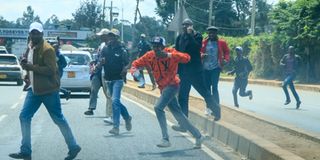
Supporters of former Mungiki leader Maina Njenga engage police in running battles at the DCI headquarters along Kiambu Road. May 25, 2023
The crackdown weakened Mungiki’s visible operations, but it did not resolve the deeper problem of criminal networks exploiting political connections and weak accountability.
Human Rights Watch also documented how political patronage had previously made it difficult for police to investigate and prosecute gang members.
After the 2007-2008 post-election violence, the organisation reported, links between Mungiki and some politicians began to re-emerge.
“The lesson is that force can disrupt a criminal organisation, but without credible investigations, prosecutions and action against its financiers, the networks that sustain it can survive. The threat facing Kenya today is not necessarily Mungiki under another name. Rather, it is the continued use of organised groups to intimidate political opponents and disrupt public gatherings,” says security expert, Paul Wambua, a retired military officer.
In a report published on September 11, 2026, Human Rights Watch said armed groups had attacked civil society meetings and opposition political gatherings in the months leading up to the 2027 election.
The organisation reported that the attacks had killed at least six people and injured dozens.
“The spate of violence, as the pre-election period begins, threatens a return to the human rights abuses that have marred Kenya’s previous elections,” said Carine Kaneza Nantulya, Human Rights Watch’s deputy Africa director.
“The authorities need to break this cycle of violence by ensuring that those responsible cannot act with impunity.”
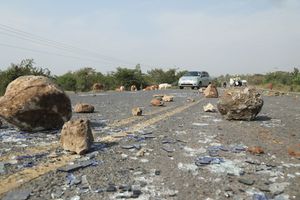
One of the incidents cited was the August 16 attack on a convoy carrying Linda Mwananchi supporters and politicians to a rally in Homa Bay. Human Rights Watch said at least three people were killed, while journalists were beaten and their equipment stolen.
The Institute for Security Studies has also warned that political actors continue to use young people to disrupt rallies and civic meetings.
In an analysis published on September 22, researcher Guyo Chepe Turi highlighted a central problem: youth gangs can be mobilised for political violence, yet those who allegedly finance or organise them are rarely held accountable.
The result is a cycle in which violence is outsourced to young men, while the political interests behind it remain shielded from scrutiny.
The Kenya Human Rights Commission’s findings on October 28, add to the concern.
The organisation documented 284 human rights incidents between January and July 2026, affecting 3,222 people. These included 39 incidents associated with goons, 31 linked to political party officials and 22 involving political gang violence.
The commission warned that intimidation and attacks could undermine citizens’ freedom to participate in the electoral process.
On October 28, the commission, Katiba Institute and the Independent Medico-Legal Unit, alongside three individuals, also filed a court petition accusing senior security officials of failing to stop organised political violence and prosecute those responsible. The allegations are yet to be determined by the court.
The petitioners want authorities to investigate the attacks, trace the people financing and recruiting gangs, and ensure adequate protection for lawful public gatherings.
Michuki’s record, Wambua opines, demonstrates the importance of political will in confronting criminal networks. But his crackdown also shows why security operations must remain within the law.
“A sustainable response requires intelligence-led policing, prosecution of gang leaders and financiers, protection of witnesses and independent investigations into allegations of police abuse. It also requires addressing the economic vulnerability that makes young people susceptible to recruitment by political actors,” says Mr Wambua.
As the 2027 campaigns gather momentum, he says, security agencies must demonstrate that the law applies equally, regardless of a suspect’s political connections.
“Michuki helped disrupt a feared criminal network. Kenya’s challenge now is to prevent political goonism from becoming another entrenched system of intimidation. The real test will not be how many suspects are arrested or how forcefully the government speaks, but whether voters can attend rallies, journalists can report freely and citizens can exercise their democratic rights without fear,” he says.
Follow our WhatsApp channel for breaking news updates and more stories like this.