The National Assembly and the Senate are pulling in different directions over whether to make a university degree mandatory for individuals seeking to be MPs and Members of the County Assemblies, despite previous court judgments declaring it unconstitutional.
Their contrasting positions have emerged in the Elections (Amendment) Bill 2024, which is still under consideration in arliament, eight months before the August 10, 2027 general election.
The National Assembly passed the Bill, which was transmitted to the Senate for review, consideration and concurrence, while maintaining the minimum of a degree as a mandatory requirement for politicians seeking the MP and MCA seats.
However, in a report to the House reviewing the National Assembly’s amendments laid on November 11, 2026, the Senate’s Justice, Legal Affairs and Human Rights Committee recommended that the House drop the degree requirement.
The committee, chaired by Bomet Senator Hillary Sigei, “took note of key judicial decisions that declared the degree requirement for various elective positions as unconstitutional for unjustifiably limiting the political rights of all citizens and equality guarantees under Articles 38 and 27 of the Constitution.”
Bomet Senator Hillary Sigei.
The standoff between the two Houses threatens to trigger a high-stakes mediation process, stalling a Bill critical to urgent electoral reforms.
With the August 10, 2027 general election just eight months away, any further delay risks derailing the Independent Electoral and Boundaries Commission (IEBC) preparations.
“While parliament may impose academic qualifications for candidates for elective office, the same must not extend beyond what the State is mandated by the Constitution to provide to every child,” the Senate committee argues in its report to the House.
“The committee therefore resolved to recommend that the Senate rejects the National Assembly amendment to the Bill,” the committee noted.
The Senate committee defended its position against the degree requirement, noting that if adopted, “it would render elective office a preserve of only those with the means to pursue tertiary education.”
Under Article 112(1) of the Constitution, once the originating House reconsiders the returned Bill, passing the amended version requires its Speaker to forward it to the President for assent within seven days, while rejecting the changes sends it straight to a mediation committee.
The committee will then have 30 days within which to generate a mediated version for approval by the two Houses.
The Sigei-led committee took note that Article 53(1) (b) of the Constitution guarantees every child the right to free and compulsory basic education, which is primary and secondary school education.
Section 22(1) (b) of the Elections Act imposes the requirement for a university degree for one to be registered as a candidate for election as an MP or MCA.
The 10th Parliament passed the law requiring a university degree as a requirement for those seeking elective seats, but when it was taken for presidential assent, the then President, the late Mwai Kibaki, used his veto powers against the decision of the House.
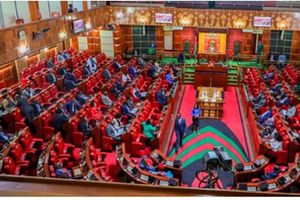
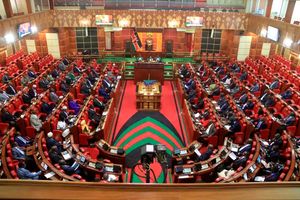
Members of the National Assembly follow proceedings during a past session.
Photo credit: File | Nation Media Group
In the 11th Parliament, it was brought back and this time it was passed and assented to.
However, its application was delayed to 2022 so that those who do not have the papers go back to class to study and acquire them.
But even as the 11th Parliament passed the Bill, a majority of them who had no degrees did not understand what they were voting for, only to learn the impact of what they had done when the hour of reckoning came.
However, the courts came to their rescue, striking down the section as unconstitutional, as Parliament was left with the task of legislative clean-up.
In a 2021 petition by the County Assembly Forum, the High Court ruled that a mandatory degree for MCA hopefuls “prejudiced the rights and fundamental freedoms of those who were not able to directly acquire or afford university degrees.”
In a separate 2022 petition by Paul Macharia Wambui, which challenged the provision, the High Court declared the requirement of a degree qualification as a precondition for nomination for election as an MP unconstitutional.
This was followed by another judgment in which the High Court declared the section unconstitutional for creating an avenue for differentiation in the eligibility requirements between MCAs and county governors.
The High Court also faulted the equating of academic qualifications of all elective positions in Kenya, “without any differentiation or regard to the different attending responsibilities and by disregarding the different remuneration and benefits, as contravening several provisions of the Constitution.”
The Bill, a product of the National Dialogue Committee (Nadco) process, proposed the deletion of the section to comply with the judicial decisions declaring the degree requirement for the positions of MPs and MCAs as unconstitutional.
Although the Senate passed the Bill by deleting the contentious provision in the law, the National Assembly overturned the decision upon receiving the Bill from the Senate, reinstating the provision in defiance of court rulings and the spirit of the Nadco process.
“The Committee observed that the amendments by the National Assembly effectively deleted a proposal, which sought to remove the degree requirement for one to be registered as a candidate for election as an MP or an MCA.”
The Senate committee further observed that, by dint of Articles 137 (1) (b) and 148 (1) of the constitution, reinstating the degree requirement for one to be elected as an MP would reimpose the same academic qualification for one to be registered as a candidate for election as President or Deputy President.
“Likewise, by dint of Article 180 (2) and (5) of the constitution, reinstating the degree requirement for one to be elected as an MCA would reimpose the same academic qualification for one to be registered as a candidate for election as county governor or deputy governor.”
The Committee also examined the practice in comparative jurisdictions and observed that a university degree requirement for election to a national legislature “is rare and that it has been abandoned or rejected in several of the jurisdictions where it was tried.”
“Where an educational qualification is imposed for national office, it is generally set at school level rather than at degree level.”
The Bill, co-sponsored by Senate Majority Leader Aaron Cheruiyot (Kericho) and his minority colleague Stewart Madzayo (Kilifi), was among the Bills that originated from the Nadco process.
The Bill was published on May 7, 2024, and introduced in the Senate on July 4, 2024.
It underwent the legislative process in the Senate and was passed, with amendments, on December 5, 2024, following which it was referred to the National Assembly for review, consideration and concurrence.
On October 22, 2026, the National Assembly considered and passed the Bill with amendments and referred it back to the Senate for reconsideration.