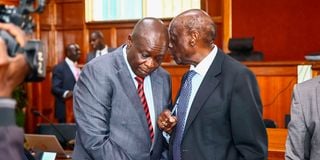
The protracted legal battle over the impeachment of Rigathi Gachagua as the Deputy President is set to enter a decisive phase, with marathon High Court hearings scheduled for mid-April.
A three-judge bench has set April 14–18 for the first round of substantive hearings in consolidated petitions challenging Mr Gachagua’s removal from office. Additional sittings are scheduled for May 26–28, the court directed on Tuesday.
The packed schedule marks a new chapter in a case that has preoccupied the High Court, Court of Appeal and Supreme Court since October 2024, when the National Assembly impeached Mr Gachagua.
“Following consensus by all parties, the consolidated petitions will be heard on April 14, 15, 16, 17, and 18, 2026, with further dates on May 26, 27, and 28, 2026,” the bench ordered. The sessions will begin at 10:00 AM daily in open court. The bench comprises Justices Eric Ogola, Anthony Mrima and Freda Mugambi.
The judges also directed parties to file written submissions at least 14 days before hearings to streamline proceedings, given the case’s complexity and volume.
Mr Gachagua’s impeachment has spawned more than 40 separate constitutional petitions filed in various High Courts, most of which have now been consolidated for joint consideration. These challenge not only the impeachment itself but also the parliamentary and judicial processes surrounding his removal.
The legal saga started October 2024, when the National Assembly passed an impeachment motion against Gachagua on 11 charges, including alleged gross misconduct, tribal discrimination, and violation of constitutional duties. Gachagua denied all allegations.
The matter was referred to the Senate for trial, and on October 17, 2024, senators upheld five of the charges, affirming his removal from office. At the time the Senate voted on the charges he was admitted in hospital and was not able to defend himself.
President William Ruto then nominated Prof. Kithure Kindiki to succeed him as Deputy President—a move briefly stalled by court orders before ultimately proceeding after the bench lifted the injunctions.
The case has 16 respondents, including the Attorney-General and the Speakers of the Senate and National Assembly, as well as eight interested parties led by Deputy President Kithure Kindiki and the Law Society of Kenya.
At the heart of the petitioners’ case are key questions, including whether due process was followed by the National Assembly and Senate in Gachagua’s impeachment.
These questions touch on the Senate’s basis for substantiating the charges, the alleged lack of adequate public participation, and the infringement of Gachagua’s rights under Article 50(1) of the Constitution.
The petitioners argue that the unprecedented speed of the process was a deliberate ploy to deny Gachagua a fair hearing. The bench is expected to determine whether he was afforded sufficient time to prepare his defense.
These issues strike at the core of constitutional and procedural fairness, raising concerns over whether MPs and senators adhered to due process as outlined in the Constitution.
The court will also examine whether procedural safeguards were observed and whether any lapses could render the impeachment flawed or unconstitutional.
Additionally, the court will assess whether the political question doctrine—which bars judicial intervention in certain political matters—should apply, potentially preventing the High Court from ruling on the impeachment’s constitutionality.
Separately, Prof Kindiki’s nomination and appointment face legal challenges, with one petition alleging that the National Assembly approved him without mandatory vetting, public participation, or obtaining an essential eligibility letter from the electoral commission.
Legal challenges flooded the courts even before the National Assembly finalised Gachagua’s impeachment.
Last month, the Supreme Court declined to halt the High Court hearings, ruling that it lacked jurisdiction to stay proceedings at that level.
The apex court also dismissed applications by the National Assembly that sought to forestall the hearings, stating that the issues raised warranted full consideration.
Gachagua’s legal team, led by Senior Counsel Paul Muite, argues that he suffered direct harm from the impeachment.
The High Court has separately set April dates for Gachagua’s compensation claim over what he terms an “unlawful impeachment.”
With multiple parties and intricate legal issues, the hearings are expected to delve deeply into parliamentary jurisdiction, judicial authority, and the legality of the impeachment process itself.