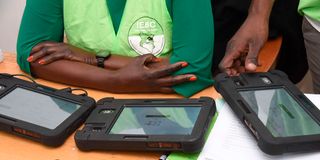
Only 20,754 new voters out of the targeted 6.3 million have been enlisted since the resumption of continuous voter registration on September 29.
The Independent Electoral and Boundaries Commission (IEBC) has decried the low turnout, especially among Gen Z, who have attained voting age.
A breakdown of voter registration shows that Nyamira County has enlisted a paltry 18 new voters, being the lowest, followed by Lamu (36), Tana River (42), Samburu (67), Tharaka Nithi (70), Elgeyo Marakwet (75), and Isiolo 81.
Nairobi County has recorded the highest number at 4,804 followed by Mombasa (1,379), Kiambu (1,203), Machakos (923), Nakuru (840), and Kisii (728).
“While we commend this progress, turnout among the targeted youth remains lower than expected. With a national target of 6.3 million new voters, the commission urges all eligible Kenyans, particularly the youth, to take this opportunity to register and make their voices count in the 2027 General Election,” IEBC Chairman Erastus Ethekon said.
The low turnout has persisted despite IEBC’s strategies to lure eligible youth into registering as new voters ahead of the 2027 General Election.
Introduction of Huduma Centres spread across the country as additional registration points and provision of universal registration kits in all the 290 constituencies were intended to ramp up registration of the Gen Z.
The Huduma Centres and the universal kits are aimed at ensuring eligible voters can register under their preferred polling stations without having to travel to their constituencies.
IEBC officials register a youth at the Nakuru Town-East Constituency offices on September 29, 2025, during the start of the continuous voter registration.
Photo credit: Boniface Mwangi | Nation
The requirement of having to travel to where one would want to vote has in the past been cited for registration apathy, especially among youth, who may at the time of registration are in colleges and universities.
IEBC commissioner Anne Nderitu, who chairs the commission’s subcommittee on voter education, explained that the changes sought to have more youth register as voters.
“One of the things we have done is to have two kits in every constituency office; one of the kits can register Kenyans from all over the country. So, if you are in Nairobi, and you want it to reflect in your preferred polling station, you don’t have to travel to your constituency,” said Ms Nderitu.
Mr Ethekon last month told MPs that the commission had come up with plans to mobilise Kenyans, including online and social media campaigns targeting the non-registered youths, as well as setting up registration centres in institutions of higher learning.
“We will use all messaging tools available to target the youths who are not registered. This includes setting up voter registration centres within the precincts of institutions of higher learning as well as using mobile voter registration facilities,” said Mr Ethekon.
According to the IEBC, the current electoral register contains 22.1 million voters, meaning the 2027 election will be decided by approximately 28.4 million voters, minus those who will have died by the time of the election.
Matatu operators queue to register as new voters at Mololine offices in Nakuru City on September 30, 2025.
Photo credit: Boniface Mwangi | Nation Media Group
The new voters, mostly Gen Zs, are expected to have a significant impact on the 2027 presidential election.
There is already a scramble for the crucial youth vote by both President William Ruto and the opposition figures, who have declared interest for the 2027 presidential race.
Popularly known as the Gen Zs, the generation has since taken an active role in the country’s politics. Although some of them were already registered before the 2022 elections, more would be eligible voters in the next poll, making them the most significant demographic in the 2027 race.
Born between the late 1990s and 2010, this group of young Kenyans is emerging not just as a voting bloc, but as a cultural and political movement.
They have shunned identity associated with any of the major political players who have historically divided the country along ethnic lines.
In the 2022 elections, Dr Ruto won by polling 7,176,141 votes against Mr Odinga’s 6,942,930. In that election, there were a total of 22.1 million registered voters, but only 14.3 million voters turned up to cast their ballot, meaning close to eight million voters failed to participate in the crucial exercise.
A report by IEBC showed that the youth turnout in 2022 was remarkably low. The same report showed that there were 8,811,691 registered voters aged between 18 and 34 – constituting 40 per cent of total number of voters ahead of the 2022 poll. This implies that their numbers alone were enough to tilt the outcome.