Forms they can't read, money they never see: Rural women vs Uwezo
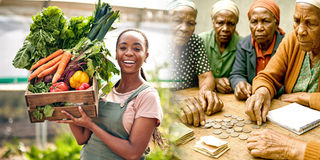
The Uwezo Fund has distributed Sh7.2 billion primarily to women, yet its impact remains uneven across Kenya, leaving many rural applicants wondering if the money is "meant for select women" only.

What you need to know:
- The Uwezo Fund, launched in 2013, has disbursed over Sh7.2 billion with 69 per cent going to women.
- Urban-based groups successfully access the funds through table banking models, expanding businesses from simple retail to tailoring and beadwork.
- Rural women struggle with language barriers, bureaucratic delays, and lack of communication, often dissolving their groups after months of waiting without receiving any money.
The determined faces of elderly women gathered around a table, their weathered hands clutching at hope as much as at their modest savings. For them, the Baraka Women's Centre wasn't just a building in Ngara—it was their lifeline, their pathway to dignity through learning.
"The women had no jobs and needed capital to start their preferred businesses, yet I was not a donor," Teresia Njora recalls, reflecting on the challenge that pushed her to find innovative solutions for her group's financial empowerment.
By 2021, Teresia had dedicated nine years to working with elderly and young women from low-income areas in Nairobi City County, equipping them with adult education, vocational skills, and entrepreneurial training. When donor support ended in 2015, causing the collapse of Baraka Women's Centre, the elderly women who had been receiving adult education refused to accept defeat.


"They demanded the continuation of their program, unconcerned about how I would sustain it," Teresia says.
With these determined grandmothers holding her accountable, she made an extraordinary decision—she sold her piece of land to breathe new life into the non-governmental organisation.
When Baraka Women's Centre reopened in 2017, it pivoted from adult education to vocational and entrepreneurial skills. But this shift brought a fresh challenge: after training, what next?
Teresia may not have been a donor herself, but she knew one: the Uwezo Fund.
Launched in 2013 by then-President Uhuru Kenyatta, the Uwezo Fund was designed as a lifeline—providing interest-free loans to women, youth, and persons with disabilities. The catch? Individuals couldn't access the facility; it was available only to organised groups.
Understanding this requirement, Teresia mobilised women into groups of 20, with Baraka Women's Group as the mother entity and three smaller 'baby groups' under its wing. She encouraged them to start modest businesses, such as grocery vending, while saving consistently within their groups.
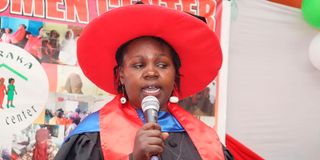
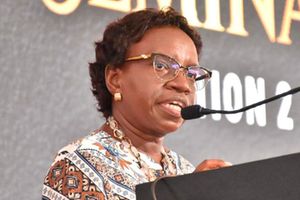
Baraka Women’s Centre CEO Teresia Njora addressing guests and graduates during the entity's graduation ceremony held in Nairobi on March 13, 2025.
These savings evolved into a revolving fund using the table banking model—an approach where members bring their savings to group meetings, place the money on the table for transparency and accountability, and then distribute loans to those in need.
In 2021, their persistence paid off. After approaching the Starehe Sub-county office of the National Government Constituencies Development Fund (NGCDF), the group applied for a Sh100,000 loan. Seven months later, the funds arrived.
"We invested the money into the group, and members took loans with a 10 per cent interest return. The money grew," Teresia explains, her voice carrying a note of pride.
With this increased capital, the women expanded beyond simple retail. Their businesses now include tailoring, basketry, and intricate beadwork—traditional crafts transformed into sustainable livelihoods.
Since its inception, according to the Uwezo Fund, more than Sh7.2 billion has been disbursed, benefiting 1,124,221 individuals, with women making up 69 per cent of recipients. Beyond financial aid, the fund provides training in entrepreneurship, basic bookkeeping, and market linkages—tools for long-term success.
Grace Wangari's story exemplifies the transformative power of accessible financing. A founding member of Baraka Women's Group, she once sold second-hand clothes, earning just enough to save Sh50 per week.
After receiving funding through the group, she secured a loan to establish a general shop in Grogan, downtown Nairobi. Today, her weekly contribution has quadrupled to Sh200.
"I am proud of the economic progress I have made through our table banking group. Without it, I would never have benefited from the Uwezo Fund," she says, her smile revealing both satisfaction and relief.
But just a few hours' drive away, in rural Kirinyaga County, the narrative shifts dramatically.
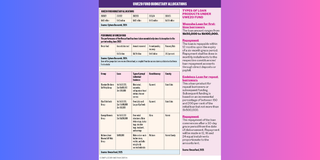
Sh7.2 billion from the Uwezo Fund has reached 69 per cent Kenyan women.
Rose Wanjiru, from Ngaru in Kirinyaga Central, has watched government initiatives come and go without touching her community.
"I am in a group, but I have never come across any group in my village that has received the Uwezo Fund. Is this money meant for select women?" she asks, frustration evident in her voice.
For Margaret Wanjiru, who chaired a group despite having limited formal education, the experience has been nothing short of heart-breaking.
In 2023, her 15-member group saved diligently for a year before applying for a loan, encouraged by their area chief. The application process immediately presented barriers.
"The application form was in English, a language I do not understand. Someone at the office had to interpret it for me, so even though I filled it in, I had no idea what was written," Margaret explains, highlighting a common obstacle for many rural women.
The waiting period proved even more stressful. For seven long months, they heard nothing. During that time, the members contributed Sh300 on three separate occasions to cover Margaret's travel expenses for follow-ups, but each time, the response was the same: "Not yet."
As weeks turned to months, suspicion replaced hope within the group.
"We had saved Sh100,000 in a bank account. As time passed with no news of the loan, suspicions arose. Some members accused me of trying to swindle them," Margaret recalls, the pain still fresh.
"They stormed my home, hurling accusations and demanding answers. The stress gave me sleepless nights. In the end, we withdrew the money, shared it out according to contributions, and dissolved the group."
What began as a journey toward economic empowerment ended in broken trust and abandoned dreams.
Navigating bureaucracy
The process of accessing the Uwezo Fund begins at the constituency level, where eligible groups can obtain application forms from the NGCDF office or the sub-county youth development officer.
Applications undergo scrutiny by the Constituency Uwezo Fund Management Committee, comprising representatives from the national government, Members of Parliament, and County Woman Representatives. This committee screens applications, shortlists qualified groups, and forwards their names to the Uwezo Fund Secretariat in Nairobi for final approval.
To qualify, a group must check several boxes: registration with the Department of Social Services, the Cooperatives Department, or the Registrar of Societies; members aged 18 to 35 years; operation of a table banking or other structured savings model with documented monthly contributions; and an active bank account in the group's name.
Margaret insists her group met all these criteria, yet they were subjected to an endless wait.

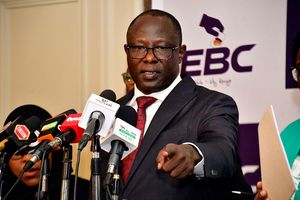
Uwezo Fund CEO Peter Lengapiani speaks during the 5th edition of the SMEs Conference and Expo held on March 21, 2024 at KICC in Nairobi. He says successful applicants receive training before funds are disbursed.
Peter Lengapiani, head of the Uwezo Fund Secretariat, defends the thorough vetting process as necessary for transparency and fairness.
"Applications are first reviewed at the constituency level before being forwarded to the board for approval. Various criteria are considered during vetting. The final list is reviewed to ensure compliance with all requirements," he explains.
According to Peter, successful groups receive notification and training before funds are disbursed. Delays, he says, can occur due to incomplete documentation or lack of follow-up.
"At the moment, we still use a manual system, but we are working towards automation. Most of our beneficiaries are more comfortable with the manual process, so we are adopting a hybrid model to facilitate both digital and physical applications," he adds.
The Uwezo Fund accepts applications year-round, operating as a revolving fund. The amount available in any constituency depends on repayments from previous beneficiaries.
"The faster groups repay their loans, the sooner they can access additional allocations," Peter explains.
However, delayed repayments in some constituencies slow down access for new applicants in the same area, as funds cannot be transferred between constituencies.
"We cannot transfer funds between constituencies. The policy ensures equitable distribution," Peter notes.
One significant barrier, particularly for older women, is language. Peter acknowledges this concern, stating that training materials have been translated into local dialects.
"We also rely on constituency-level committee members to communicate in the most accessible language for each group," he says.
The path forward
While the Uwezo Fund has transformed lives like Teresia's and Grace's, women like Margaret and Rose continue to wait, their hopes fading with each passing day.
"Why don't they make it easier for women of all ages in rural areas to access these loans?" Margaret asks.
"We should have those offices in the villages, with forms available in local languages. They should also provide frequent updates on the status of our applications instead of leaving us anxious and uncertain."
From Nairobi's bustling streets to Kirinyaga's quiet villages, the Uwezo Fund remains a tale of two realities—a bridge to prosperity for some, and a door that remains frustratingly closed for others.
For now, thousands of women continue to gather around tables, counting their savings shilling by shilling, banking on a promise that may or may not materialise.