'It was taboo, now it's normal': When water scarcity rewrites gender roles in Bomet
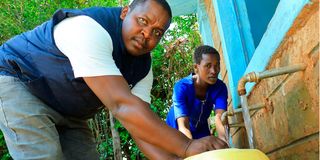
Miriam Sitonik (right) and Joseph Kitur, residents of Olbobo village in Bomet County, draw water at a water kiosk on August 25, 2025. The facility has encouraged men to fetch water for their families—a task that was previously considered taboo and left to women and children.

What you need to know:
- Traditional gender roles are being shattered in Bomet County as Kipsigis men break century-old cultural taboos by queuing alongside women to fetch water.
- The transformation has ended decades of acute water shortage that previously forced residents to trek over two kilometres to contaminated river sources.
The sight would have been unthinkable just a few years ago—grandfather Joel Koech standing patiently in line under the scorching Thursday afternoon sun, surrounded by women and children, waiting to fill his 20-litre jerry cans from three running taps at a village kiosk.
In Olbobo village, Kipreres ward, Bomet East Constituency, this scene has become routine. Men armed with water containers, handcarts, donkeys, and motorcycles now queue alongside the women, shattering age-old cultural barriers that once made water collection strictly a woman's domain among the Kipsigis community.
"The society frowns at a man fetching water from local rivers as there is a high chance of bumping into one's mother-in-law and grandmothers. It has been known as a traditional role for women and children in the local community," explains Mzee Koech, his weathered hands gripping the handles of his jerricans.


But desperate times have rewritten the rules. The chronic water shortage that plagued this dusty, rural community for decades has forced a complete paradigm shift in traditional gender roles—one jerry can at a time.
Necessity breaks tradition
The transformation began with the drilling of the Olbobo borehole in 2022, though it remained unequipped until April 2025. The project, funded through the national government's Financing Locally-led Climate Action (FLoCCA) program and the Bomet County government, finally brought an end to generations of acute water shortages.
"It was unheard of in the past to see men queuing in the rivers to collect water with women and children. It was actually considered a taboo for one to do that. But the narrative is changing fast and spreading across due to the challenges facing households," Koech reflects.
Joseph Kitur, a resident of nearby Omega village, witnesses this cultural revolution daily. "Water for washing clothes, bathing, cooking, irrigating the farm, and feeding livestock is now being fetched equally by men, women, and children. It has become a shared responsibility due to the scarcity that has been experienced in homesteads for decades."
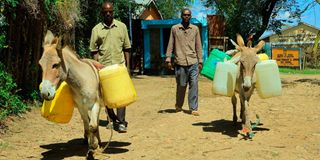
Caleb Kiprono Koech (left) and Wesley Koech, residents of Olbobo village in Bomet County, lead donkeys carrying water for their families on August 25, 2025. The men are part of a growing trend in the area where males are taking on water-fetching duties, breaking traditional cultural practices and norms.
The peasant farmer sees deeper implications beyond the immediate practical needs.
"The phenomenon is a complete paradigm shift in family roles and management among members of the Kipsigis community that has far-reaching effects on the society."
While women and children continue to carry 20-litre containers on their backs, hands, and heads, making multiple daily trips to the water point, men have brought efficiency to the task. They use handcarts, bicycles, and motorcycles, transforming water collection into a more productive enterprise.
"I carry the 20-litre jerry cans to my home using a motorcycle daily, and that has helped me turn around my farming enterprise with healthier livestock than before," Kitur explains.
The results speak for themselves: "A cow that produced four litres of milk is now producing seven litres, with prospects of further raising production due to the feeding regime and high water intake."
Festus Kirui, chairman of the Olbobo water project, oversees an operation that currently supplies water to 600 households, with plans to extend coverage to a maximum of 1,000 homesteads. The beneficiaries already include Olbobo primary and secondary schools, a local church, with plans to expand to the nearby Olokyin dispensary and additional churches.
The project's pipeline will eventually reach Kapliyo, Olokyin, and Kiplobotwo sub-locations, areas where residents previously trekked to the Amalo River—a tributary of the Mara River on the Bomet-Narok border—for their water needs.
Transformation
"The problem with local rivers is that the water is contaminated due to washing of clothes and open bathing upstream and drawing of the same water downstream for domestic use," Kirui explains.
"The issue of contamination has now been eliminated with the construction and opening of the community water project that has solved many long-standing issues cutting across health, agriculture, and economic empowerment."
Ann Soi, a grandmother who has called Olbobo village home for over 60 years, remembers the dark days all too well.
"Typhoid has been a major problem for generations in the area, which is now being addressed with fewer people seeking medication from Longisa County Referral Hospital. It is a major relief to us as residents."
The cultural shift amazes her most: "The fact that husbands are queuing with their mothers-in-law, children, elderly, and young women for water is historic in the sense it was regarded as taboo—one that has now been broken."
Time and distance conquered
Deborah Chelangat recalls the exhausting routine that defined women's lives for generations. "Water scarcity had been the order of the day for decades, with the issue getting worse during dry seasons. It was a sigh of relief and blessing to the residents when the borehole was drilled and equipped, enabling residents to access this important resource."
The transformation is measurable: "It used to take us over an hour to and from the river to fetch a 20-litre jerry can of water, but it now takes less than 15 minutes to access clean, safe drinking water."
Solomon Kimetto, Chief Officer for Water, Environment, Natural Resources, and Climate Change, observes the ripple effects across the community. "The farms in the area are now green and full of healthy vegetables as residents use water from the borehole to manually irrigate their gardens and orchards. Issues related to hunger and health are being addressed inch by inch in this area."
The project embraces sustainability through solar-powered pumping systems, embodying green energy to cut operational costs. "The water is provided for free to the residents of the area, and there is no restriction on the volumes one can collect in a day," Kimetto notes.
Traditional vegetables now flourish in evening-watered gardens, enhancing food security and nutrition while creating surplus for local markets.
Johana Mosonik, a livestock farmer, testifies to the project's transformative power. "I can attest to the difference the water project has had on the residents and their animals since it was handed over to the local community by FLoCCA and the Bomet County government."
His livestock now drink more water due to its availability and proximity, resulting in better health and production. "I am now planning to raise the number of livestock I have on the farm so I can move towards running a commercial enterprise, which will enable me to educate my children."
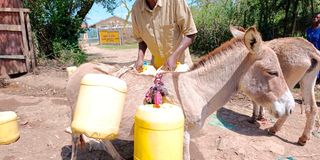
Caleb Kiprono Koech, a resident of Olbobo village, loads jerrycans of water onto a donkey on August 25, 2025, at a water kiosk. The facility has prompted men to fetch water for their families, breaking with local cultural traditions and customs.
Hillary Ngeno, a resident of Kiptunoi village, remembers how water scarcity disrupted education. "It was common for school children to skip classes for days after contracting typhoid, while others were withdrawn during dry season to help their parents fetch water and drive their animals to rivers that are far apart."
Joel Koech from Omega village recalls the gruelling distances: "Residents used to trek for over two kilometres to get water both for their livestock and domestic use."
The Olbobo success story is part of a broader network of water projects across Bomet County. However, significant challenges remain. The County faces water shortages across all five sub-counties: Bomet East, Bomet Central, Konoin, Chepalungu, and Sotik. The Bomet Water Company struggles with operational and management challenges, carrying a debt of over Sh300 million, unable to pay employees for more than 19 months, and owing Kenya Power more than Sh28 million in unsettled electricity bills.
The national government's Sh1.2 billion Bomet-Longisa-Mulot water project, started in 2019, has faced implementation challenges but shows progress with 48 per cent completion as of June 2025. The Itare water project, spanning Bomet and Kericho counties, has failed to adequately supply residents, prompting the national government to consider taking over its management.
Residents of Bomet town have endured nine months without water, a crisis exacerbated by population growth during 15 years of devolution, increased institutions, and rural-urban migration. Bomet East constituency remains the most affected by water shortages, having been neglected by both national and county governments in infrastructure development.
Looking forward
Prof Hillary Barchok, the Bomet Governor, acknowledges the community-driven nature of these climate-resilient projects. "The climate-resilient projects are driven by community needs, with streams, springs, rivers, and water pans being far apart. Work plans are being developed for implementation of the five-year FLoCCA program."
The Governor actively seeks donor partnerships for water provision, recognising the capital-intensive nature of the undertaking.
"The FLoCCA program, especially on climate change, was addressing problems that would otherwise not have been possible to address as a county without donor support."
The county government faces major challenges in providing water to residents, especially in Bomet town and major trading centers including Silibwet, Kapkwen, Mulot, Longisa, Sigor, Sotik, and Mogogosiek.
Back at the Olbobo water kiosk, as the afternoon sun beats down on the queue of men, women, and children, something profound is happening. Traditional gender roles that seemed carved in stone are dissolving, replaced by practical partnership born of necessity.
In this dusty corner of Bomet County, water hasn't just quenched thirst—it has washed away centuries of cultural barriers, proving that sometimes the most profound social changes flow from the most basic human needs.


