'They are taking our women': The gender politics behind South Africa's anti-migrant violence
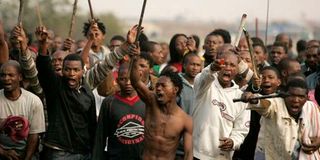
Protesters during clashes believed to be linked to anti-migrant violence in Reiger Park informal settlement. South Africa's police and ruling ANC party intensified efforts to quell deadly violence against foreigners.

What you need to know:
- Apartheid-era divisions, economic inequality and wounded identities continue to shape recurring waves of Afroxenophobic violence.
- Decades after independence, unresolved injustices and resentment still fuel hostility towards black African migrants.
The apartheid doctrine of ‘divide and conquer’ used imposed differences to cultivate tension among black communities. Architects of apartheid's white power structure separated black residences along ethnic lines, using a stratification model. The Zulu, Xhosa, Tswana, Ndebele, Swazi, Tsonga, Venda, Sotho, Bhaca and Pedi were subjected to low-income, ethnically segregated urban areas and pushed into resenting one another, rather than their white oppressors.
This carefully crafted distraction built a psychological admiration for whites and quietly planted seeds of conflict, hostility and self-hatred among black communities. Ethnic loyalties hardened, tribal circles formed, and it became common for a black person to be brutally assaulted or killed for straying into an opposing ethnic territory.
Black townships of Daveyton in East Rand, Alexandra on northeast Jo'burg, and Soweto in the southwest were created as labour pools for the affluent white suburbs of Benoni, Boksburg and Sandton. Serving white interests was deeply ingrained, fostering an inferiority complex among black people and leaving them with a distinct self-loathing and a troubling Stockholm syndrome, a condition where oppressed people become loyal to their oppressors.


Shebeensselling cheap liquor were opened in black areas to push demoralised black men towards alcohol addiction and nurture a community perceived as lazy, impulsively violent, and deferential to white authority. The result was a toxic social environment that idolised white people, viewed every other black ethnic group as a threat, and gave rise to systemic Afroxenophobia; the hatred of black foreigners.
In 1993, the year before independence, civil conflict escalated and ethnic factions murdered and burnt black people from rival ethnic groups. The psychological trauma and deep stress responses that apartheid had planted were ultimately unleashed in this brutal proxy war.
After independence, the Freedom Charter, a landmark document that proposed financial equity, fair distribution of resources and just factory wages and dividends, was never implemented. Instead, privileged white entrepreneurs co-opted black economic empowerment leaders Tokyo Sexwale, Patrice Motsepe and Cyril Ramaphosa, offering them board positions in multiple large companies that made them wealthy.
Funds owed to workers as dividends were funnelled into the pockets of a few black leaders, to protect white business interests. White-owned South African banks began charging black customers excessive interest rates on car and mortgage loans. A hidden system of apartheid disguised as freedom kept wealth and 80 per cent of land firmly in the hands of the white minority.
The first publicised Afroxenophobic attack occurred in September 1998, when a Mozambican and two Senegalese nationals were thrown from a moving train travelling from Pretoria to Jo'burg. In the early 2000s, a wave of black migrant entrepreneurs settled in the commercial cities of Jo'burg, Cape Town and Durban, and a derogatory term, kwere kwere, was used to describe them.
More migrants moved into smaller cities in the provinces of Limpopo, Mpumalanga and Eastern Cape, opening spaza shops and tuck-shops that became direct competitors to white-owned supermarkets and malls. Since May 2008, there have been more than 10 mass waves of Afroxenophobic or Afrophobic attacks. In 2012, 'Operation Hardstick', a military-style campaign run by the police, targeted black refugees and migrants in Limpopo. In October 2013, 'Operation Cleansweep' forcibly removed black immigrant traders from Jo'burg pavements. In April 2015, a wave of vigilante-led Afroxenophobic attacks in Durban required the intervention of the South African Defence Force.
Migrants from Bangladesh, India, Pakistan and China were largely unaffected, but foreigners from black nations of Nigeria, Zimbabwe, DRC, Malawi and Ghana were singled out and targeted. The accumulated hatred, dehumanisation and lack of empathy that apartheid had cultivated conditioned black South Africans to resent anything that reminded them of themselves.
Whenever black immigrants arrived at OR Tambo in Jo'burg, King Shaka in Durban and Cape Town International, they were met with hostile stares, dismissive questions and demeaning remarks. The discrimination was noticeably worse for those with darker skin tones. Mean Streets: Migration, Xenophobia and Informality in South Africa, a non-fiction book edited by Jonathan Crush, Abel Chikanda and Caroline Skinner, notes that despite these obstacles, black migrants showed a remarkable entrepreneurial drive in the informal sector.
The cover of Mean Streets: Migration, Xenophobia and Informality in South Africa, a non-fiction book edited by Jonathan Crush, Abel Chikanda and Caroline Skinne.
A study of street traders in inner-city Jo'burg found that the initiative, competitive drive and overall entrepreneurial spirit of black migrants pushed them to excel. This determination among West African traders attracted the attention of many South African women. Black South African women's interest in hardworking black foreign nationals, particularly from West African nations of Cameroon, Nigeria and Ghana, unsettled and angered South African men. Many South African women were drawn to the confidence, expressiveness and romantic effort that characterise West African dating culture.
Domineering masculinity
Across many West African ethnic groups, specifically the Igbo, Yoruba and Akan, traditional masculinity holds that a man must provide, protect and lavish his partner with gifts. West African men, known for their social generosity, place great value on verbal appreciation, courtship and chivalry.
Local women who had grown used to the dating dynamics of distant and inconsiderate men found the West African emphasis on provision and affirmation appealing. South African women became increasingly vocal about expecting generosity in courtship and lifestyle, calling it the “princess treatment”. They found West African ambition, directness and confidence a striking contrast to the emotional withdrawal of many South African men.
South African men’s resentment was further inflamed by social media content that cast West African men as romantically and sexually superior, a narrative that fed wounded masculinity and was used to justify fresh waves of violence. This stirred bitter rhetoric and led to a new wave of attacks, as locals accused African immigrants of “stealing our women” and launched fresh Afroxenophobic violence in late 2025, under the false pretext of protecting local jobs.
The writer is a novelist, Big Brother Africa 2 Kenyan representative and founder of Jeff's Fitness Centre (@jeffbigbrother).


