'We rejected harmful traditions': Young West Pokot women turn cultural craft into thriving business
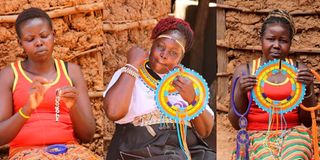
Dorcas Cheyech, Joan Cheyech and Faith Chepengat do beadwork in Chepararia, Pokot South, West Pokot, on April 8, 2026.

What you need to know:
- In Pokot South, young women are reclaiming beadwork to rebuild lives after escaping harmful cultural practices.
- Survivors of child marriage and FGM are turning traditional beadwork into income and independence opportunities.
When we arrive at a compound in Chepararia, Pokot South, West Pokot, a group of young girls are busy doing beadwork. Such a scene would have been rare years ago.
For decades, beadwork—usually practised by pastoralist communities such as the Maasai, Samburu, Pokot, Marakwet, and Turkana—was associated with elderly women. However, young women in their 20s have now taken up beadwork and business, thus reshaping the industry.
Many of these young women are survivors of female genital mutilation and child marriage. With jobs becoming scarce, they resorted to beadwork to earn a living, often after cutting ties with their families for rejecting the cultural rite.

One of them is Dorcas Cheyech, a child marriage survivor from Chepararia village. Dorcas tells the Nation that she narrowly escaped being married off. She fled and sought help from a local gender activist who sheltered her and took her to school. “During school holidays, I would learn how to make different products in beadwork, which I was taught by my guardian,” she says.
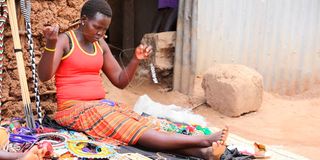
Dorcas Cheyech makes bead products in Chepararia, Pokot South, West Pokot, on April 8, 2026. The child marriage survivor sells bead products to raise money for upkeep.
She is grateful to her guardian for introducing her to beadwork at a young age, a skill that now helps her earn a living. “I used to accompany my guardian to the market to sell bead products. From the little cash I made, I was able to enrol at Kitale National Polytechnic, where I pursued a certificate in supply chain management.”
Last year, Dorcas, armed with Sh3,000 savings, started her own beadwork business. In a bad month, she earns between Sh3,000 and Sh5,000, while in a good month she makes at least Sh10,000. She identifies October, November, and December as peak seasons, when sales rise due to increased ceremonies.
The young entrepreneur hopes to use her savings to return to school and pursue a diploma. She also plans to save for a smartphone to support digital marketing, expand her market reach, and boost her income. “The business is seasonal and most profitable towards the end of the year. Starting a good bead business also requires substantial capital, and the products are expensive. However, despite these challenges, I have so far managed to save Sh30,000, which I hope to use to expand my business,” she says.
Faith Chepengat from Kacheliba, another child marriage survivor, has embraced beadwork. She is 20 years old. She was fortunate to find a well-wisher who took her to a shelter, where she has lived since 2016 after fleeing forced marriage. The shelter has supported her education, and she has completed her Kenya Certificate of Secondary Education. She is set to join university in September.
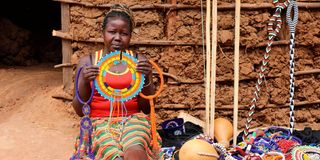
Faith Chepengat displays her bead products in Chepararia, Pokot South, West Pokot, on April 8, 2026. Faith evaded child marriage and now wants to pursue nursing at university to help survivors of female genital mutilation.
During school holidays, she also learned how to make beadwork products, eventually becoming a skilled bead-maker. “My mission is to start my beadwork shop, where I will sell beadwork products. I do not have the capital, but I am optimistic that the dream will one day come true,” Faith says.
Since completing Form Four, she has relied on beadwork to raise money for her education. She doubts her father “will agree to fund my education, as I defied him and refused to get married as he wanted”.
She saves about Sh3,000 a month—an amount she says is too little to fully fund her education. She has appealed to well-wishers to help pay her fees and support her dream of becoming a nurse.
“All I want is to have customers for my beadwork. If I can get orders for my products, then I would not have to worry about getting money to join university come September. I intend to pursue a Bachelor of Science in Nursing,” she adds.
The two young women make a wide range of jewellery, including necklaces, cuff bracelets, earrings, beaded belts, collar necklaces, dancing dangle earrings, and leather-beaded bracelets. They also produce beaded sandals, passport holders, handbags, luggage tags, tassel key chains, and dog collars.
In addition, they create home décor items such as beaded coasters, napkin rings, Christmas ornaments, and animal sculptures. They also craft cultural items, including intricate collars and headbands that signify social status, marital status, or ethnicity. Their products cost from Sh100 to Sh30,000 apiece, depending on design and detail.
Generational shift
For decades, elderly women in Kenya have practised beadwork as custodians of culture while serving as economic anchors for their families. The craft has long provided a sustainable, traditional livelihood and remains deeply embedded in cultural identity, economic resilience, and community leadership.
These older women have preserved cultural heritage while adapting to modern economic demands. Joan Cheyech, a guardian to the two young women, says she is pleased they chose to learn bead-making. “I am happy that the two young women were proactive enough and willing to learn about bead-making. They are now able to make some money when they sell these products and can support themselves,” she says.
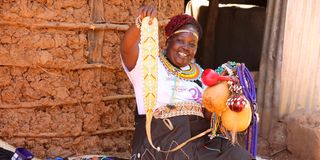
Joan Cheyech displays some of her bead products at her home in Chepararia, Pokot South, West Pokot, on April 8, 2026. Joan is a leading bead products trader in West Pokot. She uses part of her beadwork proceeds to support survivors of child marriage and female genital mutilation.
In recent years, bead products have gained popularity in Kenya as a significant economic activity. The industry, rooted in pastoralist traditions, features vibrant hand-beaded jewellery, leather accessories, and home décor. More than 50,000 artisans in Kenya are engaged in beadwork, making it a key source of livelihood, especially for women in pastoralist communities.
Beadwork has evolved from a hobby into a structured, income-generating activity, supported, for instance, by the Ushanga Initiative, which has established over 60 cooperatives and trained thousands of women.