'We were blind, but now we see': Koko’s journey from FGM to change agent
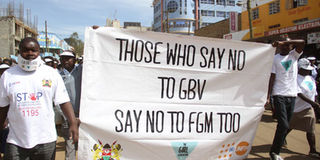
An anti-FGM campaign: Participants march during a campaign to end female genital mutilation.

What you need to know:
- Koko’s transformation shows how education, community leadership, and global partnerships are dismantling harmful traditions like FGM.
- Despite legal reforms and activism, 27 million girls risk FGM by 2030 unless global momentum accelerates urgently.
A woman identified as Koko from Mali narrated to a joint team from UNFPA and Unicef how she witnessed the death of two girls being subjected to female genital mutilation (FGM).
At first, Koko told the team conducting a survey on FGM that she never thought FGM was wrong until she witnessed the two deaths. “I witnessed the two girls die. That was a turning point,” she said.
Her perception of the outlawed cultural practice when she, through the support of the Joint Programme on Elimination of FGM, joined a community education programme that changed her life – and her voice.


Read: FGM's bold return: A decade of silence, now proudly public, and why old messages aren't working
“Thanks to the programme’s awareness sessions, we now understand the dangers of FGM and early marriage. We’ve left these practices behind to protect our daughters’ health and future. We were blind, but now we see,” she said with pride.
Today, Koko is a respected community member, serving in the village’s community management committee and leading income-generating activities for women. Her story, like many others, is a powerful testament to what happens when tradition meets progress and communities choose change.
“FGM is not a rite of passage. It is a danger. And no girl should suffer in silence as mine did,” Koko said. “We owe our daughters better.”
The programme by the two UN agencies has been instrumental in fighting the elimination of FGM on the continent. According to Unicef, over 230 million girls and women have been cut around the world, with Africa accounting for the largest share with over 144 million.
And even as the women like Koko and many others join the anti-FGM bandwagon, the findings by the latest survey by UNFPA-Unicef Joint Programme FGM are worrying. The survey indicates the slow pace in the fight against FGM will result into about 27 million girls undergoing the cut by 2030.
The survey, conducted in 18 countries including Kenya, indicates the fight against FGM is not moving fast enough to meet the global target of elimination by 2030. The report, however, shows that that the percentage of adolescent girls aged 15–19 who have undergone FGM declined from 47 per cent in 1993 to 33 per cent in 2023.
Positive outcomes
It is, however, not all groom as the survey found some positive outcomes. The survey shows that in 2024, about 1.1 million girls aged 0 to 14 years were protected from undergoing FGM. It also indicates that two million women and girls have initiated conversations on FGM elimination with an additional 50 million people making public declarations to abandon FGM.
A total of 19,809 communities established surveillance systems to protect girls from undergoing FGM, which resulted in close to seven million girls and women received FGM-related prevention and protection services.
Some 452 arrests made as part of enforcing FGM legislation and an additional 405 cases brought to court as part of enforcing FGM legislation. Over 230 million girls and women worldwide have undergone FGM. One in 144 million live in Africa, more than 80 million in Asia and around six million in the Middle East.
While FGM prevalence is concentrated on two continents, it is reported in 94 of 195 countries (48 per cent) globally. The percentage of girls and women aged 15–49 who have undergone FGM varies significantly among countries with available data, from 0.2 per cent in Uganda to 99 per cent in Somalia.
Progress has been made in reducing the global burden of FGM. Over the last 30 years, Burkina Faso, Ethiopia, Kenya, Liberia, Maldives and Sierra Leone are among the countries that have made great strides in diminishing national prevalence.
Kenya is among the few African countries that have enacted a law to tame FGM, the Prohibition of Female Genital Mutilation Act, 2011. The law enacted in 2011 has outlawed the cultural practice and carries a minimum punishment of three-year imprisonment and a Sh 200,000 fine.
Law enforcement
Besides the enactment of the law, the Kenyan government has been leading some initiatives to tame the vice. The Anti-FGM Board has, for example, been leading the Dear Daughters to sensitise mothers to stop passing on the FGM trauma to their daughters.
The campaign is a generational declaration by mothers to protect their daughters from FGM for a future free from the vice. Anti-FGM Board CEO Bernadette Loloju said the campaign is encouraging mothers who underwent the cut to write letters to their daughters and protect them.
The campaign also involves girls who have been saved from FGM to create their own movement called ‘Daughters against FGM’. They stand up for themselves and denounce the practice.
The campaign will require mothers to write letters to their daughters about FGM vowing not allow them to be cut, a move that will see the passing of the generational button of ending FGM among their families and communities.
The letter reads, “Dear daughter, even though I went through FGM trauma, I will not let you go through the same. Mothers are better placed to protect their daughters than anybody else because we cannot place a police officer in every household, but a mother can be the best protection for her daughter,” Loloju told theNation.
In other countries, such as The Gambia, Guinea-Bissau, Mali and Somalia, prevalence has remained about the same. While progress is uneven, the pace of FGM elimination has generally increased. Half of the progress realised over the last 30 years has occurred in the last decade.
A recent report indicates that the percentage of adolescent girls aged 15–19 who have undergone FGM declined from 47 per cent in 1993 to 33 per cent in 2023. In 2024, through the Joint Programme, 1,749,492 girls and young women participated in social and behaviour change programmes to foster critical life skills and promote FGM abandonment.
These programmes included girls’ in- and out-of-school clubs, community dialogues and advocacy platforms. They leveraged digital technologies to enhance accessibility and engagement. The result exceeded the 2023 achievement of 1,068,595 by 64 per cent and the 2024 annual target of 1,154,931 by 51 per cent.


