Explainer: Frequent questions asked about FGM
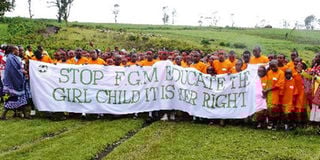
Some 247 girls who took part in the alternative rite of passage at Olosito Primary School in Narok North. An alternative rite of passage is one of the efforts employed to eliminate FGM.

What you need to know:
- Female genital mutilation is a harmful, non-medical practice causing lifelong physical and psychological health complications.
- It affects millions globally, driven by cultural and religious beliefs, with efforts focused on education, legislation, and empowerment.
What is female genital mutilation?
UN Women defines female genital mutilation (FGM) as all procedures involving the partial or total removal of female external genitalia or other injury to female genital organs for non-medical reasons.
It is also referred to as female circumcision or female genital cutting. FGM is normally carried out between infancy and age 15, although older girls and women may also undergo the practice. It is most often performed on minors by traditional practitioners, making it a violation of girls’ rights.


According to World Health Organisation, FGM is classified into four types. Type 1 (Clitoridectomy) is the partial or total removal of the clitoris and its surrounding tissue. Type 2 (Excision) involves the partial or total removal of the clitoris. Type 3 (Infibulation) is the narrowing of the vaginal opening by creating a seal, formed by cutting and repositioning the labia. And Type 4 refers to all other harmful procedures to the female genitalia for non-medical purposes, such as pricking, piercing, scraping, or cauterising.
What are the consequences of FGM?
Female genital mutilation has no health benefits for girls and women and causes immediate and long-term health consequences. Immediate sexual and reproductive health issues like severe bleeding, infections, urinating problems, and debilitating pain are attributed to this vice. Later in life, girls who have been subjected to FGM face longer-term health risks, such as chronic pain, cysts, abnormal scarring, menstrual problems, sexual problems such as pain during intercourse, infertility, complications in childbirth, postpartum hemorrhages, stillbirth, and increased risk of newborn deaths. In some cases, these complications are fatal to the woman.
Where is FGM practised?
UNFPA and UN Women note that FGM is a global problem, and is carried out in 92 countries around the world. Of these countries, just over a half (51) have national laws prohibiting FGM. In Africa, FGM is reported in 33 countries, while in the Middle East, the practice occurs in Iran, Iraq, Jordan, Oman, Palestine, the United Arab Emirates, and Yemen.
In Asia, this vice has been documented in India, Indonesia, Malaysia, Sri Lanka, Bangladesh, Thailand, Brunei, Singapore, Cambodia, Vietnam, Laos, the Philippines, Afghanistan, Pakistan, and the Maldives. Europe also has FGM cases in Georgia, Russia, and the United Kingdom, often within migrant communities. FGM cases have also been identified in the Americas and Oceania: The United States, Canada, Australia, New Zealand, Colombia, Ecuador, Panama, and Peru.
Who is at most risk of FGM?
UNFPA estimates that more than four million girls were at risk in 2023. The UN agency notes that efforts to prevent the practice have led to positive results, with the proportion of girls undergoing the cut dropping from over 46 per cent in 1993 to 31 per cent in 2023. Girls living in poverty and in rural and remote areas are more likely to experience FGM. The practice is more widespread in Africa, where 144 million women and girls have been cut. However, countries like Cameroon, Ghana and Uganda have achieved the target of eliminating FGM before 2030. UNFPA says if the rates continue at current levels, 68 million girls will be subjected to FGM between 2015 and 2030 in 25 countries.
Why is FGM practiced?
Anti-FGM Board CEO Bernadette Loloju observes that the reasons behind FGM vary across regions and communities, often depending on cultural, social, or religious beliefs. In some communities, she notes that FGM is seen as a rite of passage into womanhood, while in others, the practice is used to control a girl’s sexuality or to ensure her “purity” and fidelity to marriage. Social pressure to “fit in” and the fear of exclusion also play a significant role in keeping the practice alive. In regions where FGM is widespread, many families see it as crucial for securing a girl’s future, believing it increases a girl’s prospects of marriage and access to inheritance.
What is medicalisation of FGM?
Medicalisation of FGM refers to the practice carried out by healthcare providers instead of traditional practitioners. Two-thirds of all girls who have recently undergone FGM in the world, according to UNFPA, have been cut by health workers. Some people mistakenly believe that having the procedure performed by medical professionals reduces underlying risks. However, medicalised FGM still violates human rights and has no health benefits.
Data provided by Nairobi County shows that more than 2,000 women living in the city reported to hospitals in 2022 with FG- related complications. The figures indicate that from January to December 2022, some 2,479 expectant mothers who visited hospitals for antenatal care and delivery had FGM-related complications.
What is being done to stop FGM?
Numerous interventions to end FGM include a combination of legislative action, community engagement, and innovative approaches.
How is FGM criminalised?
This is through enacting and enforcing laws to ban FGM. Kenya, for example, banned the practice in 2011, paving the way for the Female Genital Mutilation Act that carries a minimum punishment of three-year imprisonment or a Sh200,000 fine.
What's healthcare intervention?
FGM is becoming increasingly medicalised, despite efforts to prevent this. Health workers play a vital role in preventing its medicalisation and educating communities about its harmful effects.
What's the role of traditional and religious leaders?
Engaging traditional and faith-based leaders is key to ending FGM. These leaders hold deep influence in their communities, and when they speak out against the practice, attitudes begin to shift. In West Africa, for example, nearly 9,000 communities have abandoned FGM through Tostan’s Community Empowerment programme, a movement largely driven by local leaders who champion women’s rights.
How do you involve men and boys in the fight?
Men, as influential members of communities can challenge societal norms and advocate ending FGM. Faith Nashipae, a leading Men and Boychild champion in Kenya, says the involvement of men and boys in increasing positive masculinity and ending violence against women and girls is critical. “Male engagement and inclusion is paramount if we want to achieve gender equality as a country. It will present an opportunity to address social issues that disadvantage men, women, boys and girls in our society,” she says.
Faith, who is also the chairperson of the national committee on male engagement and inclusion, adds that engaging men and boys is a transformational approach in ensuring social norms transformation and ending violence against women and girls. She further says that to change social norms in different communities, men have to be fully involved given that they are the gatekeepers of culture and most perpetrators.
How can the international community cooperate?
Strengthening legal frameworks to address cross-border FGM and harmonising efforts across countries is essential for its elimination. The United Nations has played a pivotal role in global efforts to end the cutting of girls and women using resolutions that have consistently called for the end of all harmful practices against women and girls. In 2021, Kenya, Uganda, Tanzania, Ethiopia and Somalia launched the action plan to end rampant cross-border female circumcision. The plan was launched by gender ministers drawn from the five countries.
The action plan constitutes a framework at the regional level for state and non-state actors to enhance prevention, protection, and prosecution programmes in ending cross-border FGM. It also sets out a regional mechanism for regional and national efforts. In 2024, the European Parliament adopted a new directive forcing all European Union countries to criminalise FGM, increase awareness of the practice, and provide support to survivors.


