"Who will marry them?” How one mother proved FGM critics wrong
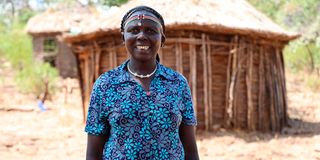
Chepomanta Todokwiang at her home in Kamrio, Baringo County, on January 22, 2025. She refused to have her daughters undergo female genital mutilation.

What you need to know:
- Chepomanta Todokwiang from Tiaty defied her community by refusing to let three of her daughters undergo FGM, despite facing ostracism and being branded a traitor.
- Though her eldest daughter was forcibly cut by an uncle seeking bride price, Chepomanta's stand proved successful as her uncut daughters found marriage and acceptance.
In a village where tradition speaks louder than a mother's plea, Chepomanta Todokwiang, 54, did the unthinkable: she said no. No to the blade, no to the whispers, and no to a cycle that had stolen the innocence of generations before her.
They called her a traitor, a rebel against her own people. But she stood her ground. Deep in Kamrio, Tiaty, where female genital mutilation (FGM) is a passage and refusal attracts labels such as a pakalian or chepngokighion (someone who refuses to have their daughter circumcised), Chepomanta chose to protect three of her daughters.
It is a sunny and windy Wednesday and we are seated under a tree as the mother of nine shares her story.


“I underwent the cut, so I know first-hand how it is. Deep down, I knew I didn't want my daughters to go through it, but I didn't know how to stop it," she starts...
"Then, when I joined the church in the early 2000s, the pastor constantly preached against FGM, saying it was boys who ought to be circumcised, not girls. That was my light-bulb moment. It set me on a path a few had dared to take, especially in my community.”
As a result, her decision did not sit well with the community, and many spoke ill of her, refusing to associate with her.
They asked, “Who will your girls live with? Who will marry an uncircumcised girl? But I did not let their words affect me. I had already made up my mind.
“What about Mzee (your husband)? What was his stand in all this?” He was undecided. To him, if the girls chose to get circumcised, he would not stand in their way, but if they did not come begging him for it, he never bothered.”
While it was somewhat voluntary, Chepomanta says she dissuaded her daughters from undergoing FGM through the word of God.
“I would tell them that if they pass through the cut, they would have sinned against God and he would burn them because FGM is a sin.”
However, as a mother of four girls, her firstborn daughter was forcibly circumcised, a decision made by her uncle so that he would claim his share of the bride price, a painful, heart-breaking memory etched in her heart.
“My brother had begged me to let my daughter live with him to help tend his livestock, and that's when it happened...” she opens up, her face clouded with sorrow.
A circumcised girl brings in a lot of wealth (livestock) because it is assumed she has attained all traditional customs and there is a potential suitor willing to pay her bride price.
“...when the ceremony was over, my daughter ran back home with my brother chasing after her. As soon as she arrived, she tearfully told me what had been done to her. I scolded my brother for going against my word and forbade my children from visiting him.”
Contrary to the belief that her girls would remain unmarried, Chepomanta says her three girls got their suitors and their bride price was as valuable as that of circumcised girls.
Though the value of education for girls remains a topic of debate in the area, Chepomanta saw the light when World Vision began sensitising them to the dangers of FGM.
“Now, instead of letting my girls drop out at Class Eight, I have allowed my last daughter to go to school further. Now she is in Form Two,” she says with a smile on her face.
Chepomanta not only advocates education but also campaigns against harmful practices. “It is wrong to allow girls to go through the cut as it will be dreadful when they are delivering children,” she says.


