1,000 days of waiting: What happened to free diapers, sanitary pads, SHA cover, and equal Cabinet?
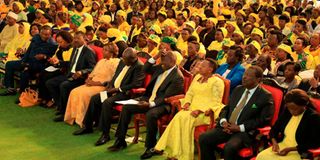
President William Ruto leads other Kenya Kwanza luminaries during the coalition’s women charter conference in the Nyayo National Stadium, Nairobi, 2022.

What you need to know:
- Despite the President's bold pledges, gender rule, Cabinet parity, and support programmes for women remain unimplemented.
- Women await promises on leadership, healthcare, and economic empowerment made in 2022.
On June 10, 2022, William Ruto, then Kenya’s Deputy President, signed a women’s charter outlining his policy interventions if he won the August 7, 2022 election.
The event in Nyayo National Stadium, Nairobi, was electrifying, with thousands of women in United Democratic Alliance party colours. Dr Ruto went on to win the presidential election. The Kenya Kwanza Alliance Women Charter sought to enhance inclusion in political and economic spheres.
Top of its agenda was the implementation of the two-thirds gender rule within 100 days upon Dr Ruto taking the oath of office. The rule had stalked the 10th, 11th, 12th parliaments, with all attempts at legislation flopping.

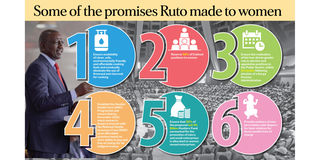
Dr Ruto said he would work with the Public Service Commission and other agencies to ensure all public appointments comply with the principle. He vowed to allocate 50 per cent of his Cabinet to women, and committed to providing new mothers with diapers for the first three months.
“Today marks the turning point in the governance of the Republic of Kenya, where women can sit on an equal basis with men. Women will become equal partners. The women will have an equal voice and will occupy equal positions in the highest decision-making organ. We will get rid of the culture of tokenism and ensure women are at the table with other Kenyans,” he said.
He said that by December 2022, every woman would be registered with the National Health Insurance Fund (now Social Health Authority) at an affordable premium.
On education, Kenya Kwanza committed to enforcing a 100 per cent return-to-school policy for all teenage mothers and giving them government’s bursaries.
Widows and single mothers were also not left behind, with the coalition pledging to redesign and implement a comprehensive national programme for the protection of older women, widows, single mothers, orphaned girls and women living with disabilities. Dr Ruto committed that his government would set up a special fund to for widows facing severe economic hardship, and ensure children of single mothers get state bursaries.
So, 1,000 days since taking over, how has Dr Ruto fared?
The implementation of the two-thirds gender rule remains a pipe dream. In June 2023, Kenya had hopes its implementation could be achieved after former Gender Cabinet Secretary Aisha Jumwa inaugurated the Multiagency Working Group on Gender Rule. However, despite the taskforce handing in its report in April last year, no action has been taken.
Daisy Amdany, the executive director of Crawn Trust, regrets that the gender rule promise remains unfulfilled. “On the two-thirds gender rule, the President has not acted at all, despite Parliament having our taskforce report for over a year with all the instruments. Of course, Dr Ruto continues to promise that before the end of his term, he will fulfil the promise, but no concrete legislative action has been taken yet.”
Read: Timeline: The rise and fall of women's representation in Kenya’s political leadership since 2022
The 50-50 sharing of Cabinet slots remains another key promise that was never honoured. When he initially formed the government in September 2022, Dr Ruto gave 30 per cent of Cabinet slots to women. Only seven women made it to the Cabinet line-up unveiled at State House, Nairobi. It fell short with four.
And even after reconstituting the Cabinet following the June 2024 protests, the number of women remains low, currently standing at eight out of 26, representing only 28 per cent. “The President has not fulfilled even principal secretary positions, diplomatic corps and with other appointments, he continues to fall short,” Daisy adds.
Lactating mothers are still waiting for free diapers as schoolgirls wait for sanitary towels. Githunguri MP Gathoni Wamuchomba, a fierce critic of the Kenya Kwanza administration, terms it sad that the government cannot keep its word.
“The promises by the Kenya Kwanza government to women and girls have not been fulfilled. The President has yet to fulfil the promises of free sanitary towels to girls. Lactating mothers have not been receiving free diapers. These promises remain unkept and I do not see any sign or effort to fulfil them,” she says.
The lawmaker termed it unfortunate that the 50-50 Cabinet has not been honoured, further raising an issue of parastatals’ and counties’ appointments. “Gender inclusivity is also lacking when it comes to strategic leadership positions in Parliament. Currently, only two women are chairpersons of departmental committees. Other women have been given the vice chair positions and members of the committees.”
Progress
However, Daisy is of the opinion that the government is doing better on women's economic empowerment. “The Cabinet approved the National Policy on Women’s Economic Empowerment early this year, which is deliberate in seeking to have a guiding framework that aims to bridge the gender economic gap, market access and address financial inclusion.”
Daisy notes that the Department of Gender has validated a policy on addressing the burden of unpaid care that keeps women from productive work. She, however, observes that the prevailing economic status of Kenya continues to hamper women's economic empowerment by reducing Kenyans’ purchasing power, thus making the business environment less friendly.
In light of the high cost of living, rising taxes and inconsistent tax policy that has occasioned capital flights and massive job losses, many women are worse off financially.
Despite the promise to increase budgetary allocations to Uwezo Fund, the Women Enterprise Fund and the National Government Affirmative Action Fund (Ngaaf), and ensure easier and speedier access for women, the situation has worsened as women cry foul.
A fortnight ago, Treasury Cabinet Secretary John Mbadi disclosed that Ngaaf had been reduced from Sh3.2 billion to Sh2.7 billion following a government-wide rationalisation of spending. The move has rattled the 47 women representatives. They say the cut severely undermines their ability to deliver on their mandate, and term the move unjust and a direct threat to grassroots development.
The lawmakers argue that the decision will be detrimental to grassroots programmes aimed at empowering women, youth, and vulnerable groups. Ngaaf is used by women representatives to implement socioeconomic programmes. The fund enables grassroots initiatives, including health projects, bursaries and shelter for the vulnerable.
Busia Woman Representative Catherine Omanyo says: “This is deeply disheartening. The 47 women reps are bleeding right now. The money itself is meagre, too little to begin with. We demand that the Sh500 million find its way back to the Ngaaf kitty. How do I go to Busia and tell them I am representing them, if the money was taken while I sat in Parliament pretending to be sober?”
Unfair reduction
Eldas MP Adan Keynan says: “I find it unfair to deny the women reps a right that has already been granted. I appeal to the mandarins at the Treasury to show consideration when making such decisions. Women are the majority of voters. Denying them Sh500 million is not just unfair; it is politically and morally wrong.”
Eva Komba, a gender and development expert, says Ngaaf reduction shows zero goodwill from the government on gender issues. “This fund is at the heart of economic development and social protection. It is a terrible move, ill-informed and not well thought out. In the wake of global resourcing changes, we target this fund? A fund that is desperately needed to augment deficit and combat household poverty. This government doesn’t mean well for women and girls.”
The promises of enrolling women for medical cover, ensuring teenage mothers resume learning, and economic empowerment of widows and single mothers are also unfulfilled. And with the Kenya Kwanza administration having hit 1,000 days in office, women and girls can only continue to wait for what they were promised.


