Dr Nancy Baraza: My phone never stops ringing

Chairperson Technical Working Group on Gender-Based Violence (GBV) Dr Nancy Baraza during an interview in her office located at the Kenyatta International Convention Centre (KICC), Nairobi, on February 19, 2024.

What you need to know:
- Former Deputy Chief Justice Dr Nancy Baraza leads a 42-member technical working group tasked with ending Kenya's GBV crisis.
- The task force, gazetted on January 10, 2025, brings together diverse experts, working through four thematic committees to deliver actionable solutions within 90 days.
- Beyond addressing violence against women, the task force is also tackling male abuse and harmful cultural practices.
"'It's horrific that a child can be violated and the perpetrator walks free. These are the weak links within our justice system that we must address,'" declares Dr Nancy Baraza, her voice thick with barely contained rage. As the chairperson of Kenya's newly formed Technical Working Group on Gender-Based Violence (GBV), she carries the weight of addressing one of the nation's most pressing crises - a crisis that has driven thousands of Kenyans to the streets in protest.
The air crackled with raw, desperate chants across Kenya last year: "Stop killing women! Stop gender-based violence!" The words, shouted in unison, reverberated through Nairobi's streets, echoing through the alleys and avenues of cities and towns across Kenya.
The demonstrators, women and men, marched twice - January and December, 2024 - with a singular, unrelenting purpose. They had had enough. The daily news of women killed in horrifying ways had become unbearable. Anger was etched on their faces, their voices hoarse from shouting, yet unyielding. This was not just another protest; it was a stark demand for justice, a cry that could no longer be ignored.


Beneath the surface of these public outcries lay a grim reality. Between January 2016 and December 2024, the lives of 930 women had been brutally extinguished, according to data compiled by Africa Data Hub, a regional network of organisations tracking gender-based killings. Of those, 628 were victims of femicide, a term that, while gaining national attention, only scratched the surface of the widespread suffering.
The sheer numbers told a chilling story, but behind every statistic lay a name, a face, a family left devastated by violence. Each life lost represented a broken dream, a child left motherless, and a community plunged into mourning.
More disturbing still, the Kenya Demographic and Health Survey (2022) revealed the extent of gender-based violence (GBV): 34 percent of women aged 15-49 had experienced physical violence since the age of 15. Similarly, 27 percent of men in the same age group had also suffered abuse. The hotspots for physical violence were Bungoma (62 percent), Murang'a and Homa Bay (54 percent each), and Migori (51 percent).
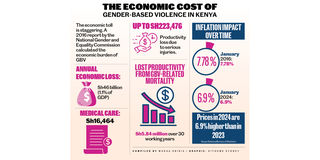
Sexual violence was equally endemic. Thirteen per cent of women and seven per cent of men had endured it. Bungoma led this grim parade with 30 per cent, followed by Murang'a (24 percent), Homa Bay (23 percent), and Embu (22 percent). The rising tide of femicide and GBV could no longer be dismissed as isolated incidents.
Faced with this crisis, President William Ruto established a 42-member Technical Working Group on GBV, including femicide, in January. The task force was given a 90-day mandate to deliver on 10 critical matters, among them identifying trends, hotspots, and causes contributing to GBV and femicide.
"This is not just a random number," Dr Baraza emphasises about the 42-member composition. "These are people with diverse backgrounds and expertise in GBV and human rights violations against women."
Aware of concerns raised over its size, she quickly clarifies: "The task force comprises academics, experts in the area of GBV and human rights. We have doctors, survivors of GBV, and parents of the children we've lost to femicide. Government departments, civil society players including the Law Society of Kenya, the Federation of Women Lawyers, IMLU, religious groups-Christians, Muslims, Hindus—Kenyans from all backgrounds."
Acknowledging concerns about potential duplication of roles with existing gender-focused institutions, Dr Baraza clarifies that the task force actually brings together all these entities, including the National Council on Administration of Justice and the Ministry of Gender, to ensure coordinated action rather than scattered efforts.
The weight of their responsibility is evident. The clock is ticking relentlessly. To meet their deadline, the members have been divided into four thematic subcommittees: legal, policy and institutions, prevention, and data and information. Already, their investigations have revealed a horrifying trend: femicide cases are rising.
Beyond the numbers, there is a deeper, more insidious problem fuelling the crisis.
"Culture is one of the biggest problems, the biggest causes of GBV," observes Dr Baraza, her voice tinged with sorrow. "And yet, by its very nature, it doesn't allow people to talk about it. People suffer in silence. This thing about wife and husband beating-it has to stop."
Since her appointment, her phone has barely stopped ringing. Women, battered and broken, reach out to her, desperate for help. She recounts horrific stories-a woman beaten for serving her husband poorly prepared food, another whose spinal cord was shattered in an act of senseless brutality.
The task force, however, is not solely focused on violence against women. "Men are also violated," Dr Baraza emphasises. "They can't go to the police to report because they will be laughed at. They will be ridiculed. And they are suffering. Their human rights are being violated. Their lives are in danger."
Human rights
She adds, "There are communities where circumcision of boys is carried out in such a harrowing manner that the human rights of those children are violated. These are things we need to face. We are focused on protecting both men and women. And we urge men to come out and give us solutions on how we can stop the violence."
To facilitate national engagement, the task force is working on creating an online platform where the public and interested parties can submit memoranda.
"We want this to be a national conversation," she affirms. "There will be radio announcements, and county meetings aimed at encouraging people to come forward, share their stories, and contribute to solutions. If they don't want to talk publicly, they can come quietly. We can hold some meetings in camera."
Dr Baraza sees hope in community-based solutions. "If we are serious and we implement, and of course, the President himself has said he wants this menace dealt with; we will make it. For instance, if we get Nyumba Kumi to take on the responsibility of ensuring that in their villages, wife beaters are dealt with, it can work."
She cites Fiji as an example: "They have successfully done away with domestic violence by mobilising community strategies. Village heads are given incentives to ensure that domestic violence does not occur within their jurisdiction."
With access to justice being a crucial factor in combating GBV, Dr Baraza highlights the importance of gender justice courts. "Previously, access to justice for GBV victims was a problem because of the nature of the courts. The distance, and the lack of courts specifically dealing with GBV. These new courts provide an avenue for victims to seek justice nationwide."
The former Deputy Chief Justice is determined to ensure that the task force's recommendations leave a lasting impact. "His Excellency the President doesn't want an academic paper but recommendations upon which he can act. So, we are not writing a beautiful report, we are coming up with implementable recommendations."
Aware of the funding challenges plaguing gender-related initiatives, she advocates for a reallocation of resources. "We have to rethink where we allocate our money. How much are we giving the Ministry of Defence compared to the Ministry of Gender? How much are we dedicating to implementing our recommendations?"
"If we develop a framework that will end GBV, we will have safeguarded the fabric of our society," she says with conviction. "GBV and femicide cannot continue unchecked. We must act now."
Dr Baraza concludes with a call to action: "We need to look at this ugly truth collectively. How does our culture continue to serve us in the 21st Century when we pride ourselves on being progressive in terms of human rights protections?"


