Address Ogiek concerns about unhonoured court judgments
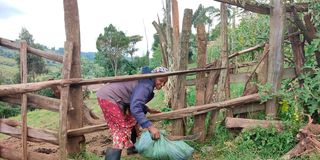
Anna Sulunye, an Ogiek, at Nkaroni in Narok County on July 28, 2023. They say they live a nightmare since their evictions from the Mau Forest and with the government having failed to honour court decisions that directed that they be resettled and compensated.

What you need to know:
- The government should be the foremost defender of citizens’ rights.
- It is thus worrying that it was found in the wrong – having violated the rights of the Ogiek through repeated evictions from their ancestral forestland.
Despite a landmark decision by the African Court on Human and Peoples’ Rights, the Ogiek are still reeling from the agony occasioned by their eviction from the Mau Forest. The brutal displacement was carried out against documented evidence that showed the community had coexisted with the forest’s ecosystem for ages. It had been their known habitat.
The court ordered the government, which accepted the judgment, to take remedial action, including resettling and issuing them with a collective title. Another key decision would follow, one that recognised the community’s indigenous status, as well as their right to reparations.
The court awarded them $492,000 (Sh57.8 million) for material damages and $850,000 (Sh100 million) for moral damages, to be paid into a development fund set up for the community. However, the Ogiek have only witnessed years of inaction, even as their lives worsened amidst rising challenges.

The government should be the foremost defender of citizens’ rights. It is thus a concern that it was found in the wrong – having violated the rights of the Ogiek through repeated evictions from their ancestral forestland, particularly contrary to the African Charter on Human and Peoples’ Rights.
The good news is that the government has a chance to redeem itself. It behoves those in positions of authority to claw back the gains made in protecting indigenous peoples as regards their right to land, development, and non-discrimination.
The Ogiek have been waiting for action, but their hopes seem to be fizzling out with each passing day. While both men and women have suffered as a consequence, the latter have borne a bigger burden. The United Nations says indigenous women unduly face many challenges due to gender, and that increases their vulnerability to poverty. The Ogiek women are no different. At this point, they can no longer be silent about their agony. They say their life is a nightmare. Their families depend on them, but being landless means they lack a key factor of production.
Land means a lot to them. It means a source of livelihood, a place to call home, a property to bequeath to future generations – it defined their hunter-gatherer lifestyle for centuries. And owing to their current deplorable living conditions, it is the closest they can get to setting out on a journey to financial freedom.
They lag behind in development and many of them have no formal education. When the judgment was delivered, they joined in song and dance in the hope that their woes would soon end. Unfortunately, that was not to be.
If the Ogiek are resettled and compensated, the money and land will go a long way in empowering them. The Commission on Administrative Justice should push the government to act. Compliance with court decisions and respect for the rule of law should always be the country’s mantra.
The government can promote climate justice while tapping into the community’s indigenous knowledge of conservation. This would involve putting them at the centre of climate action. In doing so, the country will make use of the connection between climate justice, gender and social equity as a key tool for development.
Their traditions have always appreciated nature and humans as interdependent—through reciprocal responsibilities and rights. So, Kenya stands to benefit from the group’s conservation efforts, which emanate from their unique relationship with the forest.


