Bead a girl, face the law: Here’s what awaits you
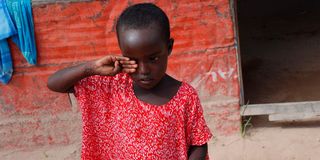
A young girl cries after facing abuse. Beading is one of the harmful cultural practices criminalised under Section 23 of the Children Act.

What you need to know:
- Beading is a practice that marks a young girl as belonging to a particular moran for a sexual relationship.
- Samburu morans bead girls, stealing education and childhood, despite strict criminal penalties under Kenya’s law.
- A Grade One girl’s future was recently shattered by beading, now criminalised under Kenya’s Children Act.
On a dusty, sunny day, a nine-year-old girl had just attended her Grade One classes at a school in Samburu County. Suddenly, a group of morans appeared, pulling her away from the place she had gone to seek an education and build her future. One grabbed her left hand, another her right, as she struggled to resist, while two others followed behind, dragging the pre-teen away like a goat being led to slaughter.
Well, these morans were indeed “slaughtering” her future. They had come to bead her, a practice that marks a girl as belonging to a particular moran. She has no power to decide what happens next between her and the moran. By virtue of their culture, she is now considered his and can be subjected to sexual relations whenever he wishes, reducing the child to an object of sex slavery.


This is a true story that recently came to light in a video shared online. While Kenyans watched in horror, the morans were clearly unaware that they were following in the footsteps of a culture that has now become a punishable crime under the Children Act (2022). First, beading is one of the harmful cultural practices criminalised under Section 23 of the Act. The criminal offence attracts a minimum prison term of three years and a fine of not less than Sh500,000, or both. That’s not all. The girl was in school learning, yet by being beaded, they were turning her into a powerless child wife with no control over her access to education.
Every child has a right to education as clearly spelt out in Section 13 of the Act. Denying that right is a straight ticket to court. Moreover, Section 29 makes it clear that instituting court proceedings when a child’s right to education has been denied, violated, infringed or even threatened is not limited to parents.
A guardian, a person acting on behalf of a parent who is unable to act, a member representing a group or class of children, someone acting in the public interest, or even a duly registered association acting in the interest of its members may all bring such a case before court.
The High Court will hear such a case and may issue orders as it deems necessary to secure the rights of the child. Beyond that, consider that the child was violently taken away to be subjected to a destructive tradition. This amounts to psychological abuse, a criminal offence under the Children Act. It is punishable by imprisonment for a term of up to five years, a fine of up to Sh2 million, or both. This is a stern reminder that children’s rights are indivisible; violate one and you unleash a cascade of harm, a crime the law punishes severely.


