Behind Arsenal success: The Kenyan chef who believes food is more than flavour

Bernice Kariuki, Arsenal head-chef and renowned private European culinary industry chef. “If Arsenal don’t win the league, I won’t come to Kenya for three years” — her playful promise.

What you need to know:
- Bernice Kariuki rose from Nairobi’s Jericho to elite European kitchens, redefining sports nutrition, resilience, discipline and mentorship globally.
- Bernice rebuilt life through adversity, cooking for footballers, Formula 1 driver, and mentoring Kenya’s youth.
Bernice Kariuki is bubbly and conversational. When the Nation catches up with her as she enjoys her vacation in Kenya, she easily discusses politics, governance, the cost of living and her face lights up brightest when she speaks about the English Premier League.
“If we (Arsenal) don’t win the league this season, I will not come to Kenya for three years,” she says, playfully but with a pure hope that Arsenal will be 23rd time lucky! The last time they won the league title was in 2004.
Bernice is the head-chef at the premier professional football team based in Islington, North London. Arsenal play in the Premier League and have a fanatical following globally. People often think of glamour when they hear that Bernice cooks for Arsenal players. But she does not focus on that glamour. “At 3am, when much of London is still asleep, my day is already underway,” she says.


She starts with a prayer. After that, there is no slow morning. There is breakfast to prepare, meals to plan, lunch, dinner, and the steady discipline of a kitchen that does not wait for anyone. By the time her day ends at 11pm, she has spent hours thinking about food, timing and bodies: what should be light, what should be filling, what should be fresh, and what will help someone perform. “That is pretty much my routine Monday to Saturday,” she says. “All food is made fresh. À la carte, no buffet setup. It is à la minute.”
She speaks more carefully about her work. What matters to her is not the label, but the craft. She wants people to understand that cooking in high-performance football environments is not about fame but about order, long hours and getting things right.
Jericho roots
Bernice grew up in Jericho, Nairobi, and she speaks about home with a tenderness that has not left her. While in London, in fast-paced kitchens, she misses the weather, the pace of life, the social ease, and the food she grew up with.
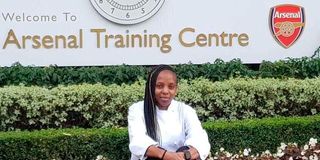
Bernice Kariuki, Arsenal head-chef and renowned private European culinary industry chef.
“East or west nyumbani is always the best,” she beams. “I miss our different machakura, pilau njeri and the likes. The weather at home is definitely best; that’s why I sneak here whenever I have a chance. I also miss the shags life, slow and peaceful. I pick my organic food straight from shamba. That’s real life. So when I am around, I find my way to Nyandarua … that’s my shags.”
She is equally direct about what Jericho gave her. “I was born over 50 years ago in Jericho and I wouldn’t change a thing,” she says. “I am proud of my thorns and where it all began and the humble beginnings. It made me who I am today.”
She is the firstborn, and she describes that place in the family in a way many eldest daughters will recognise. “As a firstborn, in most families, I think you become the second mother, inheriting a lot of forced responsibility,” she says.
As such, cooking, then, for her family and siblings, did not begin as a glamorous dream. It began closer to duty and looking after others. After going through school and completing high school, she failed and could not go to university or college. Her uncle connected her to a hotel in Mombasa where she worked as a housekeeper. After working there for a while, she felt that was not the work for her.
“Also, my friends and peers from high school had left the country through an agency. I told my uncle that I needed to go back home and talk my day into finding me a way out of the country,” she recalls.
“We didn't have enough money for my travel but my dad called for a harambee (fundraiser) after he helped me secure a slot in Sweden to go and study hospitality. I remember being at the airport for the first time looking lost and staring at the escalators, but more than anything else, I remember my dad telling me not to forget where I came from and that I should remember that I was their only hope back home.”
Bernice recalls the culture shock she encountered in Sweden. “It was an instant life upgrade. I had a room that had a TV set, a fully stocked fridge, a private toilet and bathroom. This, for me, was a new life and it was a new standard for me. Back home the toilets and bathrooms were shared among neighbours and they were outside.”
She was in Sweden for a while and she studied a bit of culinary arts, but then again she felt overwhelmed, especially by the weather and language barrier. She reached out to an uncle in the UK and expressed her wish to move from Sweden to the UK. Back then, she says, it was not hard to navigate. You would easily catch a train or a ship from Sweden to the UK.
“That’s how I ended up in the UK, sought asylum and finally became a citizen. My dad urged me to pursue a course in psychology. This worked well for me because I love talking and I connect easily with people. So I got a chance, enrolled for a psychology course, graduated, and later completed a master’s degree. For a time, the work suited me. I enjoyed counselling.”
Starting over
In the UK, she had also reconnected with a first love from Kenya—a man she had met in high school, lost touch with, and found again. They married and had a daughter. But soon, it came falling apart. So her work as a psychologist became impossible to separate from her own life.
“After 12 years of practice, I hated it because I wasn’t happy in my marriage, it was hell. Imagine everyday most of your clients mirroring you with the same problems you are going through at home, singing the same song. I got depressed and I couldn’t confide in anyone, so I had to quit my marriage and career, and start all over again.”
She went back to cooking and enrolled at Westminster Kingsway College, which she describes as the best international culinary arts college in London. She did not arrive there lightly. By her own account, this was reinvention after collapse: after depression, after the breakdown of a marriage, after the loss of the professional identity she had spent years building.
Then came the mentor she still speaks about with gratitude. Her first boss, an Irish executive chef. “He really invested in me,” she says. “A true mentor in my culinary journey.”
That matters because professional kitchens are rarely gentle places. Bernice says one of the first-hard truths she learned was that toughness is built into the work. She speaks openly about racism, discrimination and punishing hours. She describes some spaces as toxic. She says no one fully prepares you for that side of the profession. “Racism and long hours,” she says, “no one prepared me for that. But I am a tough cookie, so I managed.”
After graduating, she worked at the Hilton in the UK for three years, then moved to the Dorchester Hotel Mayfair. It was there she first cooked for a footballer—Pierre-Emerick Aubameyang, who became a regular specifically for her biryani. Doors began to open.
Those bigger doors led into football spaces where nutrition and performance matter as much as flavour. She is firm on this point. She does not talk about food as decoration or luxury. She talks about it as part of a system. “It requires a lot of professionalism,” she says. “Nutrition-wise, diet is important.”
Asked what Kenyan clubs and sports systems get wrong, she does not hesitate. “Find professional chefs who understand nutrition first,” she says. “Then go through each and every footballer's diet chart and their menu sheets.”
That, in her mind, is the work: not simply feeding people, but building routines around performance. It also explains why she keeps returning to the same words when she describes her life now: discipline, nutrition, structure.
She says bad days still come. They are rarely dramatic. More often they are practical: short staff, hangovers, sickness, extra workload, and the need to hold standards when the day has already gone wrong. Even then, she sounds less interested in complaint than in the discipline of getting through. That same realism shapes how she sees public perception. She knows what some people assume when they hear about her life.
Kazi ni kazi
“They think I’m bourgie and wealthy. Some also think I hang out with footballers or celebrities as friends. But no, I am only their chef; kazi ni kazi, I do what is expected of me and move on with my life,” she says, laughing.
She further clarifies that she is not an Arsenal chef as many regard her. “I am not employed by the club though I work there as the head chef, we are 96 chefs in total there. Personally, I cook for many individual football players even in Madrid. Ooh, I am also the Ferrari Chef, I cook for Lewis Hamilton and many other sports people that I don’t really have to mention,” she says, casually.
She also addresses a rumour that circulated in 2023 that she had left Arsenal. “It was a strategy. I was trending all over and some bloggers were writing things that are not true about me and dragging the club into it. That was risking my job. So I took to Twitter (X) and posted that I had left the club. They fell for that too, and started publishing news about my leaving. That worked and I got to have peace of mind. But the truth is, I never left!”
What she wants to build
Through all the movement in her life, the losses, the reinvention and the professional rise, the identity she returns to first is not chef. “I am a mother first to my beautiful daughter. And am still the same girl who came from a poor background, in the slums of Jericho. Who I am today never changed me, because no matter where I go and who I become, I’ll never forget where I come from: humble beginnings.”

Bernice Kariuki, Arsenal head-chef and renowned private European culinary industry chef.
She says she mentors college students and chefs when she is in Kenya. What she wants to build is even bigger: apprenticeships, basic culinary training, and hospitality programmes for underprivileged children from places such as Kibra, Mukuru wa Njenga, Dandora and Mathare.
“I would have loved to initiate a lot of ideas, apprenticeship, basic training and culinary programmes to give our underprivileged children a starter in hospitality.”
Her greatest achievement is being a mother of her daughter, now 28, and breaking through in the European culinary industry as a private chef, she says. Her legacy, she hopes, is simpler. “To give back and to be remembered as a chef that made a change and difference here in Kenya to underprivileged children in hospitality.”
There is, of course, one lighter detail that neatly ties the public image to the private person. She says she has supported Arsenal from the beginning. “Yes, since day one, I never supported any other team. I’m a Gunner and I’ll die a Gunner.”


